49 works in this view — arrow keys or swipe to move between them.
Dance in Art
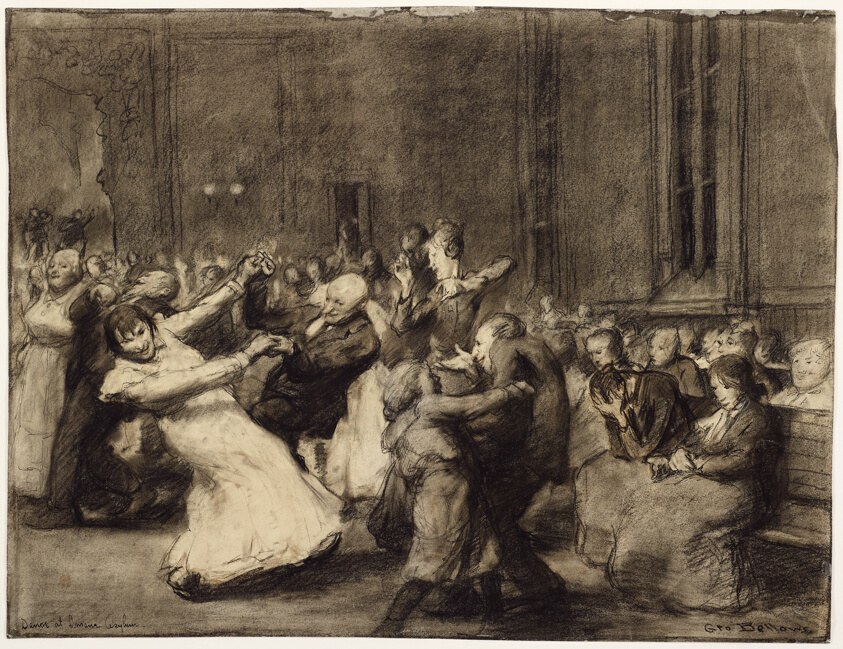
Dance at Insane Asylum
George Wesley Bellows
- Source:
- Art Institute of Chicago
- Rights:
- Public domain — free to use, share and adapt.
- Recorded as:
- CC0 (Public Domain)
This work exposes the historical tendency to treat the movements of the institutionalised or unwell as spectacle rather than agency. For anyone studying the social history of dance or the relationship between movement, power, and representation, it is crucial evidence of how the nineteenth-century art world drew the boundary between 'dance' (disciplined, intentional, beautiful) and 'movement' (chaotic, pathological, other). The image forces a reckoning with historical condescension embedded in artistic practice.
What you are looking at
A chaotic scene of figures in apparent distress or frenzy within what appears to be an institutional interior—narrow corridors with high walls and recessed doorways suggest a confined space. The composition is crowded and animated: figures in white robes or nightclothes surge and cluster together, their bodies contorted and gesturing wildly. Some reach upward or outward with arms extended; others huddle or recoil. The lighting is dramatic and shadowy, created through cross-hatching that pools darkness in the corners and doorways while catching highlights on pale fabric and exposed flesh. The overall impression is one of movement born from disturbance rather than joy—the scene is frenetic, unsettling, and deliberately staged to show disorder and loss of control.
The dancing
The bodies are arranged without conventional dance frame or partnering. Isolated figures twist at the torso, throw their arms outward in expansion, or fold inward. A kneeling or crouching figure in the foreground dominates; standing figures surround and press against one another without the spatial awareness or synchronisation of trained dancers. The arms and legs do not compose a recognisable hold or basic step. Instead, the gestural language reads as fragmentation: individual emotional expression overrides any collective form.
The dance depicted
This is not dance in the formal sense. The title 'Dance at Insane Asylum' frames the movement as pathological—a visual metaphor for madness expressed through bodily chaos. The work appears to document or depict institutionalised patients in a state of agitation, their movements read by the artist as inherently theatrical and worthy of recording. This reflects a nineteenth-century appetite for depicting the mad body as a spectacle, often with patronising or sensationalist intent. The image shows movement born from psychological distress, not choreographic intention.
How it was made
This is an engraving or etching executed in fine lines and cross-hatching, characteristic of reproductive printmaking of the nineteenth century. The tonal range is achieved entirely through the density and direction of mark-making; the play of light and shadow deepens the psychological intensity of the scene. The technique allows for sharp definition of individual figures while maintaining overall atmospheric gloom. This would have been a work for public circulation in periodicals, books, or art portfolios—it addressed a mass audience and contributed to visual culture surrounding psychiatry and social welfare.
About this work
This engraving documents or invents a scene of patients in an asylum, their bodies in motion but untrained and expressive of disturbance rather than skill. The title frames movement as a symptom, not an art form. Artistically, the work sits in the nineteenth-century genre of asylum imagery and medical illustration—pictures that rendered madness as visually consumable spectacle. It belongs in a dance archive because it presents the human body in coordinated motion within a social context, and because it asks us to examine what we mean by 'dance' and how art has historically distinguished between intentional choreography and the movement of bodies in distress. The work serves as a historical mirror: we can trace shifting attitudes toward mental illness, artistic representation, and the dignity of the marginalised through how we now read such images.
How to look at it
Attend to the distribution of bodies in space and the deliberate lack of symmetry or repetition: the artist has chosen not to arrange these figures in any pattern that suggests beauty or order. Notice how the engraving technique itself creates anxiety through its heavy use of shadow and the density of marks in the background. The contrast between the pale cloth of nightwear or robes and the dark architectural space draws the eye to individual gestures—a raised arm, a twisted spine, a kneeling posture—each isolated and heightened by light. The composition invites voyeuristic looking, which is precisely the problem the image now poses for us.
The artist
The artist is not recorded. The work comes to us through the Art Institute of Chicago's collection, bearing only a generic title and minimal documentation. This anonymity is itself informative: the image was likely produced as part of commercial printmaking practice, reproductive or illustrative work not attributed to a singular artistic vision. The style and technique suggest professional engraving of the mid-to-late nineteenth century, executed for wide distribution rather than exhibition.
The period
The nineteenth century saw intense growth in art depicting institutions and social welfare—prisons, hospitals, asylums featured prominently in literature and visual culture as sites of both reform and morbid curiosity. Simultaneously, the study of 'scientific' psychiatry gave rise to detailed observation and illustration of mental symptoms, often presented as visual records. Dance historians recognise this period as one of Romantic ballet's dominance in theatrical contexts, when bodily control and technical virtuosity defined stage dance. The collision between institutional movement and theatrical movement—between pathology and art—runs through the century's visual record.
Where it lives
The work is held by the Art Institute of Chicago. It appears in their collection records with minimal documentation—no recorded medium, artist, or date—suggesting it may have entered the collection as part of a broader acquisition of prints or as a work of minor or anonymous status. The source notation (aic) confirms its institutional provenance.
Questions about this work
Is this actually a dance?
Not in the formal sense. The title frames the movement as a symptom of madness rather than an intentional choreography. However, it is a representation of human bodies in coordinated motion within a specific social space, which makes it relevant to the history of how movement has been perceived, documented, and valued. It shows us where nineteenth-century artists drew the line between 'dance' and 'disorder'—a boundary that dance historians now interrogate.
Why is this in a dance archive?
Because it documents attitudes toward movement and the body in a historical moment when psychiatric institutions were becoming visual spectacle. It reveals how the body in motion was interpreted through the lens of pathology. For dancers and scholars, it serves as evidence of how social power—who gets to move, whose movement is valued, whose is labelled mad—has been encoded in art.
Who created this and when?
The artist and date are not recorded in the available catalogue information. The style and technique suggest professional engraving of the mid-to-late nineteenth century. Without further documentation, attribution and dating remain uncertain, though the work likely circulated as part of commercial or illustrative printmaking practice rather than as a signed artistic statement.
What does the technique tell us?
The engraving technique—fine lines and cross-hatching—was a standard method for producing multiple impressions for distribution in periodicals, books, and portfolios. It allowed for fine detail and high contrast, making individual figures and expressions legible to a mass audience. The technique itself supported the work's function as a document or spectacle for public consumption.
More dance artwork