49 works in this view — arrow keys or swipe to move between them.
Dance in Art
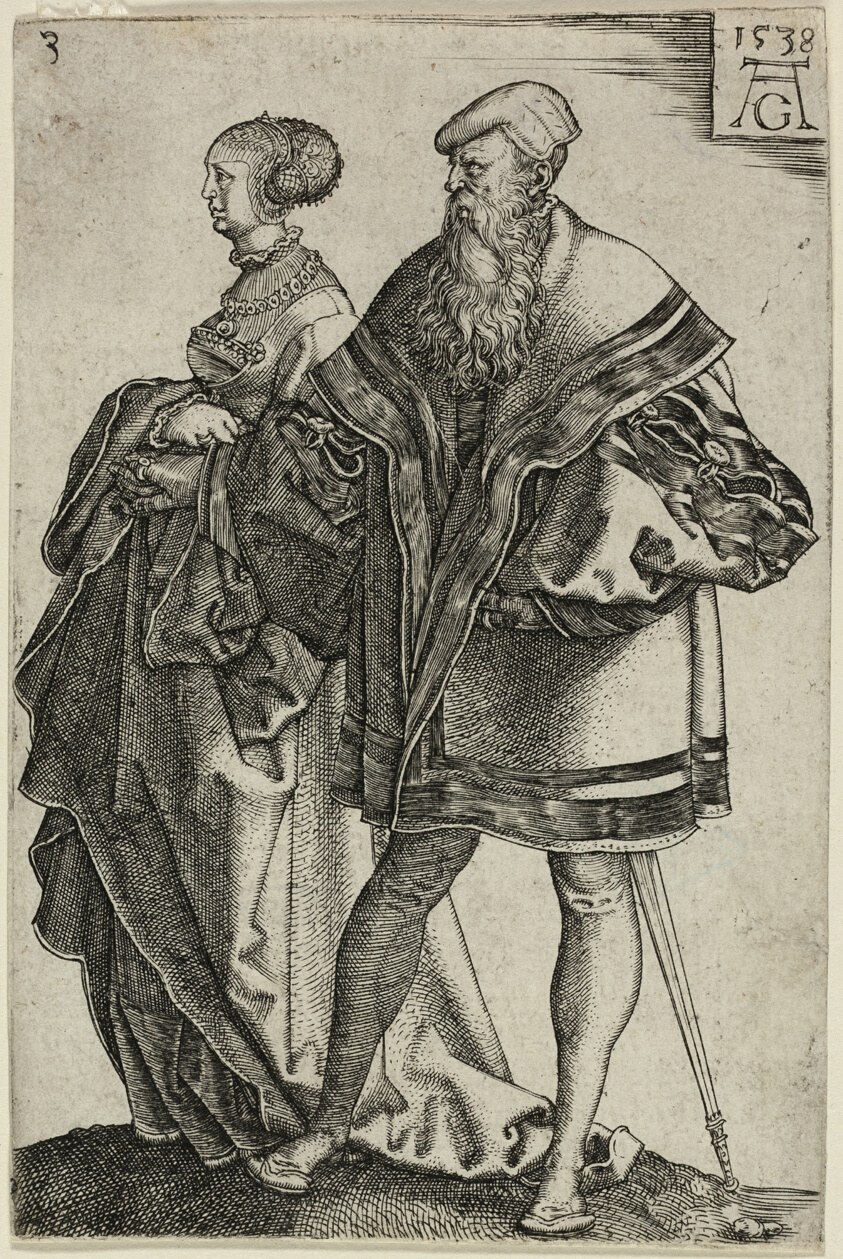
Dancing Couple plate three from The Large Wedding-Dancers
Heinrich Aldegrever
- Source:
- Art Institute of Chicago
- Rights:
- Public domain — free to use, share and adapt.
- Recorded as:
- CC0 (Public Domain)
This work shows how 'dancing' was conceptualized and depicted in early Renaissance courtly society: not as dynamic movement or athletic display, but as formal presentation, courtship ritual, and expensive dress. It is a rare engraved document of how the social performance of dancing was understood before the codification of court dance in the later 16th century.
What you are looking at
A man and woman stand together in a three-quarter view, occupying most of a small engraved composition. The woman, at left, wears an elaborate early 16th-century dress with a high collar decorated with pleats or lace, long fitted sleeves, and a full skirt with deep folds; her hair is caught up in a jeweled net or caul. The man wears a short tunic or doublet with fine cross-hatching to show fabric texture, a broad-brimmed hat with a feather, and carries a sword at his side. Both figures are rendered in sharp black line on a cream ground, with careful hatching to suggest volume and the quality of expensive cloth. The composition is intimate and frontal, with both figures meeting the viewer's gaze directly. A simple ground line anchors them; there is no architectural setting or landscape. The engraving is dated 1538 in the upper right corner.
The dancing
The pair stand close but not in contact, the woman slightly turned toward the man. Their postures are upright and formal, weight distributed evenly on both feet—a stance of presentation rather than movement. The man's left hand hangs at his side while his right holds his sword hilt; the woman's hands are folded before her in a gesture of modest composure. Neither figure leans into the other, and there is no suggestion of physical contact, dance position, or embracing. The distance and decorum between them suggest courtship or betrothal ritual rather than active dance.
The dance depicted
This is not a depiction of active dance in progress. The title *Dancing Couple* is misleading; the image shows a man and woman in formal courtship dress and bearing, positioned as if for a formal introduction or betrothal ceremony rather than captured mid-dance. If this is one of a series called 'Wedding-Dancers,' it likely documents the fashionable dress and social protocols surrounding a wedding celebration rather than the choreography or movement of the dance itself. The stiffness of posture, the emphasis on costume detail, and the frontal presentation are typical of early 16th-century engraved fashion plates and courtship imagery.
How it was made
This is an engraving on paper, executed in fine black line with careful cross-hatching to describe volume, texture, and the fall of fabric. The technique allows for sharp detail in the rendering of lace, pleats, embroidery, and the texture of the man's wool tunic. Engravings of this type were mass-produced from copper plates and circulated widely among courts and urban elites across Europe; they served as models for costume, records of fashion, and markers of social status. The date 1538 and the monogram in the upper right suggest publication by an established workshop, likely German or Low Countries.
About this work
This engraving documents the formal dress and courtship protocols of the early 16th-century European court or urban elite, not an active dance. The title *Dancing Couple* refers to the festive context—a wedding or betrothal—rather than to choreographed movement. It is one plate in a series illustrating the costumes and social rituals of wedding celebrations. For a gallery of dance in art, it is valuable as evidence of what 'dancing' meant in courtly context: a formal social gathering in which elaborate dress, bearing, and ceremonial protocol were as important as any physical movement. The engraving is significant for its meticulous record of early Renaissance fashion and for what it omits—the bodies are stiff, the postures unstudied, the emphasis entirely on costume.
How to look at it
Attend to what the engraver chose to omit: there is no indication of dance steps, no asymmetry of weight, no partnering hold, no sense of music or rhythm frozen mid-gesture. The figures are presented as if for a formal portrait, not caught in action. The extreme fineness of the line work, especially in rendering the woman's collar and sleeve lace, shows that the artist's primary investment is in fabric and fashion, not in the bodies beneath. Compare this to contemporary Italian Renaissance images of actual courtly dances (such as scenes of galliard or pavan), where figures lean into each other, one foot lifts, sleeves billow—all signs of movement. Here, stillness and formality govern.
The artist
The engraver is unknown, but the style, date, and monogram suggest an established workshop operating in the German-speaking territories or Low Countries during the 1530s. The series *The Large Wedding-Dancers* belongs to a tradition of engraved costume books and courtly imagery that flourished in early 16th-century Northern Europe. Such prints were produced for a wealthy, urban, and courtly audience interested in fashion, social protocol, and the visual markers of elite status.
The period
In the early 16th century, 'dancing' at court or in urban celebrations was not yet the formalized, choreographed practice it would become by the late 1500s. Wedding celebrations were occasions for feasting, music, and the display of fine clothing and social rank. The emphasis in this engraving on costume detail reflects the period's investment in dress as a primary marker of status and as the main event of courtly festivity. By contrast, the actual choreographed court dances of the period—pavane, galliard, branle—were practiced and taught but rarely illustrated in such detail. This series suggests that for its audience, the spectacle of the wedding was the spectacle of the clothes.
Where it lives
The work is held in the Art Institute of Chicago. It is an engraving of the early 16th century, part of a series titled *The Large Wedding-Dancers*, of which this is plate three. The catalogue record provides minimal information about the artist, medium, or original publisher, but the date 1538 and the monogram visible in the image are primary sources on the print itself.
Questions about this work
Is this really a picture of dancing?
No—despite the title, the image shows a man and woman in formal courtship dress standing still. The title refers to the social context (a wedding celebration) rather than to choreographed dance. The couple is posed for presentation, not captured mid-movement. If you are looking for Renaissance dance imagery, look for prints showing the pavane, galliard, or branle, in which bodies tilt, feet rise, and garments swirl.
Why is so much detail lavished on the woman's collar?
Because the collar is the point. In early 16th-century elite dress, elaborate lace and pleated linen collars were status markers and fashion statements. For the audience of this engraving (wealthy court dwellers and urban elites), the rendering of every pleat and thread was the purpose of the image. Fashion prints like this served as models for tailors and as records of what was current and desirable.
What does this tell us about Renaissance attitudes toward dance?
It suggests that in the early 16th century, 'dancing' at court was not primarily understood as bodily technique or choreography, but as an occasion for displaying wealth, status, and refined taste through dress and decorum. The formality and stillness of the image, far from being a limitation, are features—they convey dignity, rank, and the seriousness of the courtship or betrothal being documented.
More dance artwork