49 works in this view — arrow keys or swipe to move between them.
Dance in Art
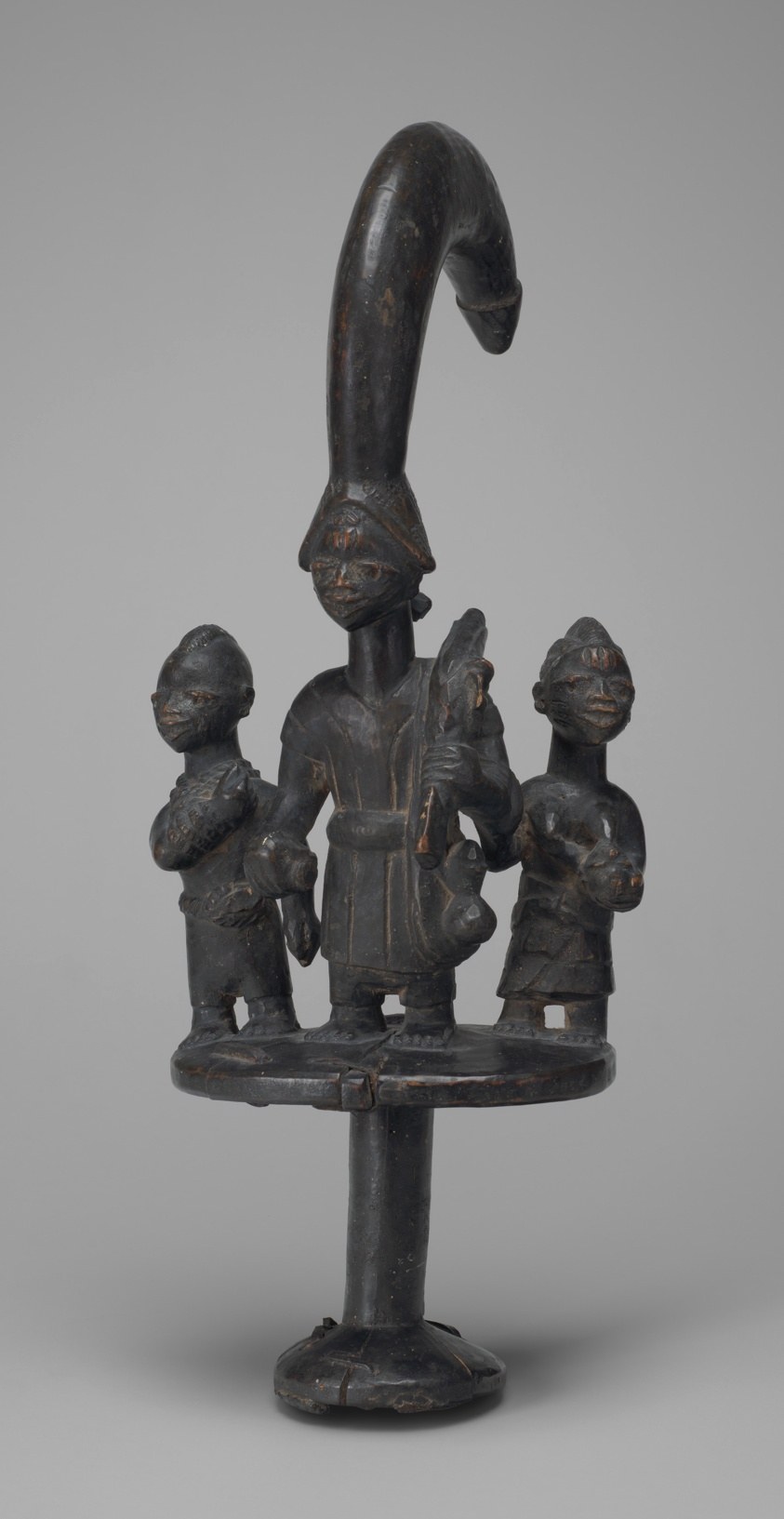
Esu Dance Staff Ogo Elegbara
Yoruba
- Source:
- Art Institute of Chicago
- Rights:
- Public domain — free to use, share and adapt.
- Recorded as:
- CC0 (Public Domain)
This staff demonstrates that dance objects are as important as dance itself in many African and diaspora traditions. The work reminds us that a gallery of dance in art must include not only representations of moving bodies but also the ritual objects, staffs, and regalia that choreograph and sacralize movement. Understanding this piece requires understanding Yoruba cosmology and the continuing presence of these practices in the Americas.
What you are looking at
A dark patinated bronze staff or finial, standing upright on a cylindrical base. The upper shaft curves in an elegant arc that loops back on itself, topped with a bulbous, comma-like finial. Below this, a broader platform holds three small-scale human figures arranged in a triangular composition around a central taller figure. The central figure wears a long garment with vertical ribbing or pleating and holds what appears to be a staff or implement across the body. The two flanking figures, smaller in scale, stand to either side with their arms positioned in gestures of reverence or engagement. All faces are carved with careful detail despite the miniature scale. The surface shows the dark patina of old bronze, with visible wear and slight areas of corrosion consistent with age.
The dancing
Three human figures occupy the platform in a hierarchical composition: the central figure dominates, standing taller with a formal, frontal posture and holding a vertical staff. The two attendant figures flank this central form, their bodies angled slightly inward and their arms raised in a pose suggesting devotion, attendance, or ceremonial participation. Their smaller scale emphasizes the central figure's authority. The postures are formal and restrained rather than dynamic—this is not depicting movement but rather ritual positioning or a moment of ceremonial pause.
The dance depicted
This is not a depiction of dance in motion but rather a ritual or religious object—specifically, a dance staff (or *ogo*) associated with Esu (also called Elegbara), an Orisha in the Yoruba pantheon. Esu is a trickster deity and guardian of crossroads, communication, and transformation. Such staffs function in Yoruba religious practice and in diaspora religions including Candomblé and Santería. The figures likely represent Esu and attendants or worshippers. The curved finial at the top is characteristic of Esu imagery. While this object may be carried or displayed during ceremonial events and dances dedicated to Esu, it is an emblem of the deity rather than a representation of dance itself.
How it was made
Cast bronze, worked in the lost-wax or sand-casting tradition characteristic of Yoruba metalwork. The level of fine detail in the facial features and the precision of the garment pleating indicate skilled craftsmanship. The dark patina suggests considerable age and handling. This is a functional object—a staff to be held, carried, and displayed—rather than a sculpture made purely for visual contemplation, which affected how the artist organized the composition: the figures are legible from a frontal view, and the central vertical axis is emphasized.
About this work
This is a Yoruba dance staff (*ogo*) dedicated to Esu Elegbara, a central figure in Yoruba and diaspora African religion. The object combines religious symbolism—the curved finial and the attendant figures—with practical use in ceremonies and ritual dances. It is a rare documented example of a sacred object that participates in dance practice without itself being a representation of dancers in motion. The work belongs in a dance gallery because such objects are central to understanding how African religious ritual, material culture, and movement are inseparable: the staff structures, authorizes, and focuses the ceremonial dances performed in Esu's honor.
How to look at it
Study the composition from directly in front: the staff is designed to be frontal and vertical, commanding attention along its central axis. The curve of the finial draws the eye upward, suggesting ascent or transcendence. Notice the three figures: the central one's formal stance and the attendants' smaller scale and inward-turning posture suggest a moment of offering, petition, or ceremonial acknowledgment rather than social dance. The precision of the facial features invites close looking—these are not abstract forms but individuated persons, which is theologically significant in Yoruba thought.
The period
Esu worship and the ritual use of such staffs are documented in Yoruba culture for centuries and continue today. The object may date anywhere from the 18th to 20th century based on style and patina; the catalogue offers no date. Yoruba metalwork of the 19th and 20th centuries was collected extensively by European and American museums, often without documentation of the maker's name or the specific commissioning context. The arrival of Yoruba religious objects in Western museums coincided with growing ethnographic interest in African art, though collecting often preceded respectful documentation of function and meaning.
Where it lives
The object is held by the Art Institute of Chicago. No acquisition date, previous owner, or collection history is recorded in the available catalogue entry.
Dance in this work
Questions about this work
Is this a musical instrument?
No. This is a staff or scepter used in religious ceremony and carried during ritual dances dedicated to Esu. It is not played or sounded. The staff itself may be shaken or struck against the ground as part of ceremonial action, but its primary function is symbolic and authoritative.
Who made this and when?
The maker's name is not recorded. Based on style and patina, it is likely Yoruba work from West Africa, possibly dating to the 19th or early 20th century, but the catalogue provides no date. Many such objects were removed from West Africa during the colonial period and entered Western collections without full documentation.
What is Esu and why does the staff have that curved shape?
Esu is an Orisha (deity) in Yoruba religion associated with crossroads, communication, change, and trickery. The curved, comma-like finial at the top is a signature motif in Esu imagery, often representing the trickster's nature or the dynamic principle of transformation. Esu is honored with dance, music, and offerings, and this staff focuses and structures those practices.
Where would this staff have been used?
In Yoruba communities in West Africa and in diaspora religions in the Americas (Candomblé in Brazil, Santería in Cuba and the Caribbean). The staff would be displayed on an altar, carried in procession, or held by a priest during ceremonies in which devotees dance and make offerings to Esu.
More dance artwork