49 works in this view — arrow keys or swipe to move between them.
Dance in Art
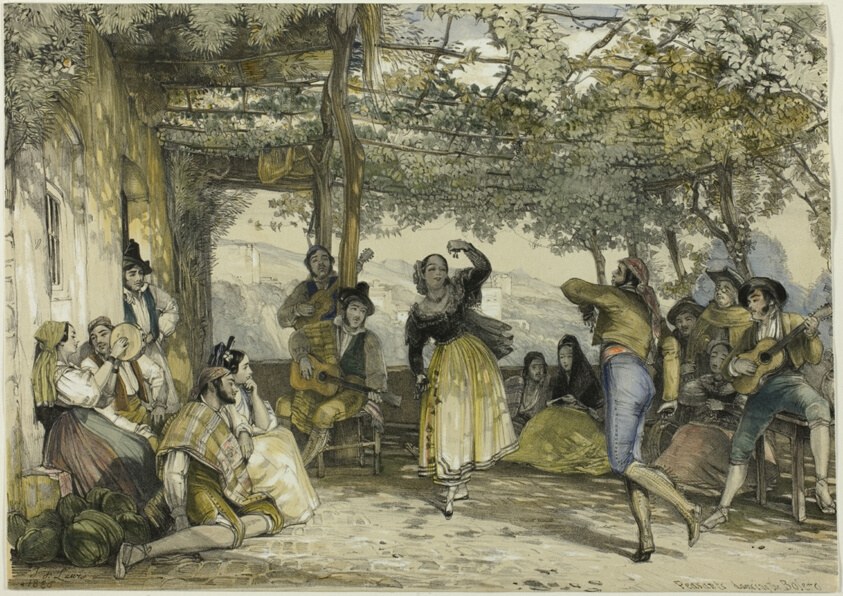
Spanish Peasants Dancing the Bolero
John Frederick Lewis
- Source:
- Art Institute of Chicago
- Rights:
- Public domain — free to use, share and adapt.
- Recorded as:
- CC0 (Public Domain)
This image is evidence of how a dance was practiced before it was standardized: the bolero shown here is a solo or variable-partner dance in a social setting, not yet the formal couple-dance it became in ballroom contexts. It documents the relationship between the artist's eye, the dancing body, and the social scene—showing us not just that people danced, but how they watched, accompanied, and participated in dance as a shared domestic experience.
What you are looking at
A lively outdoor gathering under a pergola or arbor draped with vines and foliage, rendered in hand-colored engraving or lithograph. At center, a woman in a yellow skirt and dark bodice dances with animated movement, one arm raised. She is watched by a semicircle of seated and standing figures—men in hats and jackets, women in period dress—arranged on both sides. A guitarist sits at left, and another musician appears to hold a stringed instrument. The setting suggests a rural Spanish village or estate, with architectural details and landscape visible in the background. The composition captures a moment of spontaneous social dancing, with the central dancer commanding attention while onlookers lean in with interest. The light is warm and even, typical of daytime in a sheltered outdoor space.
The dancing
The central dancer exhibits the lifted carriage and animated limb movement characteristic of Spanish regional dance: her torso is held upright, one arm raised with a relaxed wrist, the other positioned at her side or torso. Her weight appears to shift through the legs as she turns; the visible footwork is light and articulate rather than grounded. The watching figures are seated on low stools or standing in informal clusters, their attention directed toward the dancer. The guitarist at left is positioned as musician rather than dancer, his posture focused on his instrument. The overall frame suggests close social proximity—this is participatory entertainment rather than staged performance.
The dance depicted
The title identifies this as the bolero, a Spanish regional couple-dance. However, the image shows a solo female dancer rather than a couple in the closed or open hold typical of bolero in the nineteenth century. The setting, dress, and the presence of a guitarist suggest this depicts a rural Spanish tradition, possibly a vernacular or regional variant. The dancer's animated upper body, lifted carriage, and apparent footwork are consistent with Spanish folk and regional dance traditions. The bolero emerged as a fashionable ballroom dance by the eighteenth century, but this image may document an earlier village or estate tradition, or a local variation performed socially rather than as a formal couple-dance.
How it was made
This is a hand-colored engraving or lithograph, identifiable by the linear hatching visible in shadow areas and the characteristic color application in flat or semi-transparent washes. The technique allowed for multiple impressions and wide circulation among the middle and upper classes in the nineteenth century. The careful attention to architectural and landscape detail, combined with anecdotal human figures, suggests this was intended for a leisured audience interested in picturesque foreign or regional subjects. The hand-coloring—particularly the warm yellows and ochres—adds specificity and charm to what would have been a black-and-white print.
About this work
This image documents a moment of Spanish regional social dancing, likely from the nineteenth century, executed as a hand-colored engraving or lithograph. It shows a solo female dancer in animated movement before assembled onlookers in a sheltered outdoor setting, with a guitarist providing accompaniment. Although titled as a bolero, it preserves the memory of how this dance was actually performed in rural or domestic contexts, away from the formal ballroom. The work belongs in a dance history collection because it captures both the movement vocabulary and the social circumstances of Spanish popular dance at a moment when these traditions were being absorbed into European high society.
How to look at it
Observe the dancer's upper body and arm position first: the raised arm with a relaxed wrist and the lifted carriage are key signatures of Spanish regional dance. Notice how the artist has rendered her mid-turn, with weight in motion rather than planted on the ground. Then attend to the framing of the scene: the guitarist at left, the clustered onlookers, the architectural shelter overhead. This composition choice tells us that the dance was not a performance by professionals for strangers, but a social occasion in which music, movement, and watching were interwoven.
The artist
The artist is not recorded. The style and execution are consistent with nineteenth-century European printmaking and the picturesque tradition, in which European artists documented regional and 'exotic' customs for a metropolitan audience. The attention to architectural detail and the anecdotal, observational approach to the figures suggest training in landscape or topographical engraving adapted to social genre scenes.
The period
This work dates from a period when European ballroom dance was absorbing regional traditions from Spain and southern Europe. The bolero, like the cachucha and other Spanish dances, became fashionable in Regency and Victorian ballrooms. At the same time, the picturesque movement in art was celebrating rural and regional life—particularly foreign peasant customs—as increasingly quaint or picturesque as industrial urbanization advanced. This engraving sits at the intersection of these two currents: it documents a living folk tradition while packaging it for metropolitan consumption.
Where it lives
The source is listed as the Art Institute of Chicago. The work is described as an artwork from the AIC collection, but without accession number, acquisition date, or medium specification in the catalogue record.
Dance in this work
Questions about this work
Is this a bolero as we know it from ballroom dancing?
Not exactly. The ballroom bolero is a couple-dance in closed or semi-closed hold. This image shows a solo female dancer, which suggests either a different regional variant, an earlier stage of the dance before it was codified for ballrooms, or a local tradition that coexisted with the ballroom version. The title may reflect the print's intent to appeal to a metropolitan audience familiar with the fashionable bolero, even if the scene depicts something more vernacular.
What can we learn about the dance from the image?
The dancer's movement shows an upright carriage, animated arm work with relaxed wrists, and articulate footwork—all consistent with Spanish regional dance. The presence of a guitarist indicates that the accompaniment was live and immediate. The informal outdoor setting and the casual proximity of the onlookers suggest this was participatory social dancing rather than staged performance, making the movement more spontaneous and variable than a formal couple-dance would be.
Why is this a hand-colored print rather than a painting?
Hand-colored engraving and lithography were the dominant modes for circulating images of social scenes, travel, and ethnographic interest in the nineteenth century. They were cheaper and faster to produce than oils, allowed for multiple impressions, and reached a much wider audience. The artist chose a medium that would make this scene available to thousands of viewers across Europe, turning a specific village scene into a marketable image of Spanish regional life.
More dance artwork