49 works in this view — arrow keys or swipe to move between them.
Dance in Art
The Dancing Trees
Alfred Stieglitz
- Source:
- Art Institute of Chicago
- Rights:
- Public domain — free to use, share and adapt.
- Recorded as:
- CC0 (Public Domain)
The photograph demonstrates how dance as a concept became metaphorical in modernist art—how artists and photographers looked for choreographic principles (rhythm, spacing, timing, counterpoint) in non-human subjects. It shows the camera's capacity to transform the commonplace into the animated, a principle central to both dance photography and avant-garde visual practice.
What you are looking at
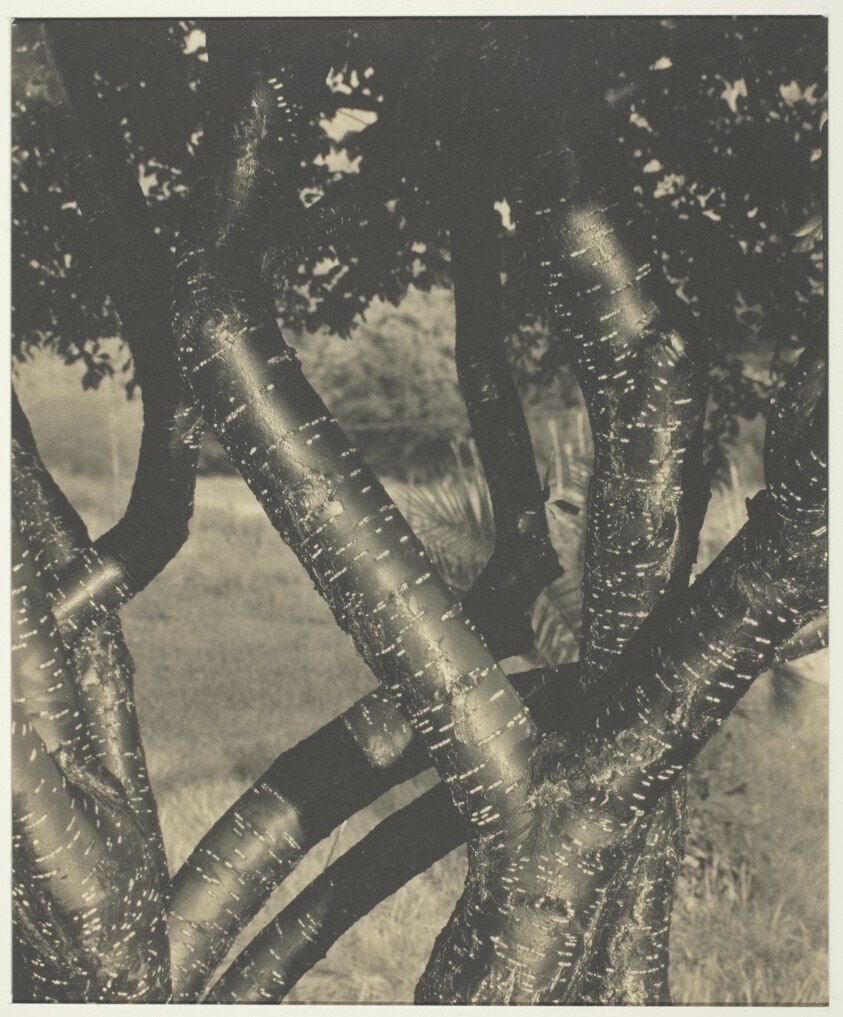
The photograph captures tree trunks in dramatic close-up, their bark textured and weathered, dappled with bright light and shadow. Foliage creates a scattered pattern across the dark upper portion of the frame, with glimpses of sky visible between leaves. The composition is densely layered—multiple trunks overlap and recede into depth, creating a forest interior. The lighting is natural and striking, with bright patches illuminating portions of the bark while other areas fall into shadow, producing strong chiaroscuro. The effect is abstract and rhythmic, almost architectural, though the title "The Dancing Trees" suggests the photographer intended viewers to perceive movement or vitality in these static forms.
The dancing
No human figures are present. The 'dancers' are the trees themselves—their trunks positioned as if in conversation or motion, leaning at varied angles, their surfaces animated by light and shadow. The photograph treats the organic forms as compositional elements with weight and spatial relationship, as one might study the positioning of bodies in a dance.
The dance depicted
This is not a depiction of dance in the traditional sense, but rather a visual metaphor using trees as dancers. The title invites viewers to perceive choreography in nature—the interplay of vertical and diagonal lines, the overlapping spatial planes, the rhythmic distribution of light and dark. The work belongs to early twentieth-century modernist photography's interest in abstraction through natural form. Without human dancers, the 'dance' exists as pure visual rhythm and compositional movement.
How it was made
This is a photograph, likely a gelatin silver print or similar early photographic process, given the tonal range and surface quality visible in the reproduction. The close cropping and emphasis on texture and light suggest the photographer was working in modernist idiom, treating the camera as a tool for discovering abstract pattern in the visible world rather than merely recording it. The technique allows precise capture of the interplay between form and illumination, creating an image that reads simultaneously as naturalistic and geometric.
About this work
"The Dancing Trees" is a modernist photograph that reimagines the forest as a choreographic space. By cropping tightly on overlapping tree trunks and using dramatic natural light to create rhythm and pattern, the photographer abstracts the woodland interior into something closer to an arrangement of forms in motion. The work sits at the intersection of landscape photography and abstract composition, treating botanical subject matter as raw material for visual music.
It represents a broader early twentieth-century impulse to find dance-like qualities in nature and in abstraction itself. The title is generative—it asks viewers to perceive movement where there is stasis, animation where there is botanical fact, thus extending the concept of dance beyond the human body into the realm of pure visual rhythm.
How to look at it
Notice how the photograph uses overlapping to create spatial depth and the sense of multiple bodies occupying a shared space. The light and shadow create rhythm across the surface, moving the eye in patterns not unlike the eye-path through a composed dance. The cropping excludes sky and ground, focusing entirely on the mid-zone where the trunks interact, suggesting a stage-like framing. The title should prime you to see movement: the leaning angles, the varied orientations, the interplay of vertical and diagonal lines, all suggest poses and counterbalance.
The period
This work emerges from early twentieth-century modernism's fascination with abstraction and rhythm. Photographers influenced by Cubism and Expressionism sought to reveal the underlying geometric and dynamic structure of natural forms. Simultaneously, modern dance itself was becoming more abstracted and interested in pure movement rather than narrative. The photograph likely dates to the 1920s–1940s, when the idea of 'found choreography' in nature—in plant growth, water, light—was a recurring theme in both photographic and dance circles.
Where it lives
The work is held in the Art Institute of Chicago. It is catalogued as coming from unknown artist, date, and medium, indicating it entered the collection without full documentation.
Questions about this work
Is this actually a dance photograph?
Not in the documentary sense—there are no human dancers. It is instead a photograph that uses the title and compositional language of dance to invite viewers to see choreography in nature. This was a modernist strategy: finding rhythm, balance, and counterpoint in non-human forms and treating them as if they were staged movement.
Why would a nature photograph belong in a dance collection?
Because dance in the twentieth century became increasingly abstract and interested in principles that extended beyond the human body. Photographers and artists explored how concepts like rhythm, symmetry, counterpoint, and spatial relationship could be discovered or created in any subject. This photograph uses the metaphor of dance to organize and animate a landscape.
What period is this from?
The style and technique suggest early-to-mid twentieth century (roughly 1920s–1940s), though the record does not confirm a date. The modernist approach to abstraction through photography and the metaphorical use of dance language were prominent in this era.
More dance artwork