49 works in this view — arrow keys or swipe to move between them.
Dance in Art
Three Dancers
Hilaire Germain Edgar Degas
- Source:
- Art Institute of Chicago
- Rights:
- Public domain — free to use, share and adapt.
- Recorded as:
- CC0 (Public Domain)
This work is a rare instance of dance-adjacent figural study that prioritizes emotional or ecstatic movement over technique or social custom. For historians of dance and movement, it documents how artists outside the dance world conceptualized physical exuberance and the body in motion—a complement to how professional dancers and choreographers understood and recorded their own practice.
What you are looking at
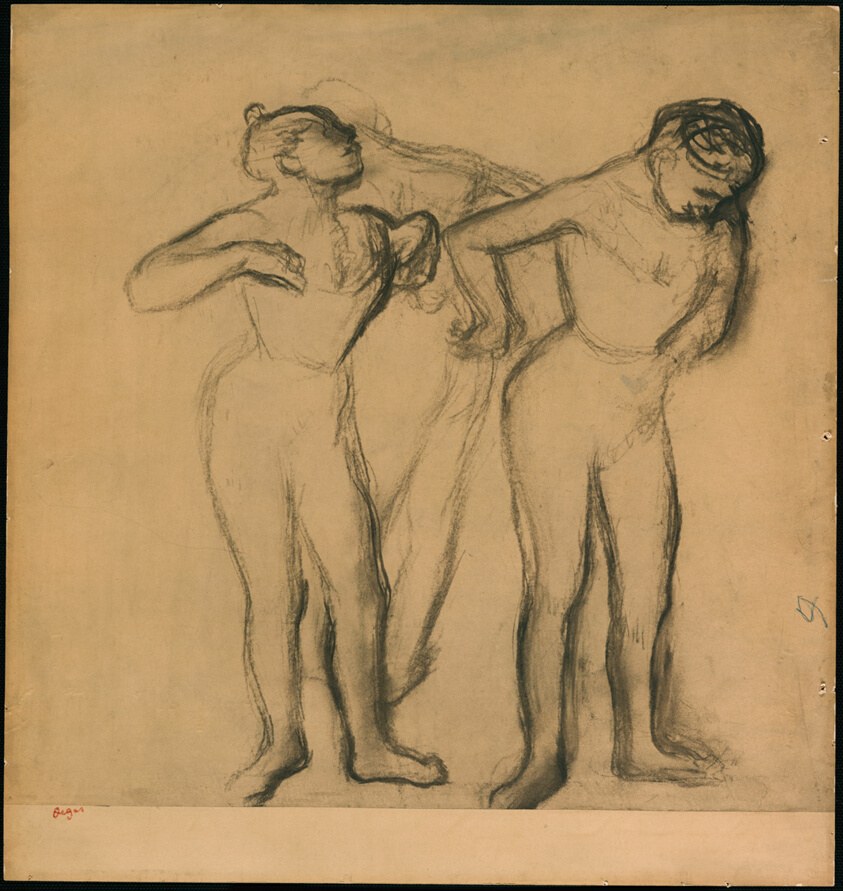
Two nude male figures stand in contrapposto, their bodies elongated and loosely rendered in charcoal or graphite on buff paper. The figure on the left tilts his head back, one arm extended before him in a gesture of openness or abandon; the figure on the right mirrors this pose with head thrown back and arms raised. Between them, a third figure—suggested more than fully drawn—appears suspended or leaning, creating a compositional bridge. The drawing is economical and gestural rather than anatomically precise; the artist has prioritized the sweep of the bodies and the emotional tenor of the moment over detailed modeling. The poses suggest a moment of exuberant movement, or perhaps a study of ecstatic or abandoned gesture. The paper is aged to a warm tan, and the line is confident but spontaneous, with heavier accents at the heads and torsos.
The dancing
Three male nudes in standing positions with heads thrown back. The outer two figures anchor the composition; their weight shifts into their legs while their upper bodies arch backward with arms open or raised. The central figure is less resolved, suggested through lighter lines as if caught mid-motion between the two stable figures. The poses emphasize spinal extension and opened chests—a vocabulary of release or celebration rather than technical control. There is no closed frame or hold; instead, the bodies are isolated and the space between them is part of the composition.
The dance depicted
This drawing does not depict a recognizable historical dance style or social dance. The poses suggest a study of ecstatic or expressive movement—possibly a moment of rapture, drunkenness, or abandon—rendered as a compositional exercise rather than documentary dance imagery. The classical contrapposto and the treatment of the male nude suggest a studio or academic context, where the artist was exploring the body in motion or states of emotional release rather than recording an actual dance.
How it was made
Charcoal or graphite on paper, loosely and economically drawn. The technique allows rapid capturing of gesture and movement; the artist has left areas of the paper unfinished, particularly the central figure, prioritizing the essential line and silhouette. This is consistent with a studio sketch or preparatory drawing rather than a finished work, suggesting this was created as a study—either from live models or from memory and imagination—for the artist's own reference or development.
About this work
This is a study of three male nudes in postures of abandon or ecstatic movement, rendered in rapid charcoal or graphite on aged paper. The work sits at the intersection of academic figure drawing and expressive gesture study, capturing a moment of release or celebration rather than depicting a specific dance or social practice. While the classical vocabulary of the male nude locates it within European art-historical traditions, the emphasis on dynamic movement and emotional tenor suggests a modernist or expressionist sensibility—the artist is interested in bodies as vehicles for feeling or abandonment, not as technical instruments performing a codified dance.
How to look at it
Look first at the three heads, all thrown back in mirror gestures of release or surrender. Follow the spinal curves downward to see how the artist has used the torso as the main vehicle for expressing exuberance or abandon; the arms and legs are less resolved, almost secondary. Notice how the paper itself—its warm, aged tone—becomes part of the image, creating a sense of immediacy and spontaneity. The asymmetry between the fully realized outer figures and the ghosted central form suggests the artist was less interested in creating a balanced composition than in capturing a fleeting moment or emotional truth.
The period
The style and handling suggest a late 19th or early 20th-century European drawing practice, when academic figure study remained dominant but was increasingly inflected by modernist interest in gesture, spontaneity, and psychological or emotional states. The treatment of the body as a vehicle for feeling rather than as a static form reflects contemporary developments in both visual art (Expressionism, Fauvism) and modern dance, where the body's capacity to express interior states—rather than technical virtuosity or social decorum—became central to artistic value.
Where it lives
From the Art Institute of Chicago collection. The work is catalogued only as 'Three Dancers' with no artist, date, or medium recorded, indicating it may be a gift or acquisition without full documentation, or a work whose attribution and context have been lost.
Questions about this work
Is this actually a dance?
Not in any formal or codified sense. The poses are too loose, too expressive, too private to represent a social or theatrical dance. They read instead as a study of ecstatic or abandoned movement—the kind of gesture a figure might make in solitude or in an altered state. The artist seems interested in the body's capacity to express feeling, not in recording technique or social practice.
Why are there three figures when the title says 'Three Dancers'?
The title assumes these are dancers, but the image does not confirm that. The central figure is barely suggested, which may indicate the artist was working from life (with one model or two models in different poses) or was deliberately leaving the composition incomplete as a study rather than a finished work.
What style of drawing is this?
It appears to be a rapid charcoal or graphite sketch, probably created in a studio setting for the artist's own development. The economy of line and the absence of finish suggest it is a study rather than a work intended for exhibition or public circulation. This was a standard practice in academic training and in modernist studios alike.
Could this be related to modern dance or Expressionism?
Possibly. The emphasis on emotional release and the gestural, non-technical rendering of the body align with modernist and Expressionist thinking about the body as a vehicle for feeling. Without a date or artist attribution, it is impossible to connect it definitively to a movement, but the handling and sensibility are consistent with early 20th-century European practice.
More dance artwork