49 works in this view — arrow keys or swipe to move between them.
Dance in Art
dancer part
Unknown artist
- Rights:
- Not recorded. Do not assume this image is free to reuse — check the source record.
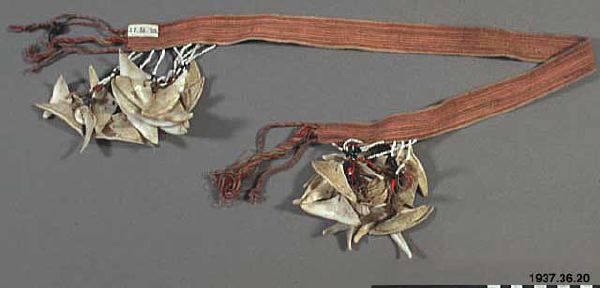
If these are indeed dance costume components or ornaments, they offer material evidence of historical dance practice and adornment traditions. However, the catalogue information is too sparse to establish a clear connection to dance, and the image alone does not reveal how these objects functioned within a performance or ceremonial context.
What you are looking at
This is a museum specimen or artifact documentation photograph showing two small decorative objects suspended from a long narrow strip of woven or braided material, photographed against a grey background. Each object consists of what appears to be dried plant material—possibly seed pods, gourds, or botanical specimens—arranged in a clustered, fan-like or radiating pattern and bound together with cordage or thread. The objects are creamy-white or pale tan in color with dark binding. The suspension strip is reddish-brown, possibly fabric, cord, or leather, with loose frayed ends at each terminus. A small white label is affixed to the upper left of the image. The photograph has the characteristics of archival documentation: flat lighting, neutral background, scale marker visible at bottom right (labeled 1927.36.20), and the sterile presentation typical of museum collections photography.
The dancing
There are no human figures in this image. The objects photographed appear to be two identical or similar decorative or utilitarian items of material culture—not depictions of dancers or dance movement.
The dance depicted
This image does not depict dance. The objects shown are material artifacts—possibly ornaments, talismans, or functional items—and do not represent dancers, choreography, or dance performance. The catalogue record's labeling of this as a "dancer part" is unclear; it may refer to a component of a costume (a bodice ornament, headdress element, or ankle decoration worn during dance), but the photograph shows only the object itself without human context or movement.
How it was made
This is a black-and-white museum documentation photograph, likely taken in the mid-20th century based on the photographic style and archival numbering system. It uses direct overhead lighting and a neutral background to present the artifact clearly for curatorial records. The photograph is a standard museum inventory technique designed for condition recording, identification, and catalogue purposes rather than for artistic or narrative effect.
About this work
This is a museum artifact documentation photograph showing what appears to be two ornamental or utilitarian objects made from natural materials and suspended from a woven or braided cord. The Europeana record identifies it as a "dancer part" and credits it to an unknown artist and date. Without additional context, the connection to dance remains ambiguous—these could be costume elements, sacred or ceremonial objects, or decorative items used in ritual performance of various cultures. The photograph is an archival record of a material object held in an unidentified collection. The precise nature, origin, and use of these objects cannot be determined from the image alone.
How to look at it
Examine the construction of the objects—the way natural materials are bundled and bound—for clues to their function and cultural origin. Note the quality and weaving of the suspension cord. The symmetry and deliberate arrangement suggest these were intentionally made items rather than natural objects. The dual presentation on a single cord suggests they were meant to be paired or complementary.
The period
The photograph itself dates to the mid-20th century based on photographic technique and museum documentation standards of that era. The objects themselves are of unknown date and origin. If they are ethnographic materials, they may represent cultural practices from any period and any geographic region.
Where it lives
This object is held in the Europeana digital collection. The original holding institution, accession number, date of acquisition, and provenance history are not recorded in the available catalogue entry.
Questions about this work
Are these dance costume pieces?
The catalogue record labels them as a "dancer part," suggesting they may be ornaments or components worn during dance. However, without documentation of their origin, use, and cultural context, this connection cannot be confirmed from the photograph alone. They could be ceremonial objects, amulets, decorative items, or functional tools used in various cultural practices.
What are these objects made from?
The objects appear to be constructed from dried plant material—possibly gourds, seed pods, plant fibers, or wood—bound together with natural cordage or thread. The creamy-white coloring and hard, structured appearance suggest they are botanical in origin, though precise material identification would require hands-on examination.
What culture or region did these come from?
The catalogue provides no information on geographic origin, cultural attribution, or maker. The materials and construction style could suggest origins in Africa, Asia, the Pacific, or the Americas, but this is speculation without supporting documentation.
More dance artwork