49 works in this view — arrow keys or swipe to move between them.
Dance in Art
dancer 401 item 625LW
Unknown artist
- Rights:
- Not recorded. Do not assume this image is free to reuse — check the source record.
This work shows how dance—specifically ecstatic or ceremonial movement—was understood by European artists and audiences as a gateway to the spiritual and the otherworldly. The technical mastery of the linear medium combined with the visionary subject matter suggests that dance was taken seriously as a subject worthy of sophisticated artistic treatment, even when it belonged to traditions the artist did not fully understand or participate in.
What you are looking at
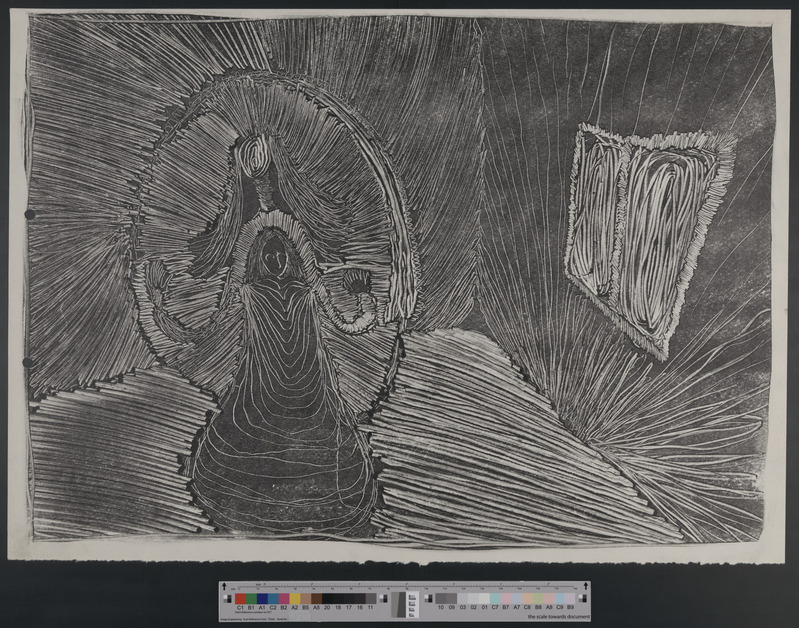
This is a woodcut or engraving of a figure in elaborate costume struck in a dramatic, otherworldly pose. The dancer wears a long, heavily draped garment with multiple layers of fabric that sweep across the composition. Most striking is the headdress or crown—an oversized circular halo of radiating lines that creates an almost supernatural effect. The figure's arms are raised and extended, with one bent at the elbow and the other stretched upward, suggesting a moment of ecstatic movement or invocation. The body appears to be in a lunging or weighted asymmetrical stance. The background is filled with dense, directional hatching that creates an almost oppressive sense of movement and energy—the lines radiate outward and inward simultaneously, suggesting either wind, spiritual forces, or the intensity of the moment itself. To the right of the figure, a rectangular portal or window opens toward a lighter area, its frame defined by similar linear hatching. The overall effect is dreamlike and ceremonial rather than naturalistic.
The dancing
A single figure dominates the composition, their body arranged in an asymmetrical, off-balance position that suggests either possession, trance, or ecstatic movement. The raised arms and tilted torso indicate a moment of maximum extension rather than a stable pose. The figure's weight appears displaced, with the lower body suggesting a lunge or deep-rooted stance that contrasts with the aerial quality of the torso and arms. The costume—voluminous and elaborately layered—obscures the legs and footwork entirely, but the draping itself becomes a kind of movement, pulled and shaped by the figure's gesture.
The dance depicted
This appears to depict a sacred or ceremonial dance rather than a social or theatrical one. The halo-like crown, the ecstatic arm position, and the overall visionary quality suggest either a mystical experience, a shamanic trance, or a ritual invocation. The style and costume do not correspond to European court dance or ballet traditions. The figure's pose and the spiritual intensity of the image are more consistent with indigenous or non-Western ceremonial practice, though the medium—a detailed linear woodcut—suggests this is a European artist's interpretation or imagination of such a vision. Without additional documentation, the specific dance tradition cannot be identified with confidence, though the image clearly positions dance as a means of spiritual transport or communion rather than social entertainment.
How it was made
This is a woodcut or engraving executed in bold, deliberate linear hatching. The artist has used parallel lines as the primary means of creating form, shadow, and atmospheric effect—a technique characteristic of Northern European printmaking of the 15th through 17th centuries. The dense, radiating hatching in the background is not merely decorative; it functions as an active compositional element that propels the eye and creates a sense of whirling energy. The medium's reliance on line over tone means every mark is visible and intentional. Such prints were relatively cheap to produce and distribute, suggesting this image was meant for a broad audience rather than a wealthy patron—whether as a devotional aid, a curiosity about exotic practice, or a record of a visionary or mystical subject.
About this work
This engraving or woodcut preserves a European vision of ecstatic, possibly sacred dance—a figure caught in a moment of spiritual rapture or trance, rendered in the technique of Northern European printmaking. The work values gesture and spiritual intensity over naturalistic movement or recognizable social dance form. It documents not a dance as it was actually performed, but as it was imagined, desired, or experienced by a viewer from outside its original tradition—a record of encounter and interpretation as much as observation. For those studying the history of how European artists represented non-Western and sacred movement, this image is a striking example of the dreamlike, occult quality often imposed on such scenes.
How to look at it
Attend to the radiating lines in the background and how they echo and amplify the gesture of the figure's raised arms—the artist has made the air itself seem to vibrate with the dancer's movement. Notice how the voluminous costume obscures the mechanics of the dance (the footwork, the spine) while the arms and crown dominate—the artist is interested in the spiritual or visionary aspect rather than the technical vocabulary. The small rectangular window or portal on the right edge suggests this is not a scene from everyday reality but from a visionary or supernatural realm.
The period
The engraving technique and linear style suggest a date somewhere between the 15th and 17th centuries, when Northern European printmaking was a dominant art form and when European fascination with non-European, mystical, and visionary subjects was growing. This period saw intense interest in alchemy, astrology, magic, and spiritual practices—both indigenous and invented—reflected in prints, drawings, and manuscript illuminations. Dance, in such contexts, was often portrayed as an ecstatic or magical act rather than a social skill.
Where it lives
The work is held in the Europeana digital collections, suggesting it is part of a European museum or archive, though the specific holding institution is not documented in the record provided.
Dance in this work
Questions about this work
Is this a depiction of a specific dance tradition?
No specific tradition can be identified with confidence from the image alone. The costume, halo, and ecstatic posture suggest a sacred or ceremonial dance, possibly non-European, but the work appears to be a European artist's imaginative or visionary interpretation rather than a direct documentation. Without inscription or archival context, the source and identity of the dance remain uncertain.
What is the circular halo or crown the figure wears?
It functions as a visual indicator of the figure's sacred or supernatural status—a common convention in European religious and visionary art. Whether it represents an actual ceremonial headdress, a spiritual aura, or a purely symbolic invention cannot be determined from the image alone.
Why are the background lines so intense and radiating?
The hatching creates a sense of spiritual or emotional intensity—the air itself seems charged with energy. This technique was characteristic of Northern European printmaking and allowed artists to suggest movement, power, and supernatural presence through pure line rather than color or volume.
More dance artwork