49 works in this view — arrow keys or swipe to move between them.
Dance in Art
dancer 401 item OFRRG
Unknown artist
- Rights:
- Not recorded. Do not assume this image is free to reuse — check the source record.
This work matters as a test case: it asks whether every figure in a seated or open-legged position should be categorized as 'dance,' and what sculptural evidence actually supports such a claim. Dancers and historians interested in the global history of embodied practice and how non-European traditions have been collected, labeled, and archived in Western museums will find this object instructive, regardless of its actual dance content.
What you are looking at
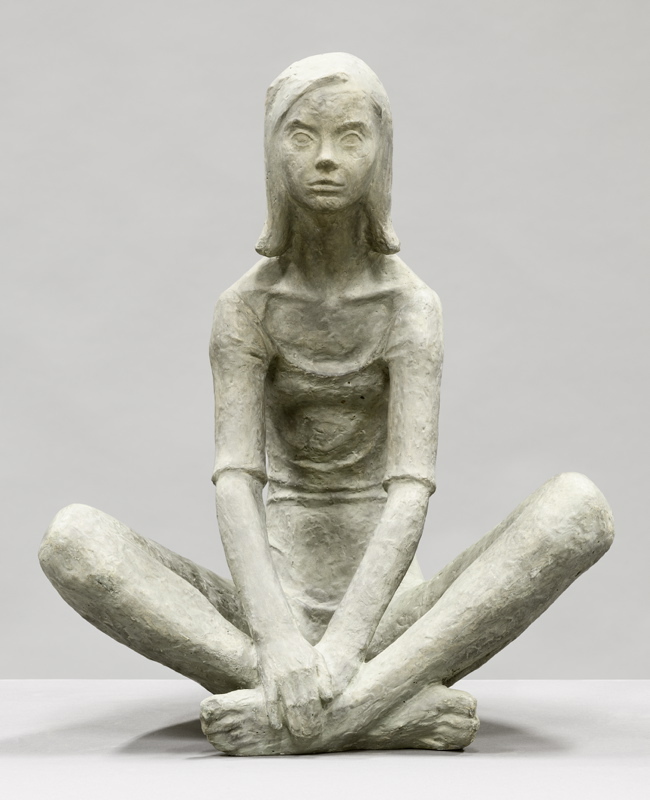
A stone sculpture in a seated pose depicts a figure with long, straight hair past the shoulders, wearing a simple tunic or shift with short sleeves. The figure sits upright with legs extended in a wide V-shape, feet flexed, arms resting on the knees with hands positioned between or slightly inward of the legs. The carving is pale stone, possibly limestone or similar, with a matte finish and visible weathering. The pose is frontal and symmetrical, the face serene and idealized, the body smooth and geometrically simplified rather than anatomically naturalistic. The work is photographed against a neutral gray background and appears to be a museum piece, shot from a centered viewpoint that emphasizes the figure's balance and the clarity of the seated position.
The dancing
A single figure seated in a wide, grounded position with the feet pointing outward and the full weight of the upper body supported upright. The posture is open and expansive rather than folded or introspective; the spine is vertical, the shoulders relaxed, and the arm position is neutral, hands resting on or near the knees. The legs are extended straight rather than crossed or curled, suggesting a deliberate, almost formal presentation of the body. The pose reads as stable and sustained rather than caught mid-movement.
The dance depicted
This figure cannot be confidently identified as depicting a specific dance tradition. The seated, wide-legged position is not standard to European theatrical ballet, nor does it align with the closed or formal frames of historic ballroom or court dance. The pose suggests either a ground-based or meditative practice, or possibly a figure from a non-European dance or movement tradition—South or Southeast Asian classical forms, yogic practices, or sculptural idealization of a seated pose from a regional folk or ritualistic context. Without documentary evidence, provenance, or recognizable costume markers (headdress, jewelry, textile pattern), the dance or movement content cannot be securely identified.
How it was made
This is a hand-carved stone sculpture, worked from a single block in a subtractive process. The carving technique is reductive and economical: details are minimal, forms are simplified and frontal, and the surface finish is smooth but not highly polished. The work appears to be carved limestone or similar sedimentary stone, showing natural weathering and a grainy surface texture. The sculptural approach—its symmetry, verticality, and formal restraint—suggests both a deliberate aesthetic choice and a functional purpose (monument, shrine figure, or garden ornament), implying a circulation beyond the collector's cabinet.
About this work
This is a stone sculpture of a seated figure in a wide-legged pose that does not conform to European dance or movement traditions. The work's date, origin, artist, and intended context are unknown; the title 'dancer 401 item OFRRG' provides no reliable information beyond a generic label. The figure's posture—upright, symmetrical, grounded—reads as meditative or ceremonial rather than theatrical, and the treatment suggests a work made for durability and public or ritual display. It enters the Gallery of Dance through the Europeana digital collection, which aggregates objects from European museums and archives. Whether the figure represents an actual dancer, a deity or ancestor in dance-like repose, or an idealized human form in a pose valued in a particular tradition remains unclear from the image alone.
How to look at it
Attend to the intentionality of the pose: the wide-legged position is not accidental or relaxed, but deliberate and sustained. The vertical spine, open chest, and centered gaze suggest a practice in which sitting itself carries meaning—ritual, meditation, or a formal movement vocabulary that prioritizes groundedness and expansion. The simplification of form (smooth limbs, idealized face, minimal detail) is typical of both ancient sculptural traditions and modern idealization, making it difficult to date the work visually. Notice also what is absent: no shoes, jewelry, or textile specificity that might signal a particular tradition.
The period
The date and cultural origin of this work are unknown, making historical contextualization impossible. The stone carving technique, the formal frontality of the pose, and the museum cataloguing practice (numbered accession label) suggest it may come from an older European collecting tradition, possibly from the 18th–20th centuries, when objects from non-Western regions were acquired as curiosities or ethnographic specimens. The work entered Europeana as a digitized museum object, likely held by a European institution.
Where it lives
This work is held in a European museum and has been digitized as part of the Europeana aggregation project, which brings together cultural heritage objects from institutions across Europe. The accession number 'OFRRG' and the generic title 'dancer 401' suggest it may be part of a large collection sorted by subject rather than by artist or provenance, a cataloguing approach common in ethnographic or decorative arts departments.
Questions about this work
Is this figure definitely a dancer?
No. The wide-legged seated pose could represent a dancer, but it could equally represent meditation, ritual, a deity, an ancestor, or an idealized human form valued in a particular culture. Without documentation, dress markers, or contextual information, the dance content cannot be confirmed. The title 'dancer' reflects a cataloguer's assumption, not a fact visible in the image.
What tradition might this come from?
The pose resembles seated postures found in South and Southeast Asian classical dance, yoga, and ritual practices, but the stone carving style, formal simplification, and unknown provenance make any attribution speculative. European museums have historically acquired sculptures from many regions under generic labels.
Why is the pose so wide and open?
In many movement traditions, a wide-legged stance signals grounding, stability, and expansiveness. In others, it may indicate a state of repose or meditation. The pose's meaning depends on the tradition from which it comes, which is not documented here.
More dance artwork