49 works in this view — arrow keys or swipe to move between them.
Dance in Art
Dancer
Unknown artist
- Rights:
- Not recorded. Do not assume this image is free to reuse — check the source record.
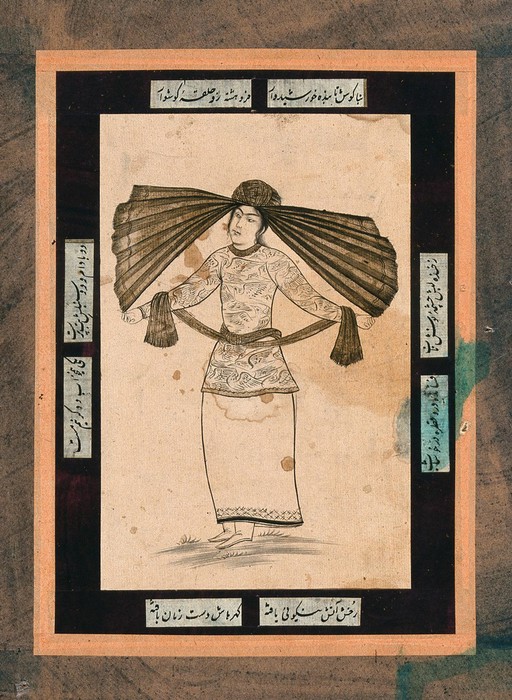
This image is one of the few visual documents of dance in the pre-modern Islamic world, and the extraordinary winged costume suggests specialized performance traditions, possibly connected to court entertainment or ceremonial contexts, that have received little attention in dance history. The work demonstrates that sophisticated, visually elaborate dance existed in the Islamic world during a period when European dance was being documented in similar ways, yet these traditions remain vastly underrepresented in the Western dance historical canon.
What you are looking at
A single figure stands facing forward against a plain ground, wearing a richly patterned garment that appears to be a long tunic or robe with decorative motifs rendered in delicate line work. The figure wears a close-fitting cap or headdress. Most strikingly, enormous wings or wing-like expanses of pleated fabric extend horizontally from the shoulders, creating a dramatic silhouette that dominates the composition. The wings appear to be gathered or pleated material, rendered with fine parallel lines that suggest fabric texture and volume. The figure's arms are raised and drawn inward, framing the body. A black border frames the entire composition, within which Persian or Arabic script appears in cartouches at top and bottom. The drawing style is linear and precise, with minimal shading, suggesting a documentary rather than a romantic intention.
The dancing
The dancer stands in a frontal, symmetrical pose with both arms raised and bent, the hands appearing to hold or frame the wings. The weight appears centered and grounded. The posture is formal and contained rather than dynamic—the figure is presented as a static display of costume and form rather than caught in motion. There is a single dancer, isolated against the ground with no interaction with other figures.
The dance depicted
The image most likely documents a dance costume or performance tradition from the Islamic world, possibly Ottoman or Persian, given the script in the cartouches. The enormous pleated wings are the defining feature and suggest a highly specialized, possibly ceremonial or court performance. The symmetrical, frontal pose and the emphasis on the costume over movement suggest this is a costume study or documentation of a specific role or character type rather than a choreographic moment. Without clarity on the script and provenance, the specific dance tradition cannot be named with confidence, but the formality of presentation and the exotic costume point to a courtly or theatrical tradition of the pre-modern Islamic world.
How it was made
The work appears to be a drawing or possibly an album page, executed in ink with fine pen work on paper that has aged to a cream color. The linear style, the use of cartouches with script, and the framing suggest this is from a manuscript or bound album, possibly a 16th–18th-century Ottoman or Persian document. The precision of the line work and the minimal use of wash suggest the work was made for documentary or instructional purposes, likely circulating within court or scholarly circles rather than as a public print.
About this work
This is a costume study or performance documentation from an Islamic manuscript tradition, presenting a dancer or character type in an elaborate winged costume. The figure is rendered in the precise, frontal style typical of court documentation, with Persian or Arabic text identifying or contextualizing the figure. The work belongs in a dance gallery because it documents a specific performance tradition and costume, offering evidence of dance practices in the pre-modern Islamic world that would otherwise be lost to text alone. The winged costume itself is a remarkable artifact, suggesting theatrical or ceremonial performance practices distinct from European traditions of the same period.
How to look at it
Attend first to the wings: their size, pleating, and construction dominate the silhouette and are clearly the focus of the documentation. Note the frontality and stasis of the pose—this is not a moment of movement but a display of the complete costume. The script in the cartouches likely names or describes the figure; if the text could be read, it would anchor the identification of the dance tradition or character type. The precision of the line work suggests this was meant to record a specific, memorable costume for future reference or circulation among others in the court or manuscript-owning community.
The period
The style and script suggest a date between the 16th and 18th centuries, a period during which both the Ottoman and Safavid Persian courts maintained elaborate court dance and entertainment traditions. In Europe during these centuries, similar costume studies were being made (particularly in the Italian intermezzi tradition and later in court ballet documentation), yet Ottoman and Persian performance traditions have survived primarily through textual reference and such rare visual documents as this one. The album tradition itself—of collecting images of types, costumes, or notable figures—was a widespread practice in Islamic courts and intellectual circles.
Where it lives
The work comes to us through Europeana, a digital aggregation of European cultural heritage collections. The original holding institution is not specified in the available record. The work appears to be a page from a bound album or manuscript, suggesting it was part of a deliberate collection or series, but that context is not documented in the current record.
Dance in this work
Questions about this work
What are the wing-like structures?
They appear to be expanses of pleated fabric—possibly silk or linen—gathered or sewn to extend from the shoulders. The fine parallel lines are the artist's way of rendering the pleats and folds. They may have been functional (moving or rustling as part of the performance) or primarily visual spectacle.
What do the inscriptions say?
The text is in Persian or Arabic script, appearing in cartouches at the top and bottom of the composition. Without a translation, we cannot determine whether these provide a name, a character type, a dance form, or a performer. This information would be crucial to identifying the specific tradition.
Is this a real costume or a fantasy?
The precision and documentary style suggest this represents a real costume that existed, likely in a court context. The artist's careful rendering of the pleating and structure indicates attention to actual garment construction rather than imaginative elaboration.
Where would this dance have been performed?
Given the formal costume and the record-keeping tradition, this was almost certainly a court performance, likely in an Ottoman or Safavid Persian court. Such elaborate performances were part of courtly entertainment, celebrations, and diplomatic occasions.
More dance artwork