49 works in this view — arrow keys or swipe to move between them.
Dance in Art
dance belt dance-belt dance belt
Unknown artist
- Rights:
- Not recorded. Do not assume this image is free to reuse — check the source record.
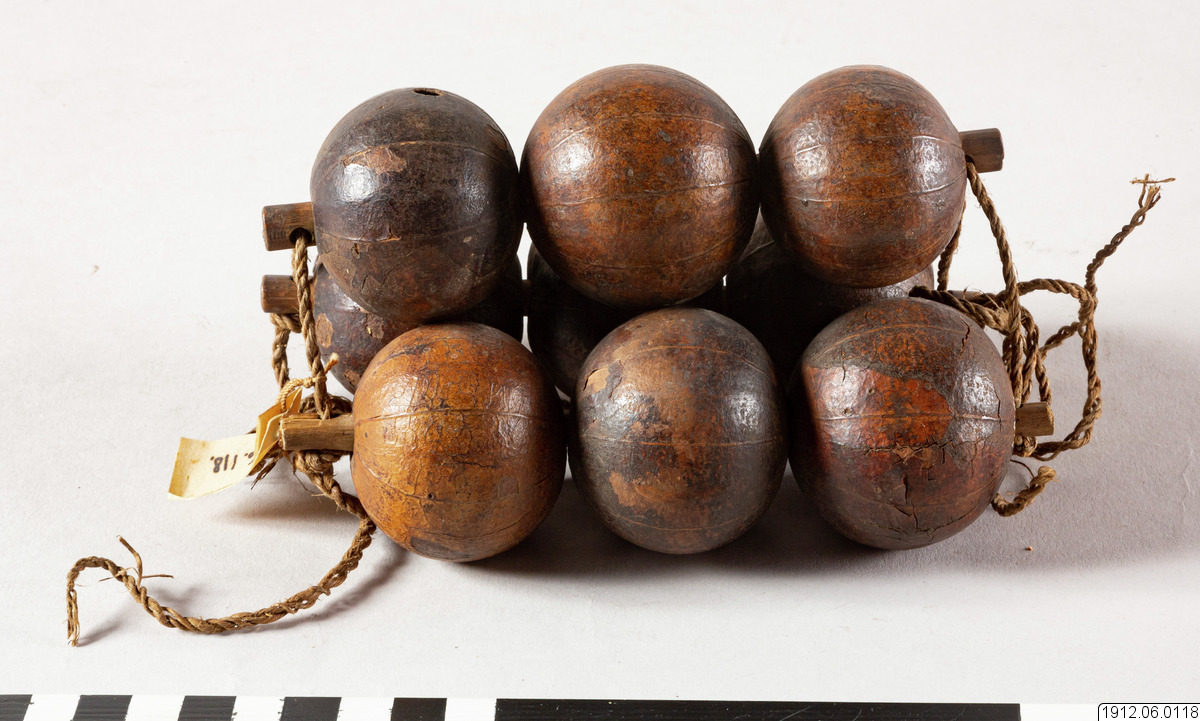
This work matters as a case study in how museum records can become corrupted or misleading over time. If the record is wrong, the object has been misidentified for archival purposes. If the term 'dance belt' has a historical meaning different from modern usage, the image documents an obsolete technology or practice. Either way, the discrepancy is worth investigating.
What you are looking at
Six wooden spheres, roughly the size of grapefruit, are arranged in two rows on a neutral ground. Each ball is made of dark wood with a polished, weathered surface showing age marks and patina. They are connected to rectangular wooden blocks or toggles via twisted plant fiber or rope cord, creating a unified object. The spheres appear identical in construction and are photographed against a plain light background with a measurement scale at the bottom edge. A small brass cataloguing tag is visible on the left side. The arrangement suggests this is a museum or archival photograph of a historical artifact.
The dancing
There are no human figures or dancers in this image. This is a photograph of a material object—specifically, six spheres attached to toggle mechanisms—not a depiction of dance or bodily movement.
The dance depicted
This object does not depict dance or dancers. The catalogue record identifies it as a 'dance belt' or 'dance-belt'—a term that refers to a specialized undergarment worn by male ballet dancers to provide support and create a smooth line, not to any dance form or movement. The physical object shown appears to be something entirely different: likely a percussion instrument, a toy, a game piece, or a training tool. Without additional context or inscription, the function cannot be determined from the image alone.
How it was made
This is a photograph—probably black-and-white gelatin silver or similar archival photographic stock—of a three-dimensional wooden artifact. The photograph is straightforward studio documentation, with controlled lighting and a neutral background. The presence of a scale and cataloguing label indicates this is archival or museum documentation, designed to record the object's form, materials, and condition for reference and preservation purposes.
About this work
This is a cataloguing photograph of a wooden object consisting of six spheres joined by toggles and cordage. The catalogue record labels it a 'dance belt,' but the physical form shown contradicts that identification entirely. A dance belt is textile and worn on the body; this is a wooden multi-part object. Either the record is incorrect, the photograph is of the wrong object, or the term 'dance belt' is being used in an unfamiliar or obsolete sense (possibly as a game, training apparatus, or percussion instrument related to dance or music). The Europeana source and the cataloguing tag suggest this comes from a European museum or archive, but the original collection, date, and true identity of the object remain unknown.
How to look at it
Look at the construction: the spheres are hand-turned or carved from single pieces of wood and then joined to rectangular blocks via twisted cordage that appears deliberately knotted and finished. The symmetry of the assembly and the uniformity of the spheres suggest a purposeful design. The weathering and patina indicate age and use. The photograph includes a scale (visible at bottom) for size reference, which is standard archival practice. The small brass label on the left would contain the museum's accession number and should be readable in high-resolution versions.
The period
Without a reliable date or cultural origin, it is impossible to place this object in historical context. The wooden construction and cordage suggest pre-industrial or early industrial manufacture. The archival photograph itself is likely 20th-century, based on the photographic technique and cataloguing methods visible.
Where it lives
This object is held in a Europeana digital collection partner, indicating it is part of a European museum or archive's holdings. The Europeana source and accession numbering (visible on the label) suggest it has been formally catalogued, though the accuracy of the current record—particularly the 'dance belt' designation—is questionable.
Questions about this work
Is this actually a dance belt?
Probably not. A dance belt is a modern elastic undergarment worn by male ballet dancers; it is textile, worn on the body, and designed to provide support and a smooth line. This is a wooden object with spheres and toggles. The catalogue record may be incorrect, or 'dance belt' may refer to an obsolete or non-English use of the term.
What is this object actually for?
Unknown from the image alone. It could be a percussion instrument, a game or toy, a training apparatus, a weight or resistance device, or a tool related to textile production, music, or dance. The repetition and uniformity suggest it was mass-produced or made in a series, which rules out a unique art object.
When and where was it made?
The catalogue record states 'unknown' for both date and medium. The wooden construction and hand-finished appearance suggest pre-industrial or early industrial manufacture, but this is speculative. The Europeana source indicates it is European, but more cannot be said without additional research.
More dance artwork