49 works in this view — arrow keys or swipe to move between them.
Dance in Art
dance belt dance belt dance-belt
Unknown artist
- Rights:
- Not recorded. Do not assume this image is free to reuse — check the source record.
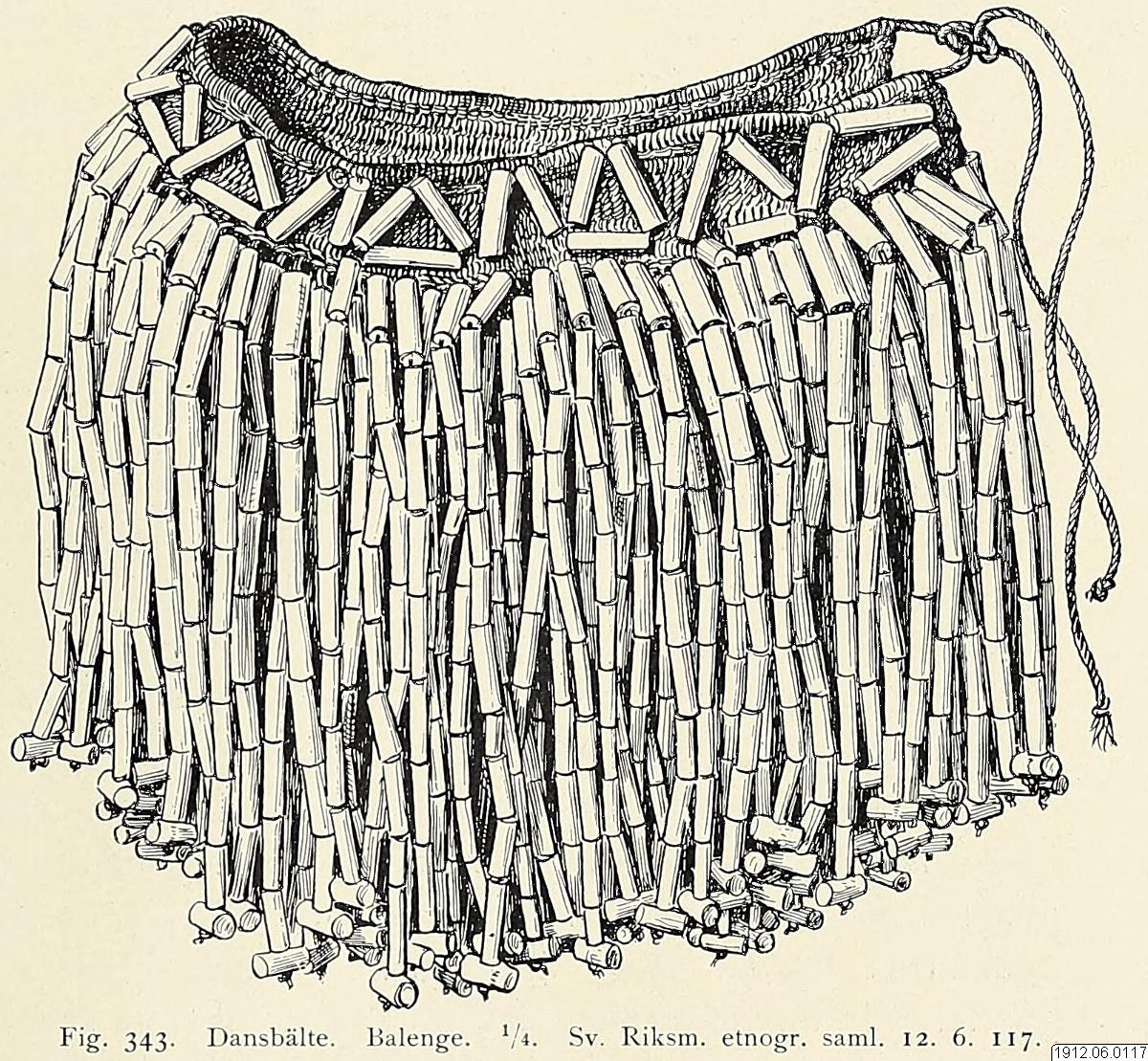
This is one of the few detailed technical records of a traditional Scandinavian dance costume, preserved as a precise engraving that reveals the engineering behind the garment. For dance historians and costume makers, it is an invaluable document of how folk dancers enhanced and amplified their movement through structured, segmented costume elements. The work shows that dance dress was not incidental ornamentation but integral to the dance itself—the belt's design determined what movements were possible and visible.
What you are looking at
A dance belt, shown in technical detail as a full-length, three-dimensional study. The belt is constructed from tubular segments—dozens of cylindrical forms resembling bamboo or cane—arranged vertically in overlapping rows from a decorative upper band to the hem, creating a tiered skirt-like garment. The segments are held in a rectangular frame with triangular spacers or ties visible at the upper edge, distributing the vertical elements evenly. Two twisted cords emerge from the upper corners, apparently for securing or fastening the belt at the sides of the wearer's body. The parallel striations scored or incised into each segment suggest the bamboo's natural growth rings or the deliberate grooved construction of a woven or bound form. The overall effect is of a stiff, segmented skirt that would move as distinct units rather than as a fluid fabric—a garment engineered for visual and structural impact rather than plasticity.
The dancing
No human figures are shown; the work is a material study of the belt as an object. The framwork and segments appear to be suspended or displayed frontally, with the cords hanging at the sides. The perspective is analytical rather than performative, presenting the construction and mechanics of the garment for examination.
The dance depicted
Dansbalte is identified in the caption as a Scandinavian dance garment—the term and context suggest a traditional folk or ceremonial belt worn in Swedish or Danish practice. The form is consistent with stiffened or structured skirts used in Northern European folk dance to enable and amplify the movement of the hips and legs. The segmentation would allow the dancer to articulate the hips and torso while the rigid elements swing and strike visually, creating percussive or visual emphasis. The construction suggests this is a garment engineered for kinetic effect: each segment swings independently, making even subtle hip movement visible from a distance. Whether it was struck, swung, or simply worn to amplify lower-body movement cannot be certain from the object alone, but the engineering implies intentional spectacle.
How it was made
This is a technical engraving or wood-engraving in black line on a cream or white ground, rendered with fine parallel hatching to model volume and shadow. The technique allowed precise documentation of the three-dimensional form and construction detail—the overlapping arrangement, the spacing, the fastening cords—with clarity impossible in photography or sketching. The fine linework suggests this was intended for publication in a scholarly or ethnographic document, circulating among dancers, costume makers, and museum professionals rather than the general public. The precision and didactic clarity mark it as part of a technical or archival record.
About this work
This is a technical drawing of a Swedish or Scandinavian dance belt (dansbalte)—a segmented, stiffened skirt worn in traditional folk dance. The engraving documents both the overall form and the engineering: how the tubular segments are arranged, suspended in a frame, and fastened to the body via cords. It is not a representation of the dance itself, but rather a material and constructive study of a key element of the dancer's costume, the kind of archival diagram found in ethnographic collections and costume documentation. The work serves as evidence of how Northern European dancers were equipped for performance: the belt is not decorative but functional, designed to make movement visible and to carry visual and possibly sonic impact as the dancer moves.
How to look at it
Examine how the segments are stacked and overlapped—notice the triangular spacers that hold them at the correct distance from one another, allowing each to swing independently. Look at the cords at the corners and imagine them tied around the dancer's waist: the belt would hang as a stiff, multi-chambered skirt, so that any rotation or hip movement would cause the segments to swing outward and back, creating visual and kinetic emphasis. The hatching on each segment is deliberate—it shows texture and materiality, suggesting that the segments are hollow or grooved, not solid.
The period
This engraving dates to the early 20th century (the catalogue notes 1912 and Swedish museum accession), a period when European ethnographic institutions were systematically documenting folk dances and costumes before industrial modernization displaced them. Swedish and Scandinavian folk dance was a focus of national cultural preservation in this era, and museum collections began commissioning detailed technical drawings of traditional garments and their construction. The precision and archival method reflect the scientific approach to ethnography typical of the period.
Where it lives
Held in the Swedish Museum of National Antiquities (Sv. Riksmuseum). The accession note "etnogr. saml. 12. 6. 1117" indicates it is part of the ethnographic collection. This is a technical drawing or engraving prepared for museum documentation and scholarship, not an artwork collected for aesthetic value.
Dance in this work
Questions about this work
What is a dansbalte and how was it worn?
A dansbalte is a segmented skirt garment worn in Scandinavian folk dance, comprising stiff tubular segments suspended from a frame at the waist and fastened with cords. The segments hung vertically and swung outward with the dancer's hip and leg movements, amplifying the visual effect of the dance. The rigid construction meant that even small movements of the torso would cause the segments to swing, creating a rhythmic visual and potentially sonic accent.
Why is this a technical drawing rather than a photograph?
Engraving allowed the artist to render the three-dimensional structure with absolute clarity—every segment, spacer, and cord is visible and precise in a way a photograph (which would show shadow and foreshortening) could not convey. For museum documentation and costume reproduction, this level of technical clarity was essential. The engraving could also be printed and circulated widely among scholars and makers.
Is this a costume piece or a musical instrument?
It is primarily a costume piece—a garment worn by the dancer's body. However, its structure suggests it may have had acoustic properties: the segmented form would create sound as the dancer moved, either from the segments striking one another or from suspended elements within them. This dual function as both visual and sonic element is typical of many folk dance costumes.
More dance artwork