49 works in this view — arrow keys or swipe to move between them.
Dance in Art
dansaccessoar dansprydnad dansgördel dance accessory
Unknown artist
- Rights:
- Not recorded. Do not assume this image is free to reuse — check the source record.
Dance regalia is as essential to understanding dance as notation or costume; it reveals what dancers wore, how they moved, and what materials and skills were available at the time of making. This object demonstrates the sophistication of plant-fiber craft and the central role of handmade ornament in dance practice. Its appearance in a European collection raises questions about how folk and global dance traditions have been documented, collected, and preserved.
What you are looking at
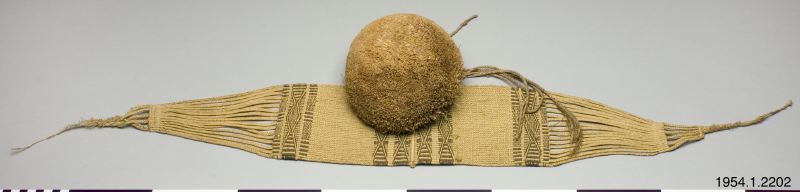
A woven textile object, roughly oval or spherical in form, displayed against a neutral background. The central element is a dense, straw-colored woven ball or pod, approximately 4–5 inches in diameter, with a stem or attachment point at the top. This ball is suspended within or attached to a flat woven band of natural fiber—straw, raffia, or similar plant material—that extends horizontally on either side, tapering toward delicate whisker-like strands at both ends. The band is articulated with several rows of tightly wrapped binding or stitching, creating regular geometric divisions along its length. The overall form suggests a stylized figure or ornament: the spherical form reads as a head, and the extended band as arms or a torso element held in a horizontal, wings-like configuration. The craftsmanship is precise; the weaving is even and the proportions deliberate.
The dancing
The form does not depict a human body in motion but rather an abstract or symbolic figure. If read as a dancer, the horizontal extension of the band suggests an open, symmetrical arm position or a pose of balance and repose. There is no weight shift, no suggestion of stepping or momentum—the figure is static and frontal. The spherical head sits centrally above the extended plane, creating a vertical axis of balance. The construction implies no actual dance posture but rather a stylized, ceremonial object.
The dance depicted
This is not a depiction of dance in motion. It is a dance accessory or adornment—a belt, headdress, or ornament worn during dance. The catalogue record titles it 'dansaccessoar' / 'dansprydnad' / 'dansgördel' (dance accessory / dance adornment / dance belt), which is supported by its form. The woven materials, the decorative patterning, and the three-dimensional sculptural quality suggest it was made to be worn on the body and to move with the dancer, creating visual emphasis or ritual significance. Without provenance or cultural context, the specific dance tradition cannot be identified with confidence, but the object belongs to a body of dance regalia across multiple cultures that use woven fiber for ceremonial or social dance.
How it was made
This is a three-dimensional textile object—woven and hand-constructed from natural fibers (straw, raffia, or similar plant material). The technique involves interlocking plant strands to form the dense spherical element and binding or stitching to create the articulated band. No glue or metal fasteners are apparent. The object is fragile and would require careful handling; its survival indicates either regular curation or recent making. The image is a museum photograph or archival documentation, likely taken for catalogue purposes. Photography at this angle and scale preserves the form and surface detail for future study.
About this work
This is a handmade woven dance accessory, likely a belt or headdress, fashioned from plant fiber and dating to an unknown period. The spherical head-form and extended arm-like band create a stylized figure that may have served ceremonial, social, or theatrical purposes in dance. Its maker is unrecorded, and no cultural or regional attribution is clear from the object itself. It survives in a European digital collection (Europeana), which may indicate European folk origin or a historical transfer through collecting practices.
The object belongs to a global category of woven dance regalia. Many cultures have created similar fiber accessories for ritual, courtship, or theatrical dance—from sub-Saharan Africa to the Pacific, Central Asia, and northern Europe. Without documentary evidence, the specific dance tradition remains unidentified. What is clear is that this was made to be worn, to be seen, and to enhance the visual and kinetic presence of a dancer.
How to look at it
Observe the symmetry and balance of the form: the centered sphere above the horizontal band creates a figure that is self-contained and frontal. Note the precision of the binding on the band—the regular divisions suggest both structural necessity and aesthetic intent. Consider how this object would appear in motion: the extended arms or band would create a silhouette, and the sphere would catch light and movement. The object invites the question of its function: was it a crown, a shoulder ornament, a waist ornament, or a symbolic figure held or carried during dance? The answer would change how we see both the object and the dance.
The period
The object's date is unknown, and stylistic analysis alone cannot reliably place it. The Europeana collection includes folk and ethnographic materials spanning several centuries and multiple continents. European interest in collecting non-European textiles and dance regalia intensified from the 18th century onward, as did documentation of European folk practices. The Europeana platform digitizes holdings from museums and archives across Europe, many of which assembled collections during colonial and post-colonial periods. Whether this object dates to the 19th century, the early 20th century, or more recently cannot be determined without additional evidence.
Where it lives
The object is held in Europeana, a digital aggregator of European cultural heritage. The catalogue record includes a museum accession number (1954.1.2202), indicating it resides in a physical collection, but the holding institution is not named in the available record. It was digitized as part of a broader effort to make European cultural materials accessible online.
Questions about this work
What is this object made of?
Plant fiber—most likely straw, raffia, or dried grass—woven and bound by hand. The spherical element is densely woven, and the band is articulated with rows of stitching or cord binding. No manufactured materials or fasteners are visible.
Was this actually worn during dance?
Almost certainly. The catalogue record explicitly names it a dance accessory or dance belt. Its form and structure suggest it was designed to be worn on the body, either at the waist, shoulders, or head. Its survival in a museum collection implies it was valued enough to preserve, which supports its role in significant social or ceremonial practice.
Where is this from?
Unknown. The object is held in a European collection, which could mean it is of European folk origin or was collected from elsewhere and transferred to Europe. Without documentary evidence—maker, place, date, or donor notes—the cultural and geographic origin remains open.
Why doesn't the record tell us more?
Many ethnographic and folk objects in collections lack detailed provenance, especially if acquired through donation, inheritance, or colonial-era collecting practices. The Europeana record reflects what the holding institution has recorded; additional documentation may exist in the physical collection but is not visible in this digital excerpt.
More dance artwork