49 works in this view — arrow keys or swipe to move between them.
Dance in Art
dansattribut dance attribute
Unknown artist
- Rights:
- Not recorded. Do not assume this image is free to reuse — check the source record.
This work matters as an example of how museum metadata can drift or become corrupted in large digital collections. The mis-cataloguing reveals both the challenge of automated digitisation and the importance of visual verification in archival practice.
What you are looking at
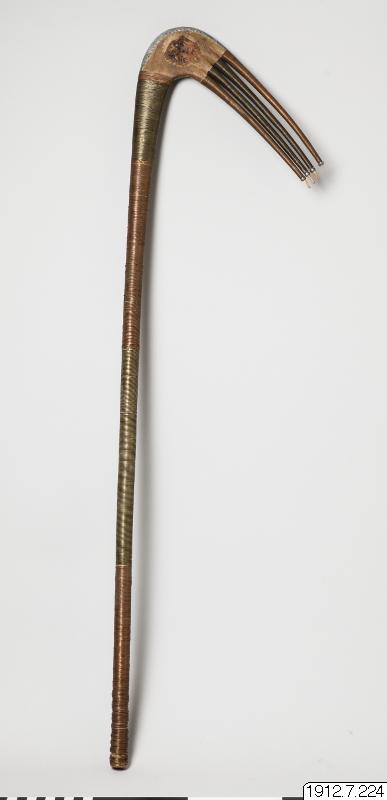
This is a walking stick or cane, not a depiction of dance. The object is constructed from metal—likely brass or bronze—with a long, straight shaft wrapped in fine decorative grooves or spiral ridging that runs nearly the full length. The handle curves sharply upward in a hooked form typical of a gentleman's walking aid, with the curved section finished to a smooth, worn patina at the grip. The head of the hook shows darker oxidation and use marks. The opposite end of the shaft tapers to a point, originally designed to strike the ground. The overall effect is utilitarian but refined, the kind of object a well-dressed man of means would have carried in the 19th or early 20th century.
The dance depicted
This object does not depict dance. It is a material artifact—a walking stick—not a representation of dancers or choreography.
How it was made
The object is a cast and hand-finished metal cane, likely brass or bronze, with decorative spiral grooves incised or cast into the shaft. The hook handle is shaped from the same stock and finished smooth. The wear patterns and patina suggest age and regular use. This is a functional object, not an artwork in the traditional sense, though it demonstrates the craftwork standards of its era.
About this work
This catalogue entry appears to be a cataloguing error. The object is a walking stick or cane—a common gentleman's accessory of the 19th or early 20th century—not a dance-related artwork. It has been titled 'dansattribut' (dance attribute) in the Europeana record, but the image shows only a metal walking aid with no connection to dance, performance, costume, or ceremonial use. The object belongs in a social history or material culture collection, not in a gallery of dance imagery.
How to look at it
Examine the shaft closely: the regular spiral ridging is consistent and even, indicating either careful hand-tooling or precision casting. The wear on the hook grip, darker on the interior curve, shows exactly where a hand gripped it repeatedly. The taper at the point is blunt with use—this stick was carried and used.
The period
Walking sticks were essential fashion accessories for men in the 19th and early 20th centuries, serving simultaneously as practical aids, status symbols, and marks of respectability. The quality of materials and decoration often reflected the wearer's social standing. This particular example, with its carefully finished spiral grooves and quality of metalwork, suggests a middle to upper-class owner.
Where it lives
The object is held in Europeana, a pan-European digital collection aggregating works from member institutions. The record provides no information about the specific holding institution, accession number, or physical location.
Questions about this work
Why is this listed as a dance attribute?
The catalogue record title 'dansattribut' (dance attribute) appears to be an error or misidentification. Walking sticks have no functional role in dance and are not worn or used in performance. The object is almost certainly a gentleman's walking aid from the 19th or early 20th century, mislabeled during digital cataloguing.
Could this ever be a dance prop or costume piece?
Exceptionally unlikely. Walking sticks do not appear in the vocabulary of any major historical or contemporary dance tradition. While a stick might be used as a prop in theatrical dance, this object shows the wear and finish of an everyday accessory, not a stage property.
What era is this actually from?
The spiral ridging technique, patina, and hook-handle design are consistent with late 19th or early 20th century manufacture, but without conservation documentation or material analysis, a precise date cannot be established from the photograph alone.
More dance artwork