49 works in this view — arrow keys or swipe to move between them.
Dance in Art
dansattribut dance club Napa
Unknown artist
- Rights:
- Not recorded. Do not assume this image is free to reuse — check the source record.
Dance props are rarely collected and preserved as seriously as costumes or notation, yet they are the mediating objects through which human movement becomes visible art. This whisk or fan is evidence of a craft tradition and a performance practice, and its presence in a museum collection signals that someone recognized it as worth saving—as belonging to history rather than to a single use.
What you are looking at
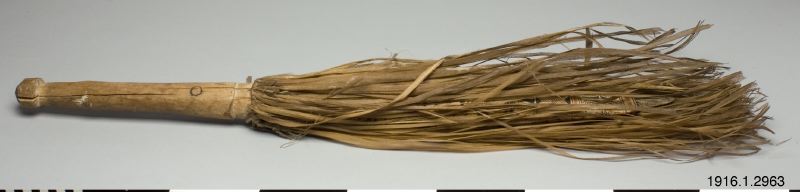
This is a single object photograph of a dance club or ceremonial whisk made from natural fibers. The implement consists of a cylindrical wooden handle, approximately 12 inches long, with a smooth finish and two binding bands near the narrower end. The handle terminates in a rounded knob. From the binding point extends a dense bundle of dried plant material—straw, raffia, or similar fibers—tied tightly at the base and left to spread and fray naturally outward, creating a full, feathered tassel roughly 8–10 inches in length. The fibers show natural color variation from golden to pale tan, with individual strands clearly visible. The object is photographed against a neutral background with a scale ruler visible at the bottom edge, indicating museum documentation practice. The wear and slight darkening of the binding suggest age and use.
The dancing
There are no human figures in this image. The object itself—the whisk or fan—would have been held and manipulated by a dancer or ceremonial practitioner whose hands and body are absent from the frame. The implement's design suggests it was meant to be wielded with a firm grip on the handle, allowing the bundle of fibers to move freely and dramatically through space with arm movements and rotations.
The dance depicted
This appears to be a prop or costume element associated with dance, most likely a ceremonial or ritual dance club or fiber fan used in Pacific, African, or Central Asian dance traditions. Objects of this type appear in hula, fire dances, poi work, and various global-pacific and global-african ceremonial practices. Without additional documentation, the specific dance form cannot be definitively identified. The craftsmanship and material suggest handmade production for repeated ceremonial or performance use rather than a single ephemeral prop. The catalogue record's title 'dansattribut dance club Napa' suggests it may be associated with Napa Valley or a Napa cultural context, but this is not visually evident from the object alone.
How it was made
This is a three-dimensional craft object made from natural materials using traditional binding and bundling techniques. It consists of wood, plant fibers, and what appear to be natural or plant-based bindings. The handle is turned or carved wood, suggesting either hand-tool work or lathe-finishing. The fiber bundle is secured through tight wrapping, a technique that allows the materials to move independently while remaining structurally sound. As a museum photograph with scale, this documentation suggests the object is held in a collection and was photographed for cataloguing purposes according to standard archival practices.
About this work
This is a dance prop or ceremonial implement—a handled whisk or fan made of wood and plant fibers. It belongs in a gallery about dance because it is equipment: an object made specifically to be moved by a dancer's body, designed to catch light and air and to amplify gesture into visible form. The implement extends the reach and visual impact of human movement, a fundamental principle across many dance traditions from Pacific hula and fire dances to African ceremonial practices and global flow-arts disciplines.
The object itself tells us little about the specific dance, the performer, the occasion, or the cultural context—that knowledge lies in the now-absent dancer and the documentation that should accompany it. What remains visible is craft: the care taken in selecting, preparing, and binding natural materials into an implement meant to be used repeatedly, to withstand the energy and momentum of dance, and to transform individual fiber strands into a unified visual and kinetic presence.
How to look at it
Examine the construction: the precision of the binding, the selection and preparation of fibers, the balance of weight between handle and bundle. The object's design reveals intent—the handle is sized for a human grip, the fiber bundle is dense enough to move as a unified form but loose enough to respond to the air and to separate into individual strands in motion. Imagine this in use: the dancer's arm rising and falling, rotating, the fibers flowering outward on each gesture and gathering back as the arm returns. The wear on the binding and the color variation in the fibers suggest long use, repeated performance, and the passage of time.
The period
Without secure dating or cultural attribution, the historical context cannot be established from the object alone. The photograph itself follows mid-to-late 20th-century museum documentation standards (scale ruler, neutral background, direct overhead or studio lighting), suggesting the object was catalogued sometime in the modern curatorial era. The Europeana source and the catalogue reference number 1916.1.2963 indicate it is held in a European collection and was likely acquired during the colonial or early anthropological-collecting period, though the accession number does not clarify the date of acquisition.
Where it lives
This object is held in a European collection via Europeana, the digital aggregation platform for European cultural heritage. The catalogue record is minimal and does not specify the holding institution, accession date, or acquisition context. The reference number 1916.1.2963 indicates a formal cataloguing system but leaves the museum and the date of entry unknown.
Dance in this work
Questions about this work
What is this object used for?
This is a dance prop or ceremonial implement—a handled whisk or fan made from wood and plant fibers. It was held and moved by a dancer or ceremonial practitioner to amplify gesture, create visual interest, and mark rhythm or ritual action. Similar objects appear across many global dance and performance traditions.
Where did this come from?
The catalogue record provides only the title 'dansattribut dance club Napa,' which may refer to Napa Valley or a cultural practice, and the reference number 1916.1.2963. The object is held in a European collection via Europeana. Without fuller documentation, the geographic origin, cultural context, and date of making cannot be established from the image alone.
How old is it?
The photograph was made using mid-to-late 20th-century museum documentation standards, indicating the object was catalogued in the modern era. The actual age of the object is not specified in the available record. The wear visible on the binding and the color of the fibers suggest age and use, but this cannot be dated precisely from appearance.
Is this a musical instrument?
No. While it may mark rhythm or accompany sound, it is a prop or costume element made to be seen and moved by a dancer's body, not to produce sound itself. Its primary function is kinetic and visual.
More dance artwork