49 works in this view — arrow keys or swipe to move between them.
Dance in Art
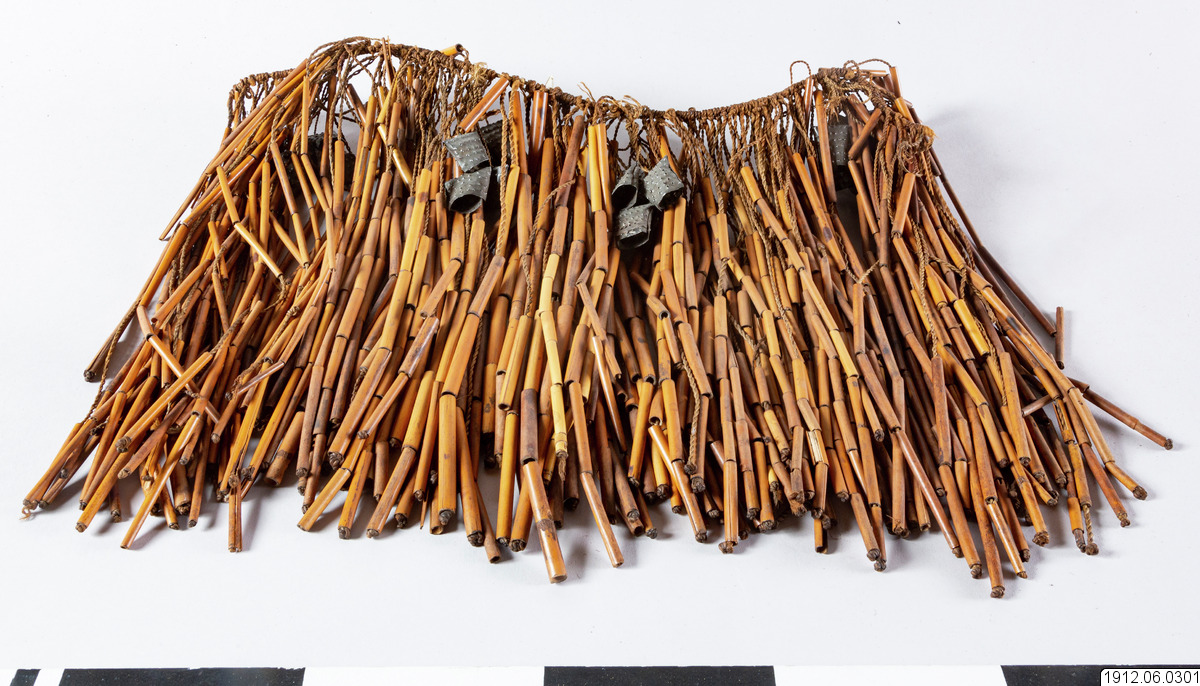
dansbälte dance belt dance-belt
Unknown artist
- Rights:
- Not recorded. Do not assume this image is free to reuse — check the source record.
Dance historians studying folk tradition and costume design need to understand that the belt was not merely worn but was an active part of the movement vocabulary. For dancers learning historical traditions, this artifact demonstrates the relationship between clothing, physics, and performance: the fringe was not ornament but a kinetic extension that made rhythm visible. It also documents a specific regional identity and era in Scandinavian dance culture.
What you are looking at
This is a dance belt—a garment worn at the waist during performance, now displayed as a flat artifact against a white background. The belt consists of a broad waistband of woven material, tan and brown in color, from which hangs a deep fringe of narrow leather or fiber strips, each roughly 12–18 inches long. The fringe is densely packed and hangs vertically, creating a full skirt-like appearance. Two small metal plaques or charms—gray-silver in color and roughly rectangular—are sewn or attached near the center top, above where the fringe begins. The overall construction suggests practical stage costume: the belt would sit at the dancer's hips, and the fringe would move with the body, emphasizing hip and lower-torso motion. The artifact shows signs of age and use; some strips appear darkened or stained, and the overall coloring is muted and weathered rather than uniform.
The dancing
There are no living figures in this image. The belt itself is a sculptural artifact, displayed flat. The fringe hangs downward under its own weight, suggesting how it would move during performance—swaying, bouncing, and creating a visual line that draws attention to the hips and legs of the wearer. The density and length of the fringe indicate that movement of the lower body would be both visible and audible.
The dance depicted
The dansbälte (dance belt) is a traditional garment worn primarily in Nordic and Scandinavian folk dance, particularly in Swedish and Norwegian traditions. It was worn around the waist, typically by male dancers, and the fringe would swing and emphasize hip and leg movements during folk dances such as the halling, springar, or other regional variants. The belt transformed the dancer's silhouette and created a visual and rhythmic extension of the body's motion. The metal ornaments suggest status or regional identity. This particular example appears to be a historical artifact, likely 19th or early 20th century, representing practical stage or festival wear rather than ceremonial dress.
How it was made
This is a three-dimensional textile artifact—a constructed garment made from woven fabric, leather or plant-fiber strips, and metal hardware. The manufacturing process involved weaving the waistband, cutting and attaching individual fringe strips (labor-intensive work), and hand-stitching or riveting the metal plaques in place. The object is now preserved as a museum artifact and photographed in a flat lay against a neutral background. The photograph documents the artifact's current physical state, including wear and discoloration, making it a record of both the original design and its history of use.
About this work
The dansbälte is a functional costume element from Northern European folk dance tradition, worn to enhance and amplify the visual and kinetic impact of hip and leg movement. This example, now in a museum collection, represents the material culture of traditional dance performance—the everyday (or festival-day) costume that made the dance visible and memorable. It belongs in a gallery about dance because it is not decoration applied to the body but a designed tool that shaped how the dance was performed and how audiences perceived it. The belt's structure—its weight, its fringe, its metal ornaments—all participated in the choreography itself.
How to look at it
Observe the weight and length of the fringe and imagine the belt in motion: how each strip would catch air and swing as the wearer's hips moved. The metal plaques at the center suggest a focal point for the eye and possibly for sound (if they clinked during movement). Consider the practical engineering: the fringe needed to be substantial enough to be visible from a distance in a performance space, yet not so heavy as to impede movement. The wear visible on some strips tells a story of repeated use and age, grounding this object in actual performance history rather than idealized documentation.
The period
The dansbälte belongs to the 19th and early 20th-century period of European folk dance documentation and performance. During this era, traditional dances were being collected, standardized, and performed in increasingly formal settings—festivals, theater stages, and later on film. The costume elements became more defined and consistent as folk traditions were codified. The preservation of this object in a museum collection reflects the early-to-mid 20th-century impulse to document and conserve folk culture as a matter of cultural heritage. This was also a period when traditional dress and dance were being studied ethnographically and performed as expressions of national or regional identity.
Where it lives
This artifact is held in a Europeana-indexed collection (specific institution not recorded in the catalogue). It is catalogued with minimal metadata, suggesting it may be from a regional or local museum collection focused on folk culture or ethnographic material. The accession number visible in the image (1912.06.0301) suggests early 20th-century acquisition.
Dance in this work
Questions about this work
What is a dansbälte and who wore it?
A dansbälte is a fringed belt worn around the waist, primarily by male dancers in Scandinavian (especially Swedish and Norwegian) folk traditions. The belt's fringe would swing and emphasize hip and leg movements during energetic dances. It was both practical stage costume and a marker of regional or folk identity.
Why would a dancer wear something like this?
The fringe served multiple purposes: it made the lower body's movement more visible and dramatic to an audience, it created sound and motion that reinforced the rhythm of the dance, and it enhanced the performer's own kinesthetic feedback. The weight and swing of the fringe became part of the choreography itself.
How old is this particular belt?
The accession number (1912.06.0301) suggests it entered a collection around 1912, but the belt itself could be older—likely 19th century or early 20th century. The wear on the fringes indicates it was used in performance, though the exact date of manufacture is not recorded.
Is this a stage costume or everyday wear?
It is best understood as festival or performance wear—costume worn for folk dance events, celebrations, and staged performances. While rooted in traditional practice, such belts were also formalized and refined as folk traditions were increasingly documented and performed in the 19th and 20th centuries.
More dance artwork