49 works in this view — arrow keys or swipe to move between them.
Dance in Art
danshänge dance attribute
Unknown artist
- Rights:
- Not recorded. Do not assume this image is free to reuse — check the source record.
Dance historians and folklorists rarely have direct access to historical costume and props; most evidence comes from written description, notation, or artistic representation. This three-dimensional survival is rare material evidence of how bodies were obscured, transformed, and characterized in European folk dance. Its cryptic catalogue entry and unknown provenance make it a puzzle: identifying the tradition and the maker would anchor it to a specific dance history.
What you are looking at
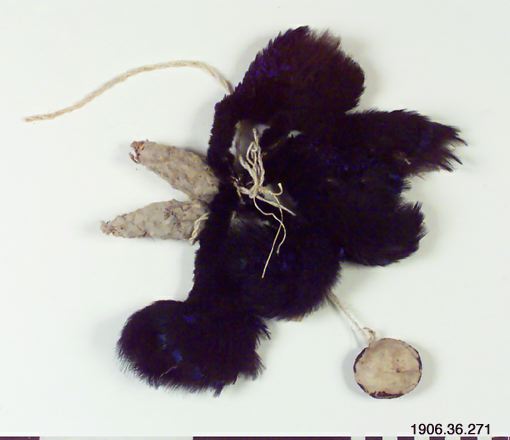
This is a three-dimensional object: a dark fur costume or garment piece, densely black and fluffy throughout, arranged against a neutral background. The main body consists of a large rounded, bulbous form covered entirely in thick fur. Extending from the body are multiple appendages: two tapered, lighter-colored (tan or cream) leg-like forms projecting outward, and a thin rope or cord with a rounded disc or button at its end hanging below. A sparse arrangement of pale straw or fiber protrudes from the central mass. The object appears handmade, constructed from real animal fur, and might be a preserved costume piece, a prop, or a decorative artifact from a performance tradition. The craftsmanship suggests folk or ceremonial use rather than commercial manufacture.
The dancing
This is not a depiction of human dancers. If this object functioned in dance, it would have been worn or manipulated by a performer whose body is not visible here. The form itself—bulbous, furred, with protruding limbs—suggests a costume designed to obscure or transform the human figure into an animal, spirit, or abstract character. The static, flattened presentation makes it impossible to assess how a wearer would have moved or held themselves within or alongside it.
The dance depicted
The catalogue title 'danshänge dance attribute' (possibly 'dansänge' or similar, in Swedish or another Scandinavian language) suggests this is a prop or costume element from a folk or regional dance tradition. The furred construction and the presence of what may be legs or appendages point toward an animal-form or masked dance—common in European folk traditions, especially winter celebrations, carnival, or ceremonial contexts. Without secure identification of the tradition or language, the specific dance cannot be named with confidence. The object's age and origin remain unknown.
How it was made
This is a three-dimensional textile object: a constructed garment or prop made from real fur (likely animal pelt), rope, and organic fiber. It appears to have been made by hand through stitching or wrapping, and was preserved as a museum or collection specimen. The craftsmanship suggests folk manufacture, possibly 19th or early 20th century. The flattening and photographing of the object for archival purposes has transformed it into a two-dimensional image; the photograph is the medium through which we now encounter it.
About this work
This is a preserved costume piece or dance prop, catalogued as a 'dance attribute' of unknown date and maker, from an unidentified folk or regional dance tradition. The furred, bulbous form with protruding limbs suggests a character costume—possibly an animal, demon, or spirit figure—worn or used in a masked or disguised performance. The object survives only as a photographic record in a digital archive. Its true cultural origin, performance context, and use remain opaque without additional documentation.
How to look at it
Observe the density and type of fur, the construction seams, and the intentionality of the appendages. The protruding straw or fiber and the dangling rope with disc suggest functional elements—perhaps sensory organs, communication devices, or deliberate visual noise meant to startle or amuse. The costume was designed to be seen from multiple angles and to move; the photograph captures it in stillness, making it harder to imagine its kinetic use. Consider what a human body inside this form would experience: restricted vision, tactile contact with fur, weight, and the transformation of familiar limbs into animal or monstrous parts.
The period
The style of the photograph and the preservation method suggest early-to-mid 20th-century museum practice, though the costume itself may be older. If this is a Scandinavian folk dance artifact—a reasonable reading of 'danshänge'—it belongs to a tradition of masked, animal-form, and grotesque character costumes used in winter festivals, carnival, and ritual celebrations across Northern Europe. Such traditions include Krampus figures, Wild Man characters, and animal-form spirits in various regional forms.
Where it lives
The object is held in a European archive accessible through Europeana, a digital aggregator of museum collections. The catalogue record is minimal: no maker, date, accession number, or institutional home is recorded. It survives only as a photograph, indicating either that the original object is in storage and difficult to access, or that it no longer exists and the photograph is the sole record.
Dance in this work
Questions about this work
Is this a real animal, or a costume?
It is a constructed costume or prop made from animal fur, rope, and fiber. A human wearer would have occupied or manipulated it during performance. The fur is real and stitched or wrapped into shape, but the form and appendages are artificial constructions.
What dance is this from?
The catalogue title suggests a Scandinavian folk dance tradition, but no specific dance or region is named. Without additional archival documentation or expert identification, the precise tradition cannot be determined.
How old is it?
The age is unknown. The photograph and preservation style suggest early-to-mid 20th-century museum cataloguing, but the costume itself could be older or contemporary with the photograph.
Why is it presented flat in a photograph rather than displayed as a three-dimensional object?
Museum practice often flattens and photographs textile and costume objects for preservation, access, and archival economy. A flat photograph allows the entire object to be visible at once and is easier to store and digitize than maintaining the object itself.
More dance artwork