49 works in this view — arrow keys or swipe to move between them.
Dance in Art
dansprydnad dance ornament
Unknown artist
- Rights:
- Not recorded. Do not assume this image is free to reuse — check the source record.
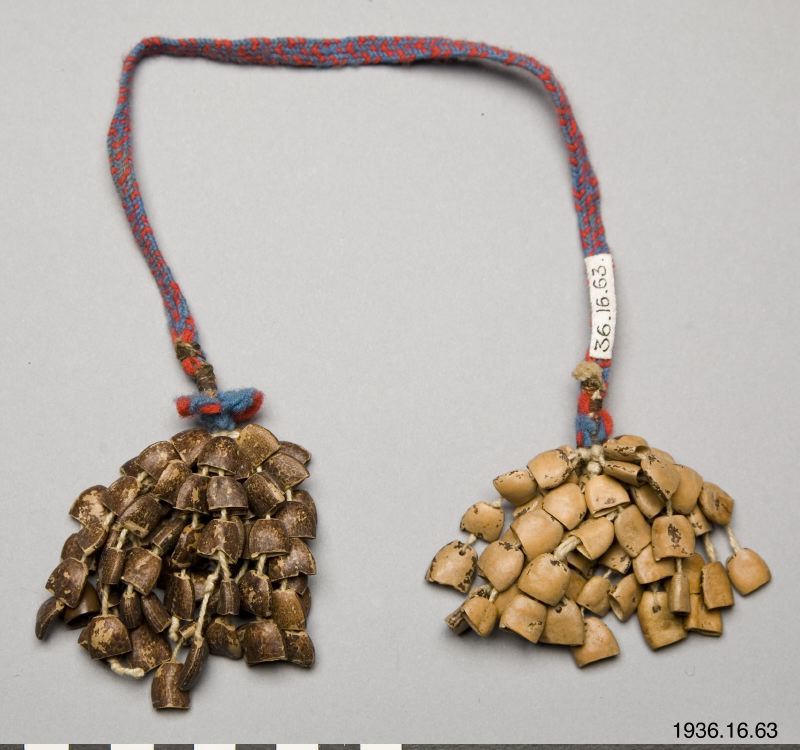
Dance ornaments like this reveal how sound, movement, and visual spectacle were integrated into folk performance traditions. The wear and variation between the two pendants document the actual use history of the object in practice, making it evidence of how dancers themselves understood the relationship between costume, sound, and motion.
What you are looking at
This is a pair of ornamental pendants or charms suspended from a single cord of red and blue woven or braided textile. Each pendant consists of a dense cluster of small cylindrical or bell-shaped metal elements—likely brass or gilded metal—arranged in a cascading or tassel-like formation. The left pendant appears darker and more heavily oxidized, with a more compressed cluster, while the right pendant shows a lighter, more golden tone and slightly more open arrangement of the metal elements. Both are attached to the cord via small metal loops or caps at the top. A paper label bearing a reference number is affixed to the cord. The objects are photographed against a neutral background, displayed flat to show their full form.
The dancing
There are no human figures or dancers depicted in this work. This is a decorative object or costume accessory, not a representation of dance or dancers.
The dance depicted
While this appears to be a dance ornament or costume element—the title *dansprydnad* translates from Swedish as 'dance ornament'—the object itself is not a depiction of dance but rather an artifact worn as part of dance costume or regalia. It may have been worn as a pendant, belt ornament, or attached to clothing during folk dance or ritual performance, but the image shows only the object, not its use or the dancers who wore it.
How it was made
This is a three-dimensional object photograph showing decorative metal pendants attached to braided textile. The pendants appear to be constructed from small cast or stamped brass or gilt-metal cylindrical bells or tubes soldered or wired together in clusters. The textile cord is handwoven or braided in red and blue fibers. The photograph is printed on paper with museum documentation practices, showing the object against a neutral background for archival purposes.
About this work
This Swedish dance ornament is a pair of decorative metal bell-clusters suspended from a hand-woven textile cord. While the object itself is undated and unattributed, its construction and style suggest 19th or early 20th-century Scandinavian folk costume traditions. The ornament likely served as an auditory and visual enhancement to folk dance performance, its jingling bells adding percussion and movement to the dancer's motion. The contrast between the darkened and brightened pendants suggests either different ages or different metallurgical treatments, or possibly the effect of wear and patina over time. This piece represents the material culture of dance rather than its depiction—an object whose purpose was to enhance the dancer's art, not to represent it.
How to look at it
Observe the difference in patina and color between the two pendants: the left shows heavy oxidation and wear, while the right remains brighter. This variation documents actual use. Consider how the cascading bells would have moved and sounded with the dancer's body—each small tube or bell would swing and strike its neighbors with each step or turn, creating rhythmic accompaniment. The weight and density of the cluster suggest it was designed to make significant sound and movement visible at a distance.
The period
This object almost certainly originates from Scandinavian folk dance traditions of the 19th or early 20th century, a period when regional folk practices were being documented and celebrated as expressions of national identity. The construction technique—casting and assembling small metal bells—was widely used across Northern Europe for dance costume decoration. Such ornaments were worn in connection with festival dances, wedding celebrations, and seasonal performances throughout Scandinavia and the Baltic regions.
Where it lives
The object is held by Europeana, the European digital library, which aggregates cultural heritage from institutions across Europe. The reference label (1936.16.63) suggests it entered a Scandinavian museum collection in the 1930s, a period of active folk culture documentation. The specific museum and acquisition history are not recorded in the available metadata.
Dance in this work
Questions about this work
What would these ornaments have sounded like?
The cascading metal bells or tubes would have produced a bright, jingling percussion sound with each movement of the dancer. In performance, dozens or hundreds of such bells might be worn across the costume, creating a layered, continuous shimmer of sound that emphasized the rhythm and energy of the dance.
Where in Scandinavia did this come from?
The catalogue does not specify the region or country of origin. The *dansprydnad* designation and the construction style suggest Swedish, Norwegian, or Finnish origin, but without more detailed provenance, the exact region cannot be determined.
Why are the two pendants different colors?
The darker left pendant shows significant oxidation and patina, likely from decades of handling and use. The brighter right pendant may be either newer, made from different metal, or restored at some point. This difference is real evidence of the object's wear history.
How would a dancer have worn this?
Dance ornaments of this type were typically sewn or tied to belts, waistbands, or the front of garments worn during folk celebrations and festival dances. Some were worn as pendants on the chest or suspended from the waist, so movement would cause them to swing and jingle with the dancer's body.
More dance artwork