49 works in this view — arrow keys or swipe to move between them.
Dance in Art
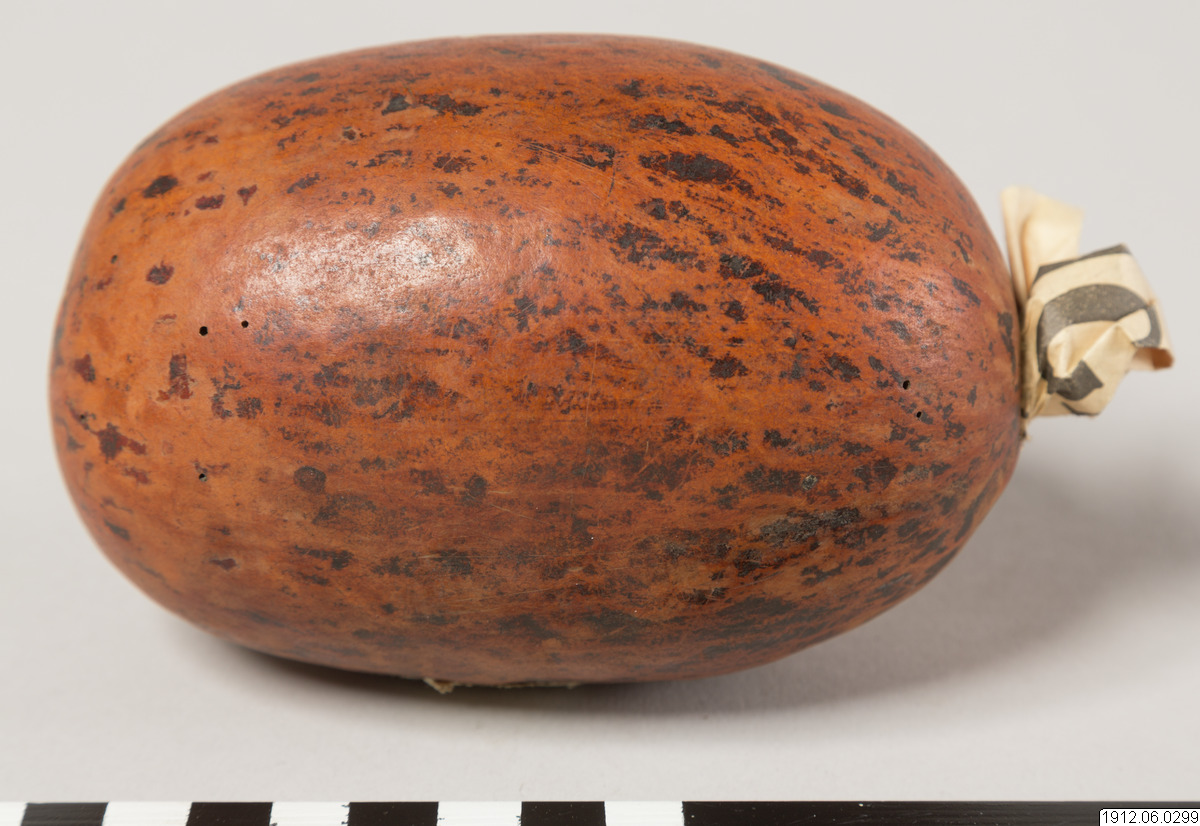
dansskallra dance rattle dance-rattle
Unknown artist
- Rights:
- Not recorded. Do not assume this image is free to reuse — check the source record.
Rattles like this are the archaeology of participatory dance—they prove that sound, movement, and the dancer's own hand were inseparable in northern European folk traditions. For historians and dancers, physical objects reveal practices that no painting or score can fully capture: the weight in the hand, the timing between shake and step, the sensory feedback that shaped how bodies moved.
What you are looking at
A single spherical object dominates the image: a large, smooth rattle of reddish-brown or terracotta colour, heavily spotted and mottled with darker brown or black marks across its entire surface. The sphere sits against a plain light grey background. A single cream or ivory-coloured cord or tassel emerges from one side of the sphere, looped and knotted, serving as both a handle and visual accent. The object has been photographed from a three-quarter angle that emphasizes its rounded form and the distribution of the decorative markings. A black and white metric scale bar sits at the bottom of the frame, establishing scale and confirming this is archival documentation rather than artistic presentation.
The dancing
No human figures are present. The rattle itself is the subject, an inanimate object designed to be held and shaken. The placement and form suggest it was meant to be gripped by the cord handle during movement or ritual performance.
The dance depicted
This is a dance rattle, a percussion instrument used to accompany or punctuate movement. The Scandinavian name (dansskallra in Swedish) indicates it belongs to folk or ceremonial dance traditions of northern Europe, likely used to mark rhythm or create sonic texture during ritual or celebratory dances. Without additional context on the specific tradition or region, the exact dance style cannot be determined, but the object itself suggests participatory or processional movement where the dancer controlled both body and percussion simultaneously. Such rattles appear in many European folk traditions where dancers or celebrants shake instruments while moving.
How it was made
This is a three-dimensional ceramic or wooden object—a functional artifact rather than a representation of dance. It has been photographed against a neutral background as archival documentation, likely by a museum or collection holding it. The photograph is a straightforward record image, common in ethnographic or historical collections, designed to preserve and make accessible the object's form, surface texture, and condition for research and reference rather than aesthetic appreciation.
About this work
This is a dance rattle from Scandinavian folk or ceremonial tradition—a functional percussion object used by dancers to accompany movement with sound and rhythm. The mottled surface and aged appearance suggest considerable use and age. As a material artifact of dance practice, it represents the embodied, sonic, and participatory dimension of folk dance: the lived experience of rhythm-making during performance. It belongs in a gallery of dance in art not as a depiction of dance but as evidence of how dance was made, felt, and heard in communities where the boundary between dancer and instrument dissolved.
How to look at it
Observe the surface wear and discoloration, which tell of repeated use and age—this is a working object, not a decorative one. The cord handle is functional and suggests the rattle was held firmly, shaken with intention. The spherical form is efficient for sound projection and easy manipulation. The mottling may result from natural aging, handling, or deliberate surface treatment; either way, it shows this object had a life in practice, not a museum shelf.
The period
Dance rattles are ancient tools found across many cultures; this Scandinavian example documents a vernacular tradition that persisted into the modern era. The object's condition and the archival documentation style suggest it was collected and preserved in the late 19th or 20th century, when ethnographic collecting and museum practice began to systematically document folk material culture. By that period, many such traditions were being recorded as they were understood to be disappearing under industrialization and cultural homogenization.
Where it lives
This object is held in a Europeana-accessible collection. The metadata is sparse, reflecting common gaps in the documentation of folk material from non-elite traditions. It has been digitized and catalogued as part of a broader effort to make ethnographic collections accessible online.
Dance in this work
Questions about this work
How was a dance rattle used?
The dancer or celebrant held the rattle by its cord handle and shook it while moving, creating rhythm and sound in synchrony with steps or gestures. In participatory traditions, the dancer was also the percussionist, controlling both the visual and sonic elements of performance simultaneously. This bound the sound to the body's movement in real time.
What can we learn from a physical object that a painting cannot tell us?
A rattle preserves evidence of wear, weight, and the ergonomics of use. It shows us how the hand gripped it, how often it was shaken (wear patterns), and the sensory experience—the vibration, the sound, the resistance—that shaped how dancers moved. These details are invisible in two-dimensional art.
Why is this in a gallery of dance?
Because dance is not only visible movement; it is also sound, rhythm, and the material culture that sustained it. This rattle is evidence of a dance tradition and a tool that shaped how bodies moved. It belongs alongside images and descriptions as proof of how people made dance with their whole selves.
More dance artwork