49 works in this view — arrow keys or swipe to move between them.
Dance in Art
dansstav dance attribute
Unknown artist
- Rights:
- Not recorded. Do not assume this image is free to reuse — check the source record.
Dance staves appear in many European folk traditions but are rarely preserved or documented. These objects are direct evidence of how dancers engaged with portable props and how folk dance traditions maintained visual and tactile vocabulary across centuries. Their presence in a museum collection indicates recognition that dance does not live only in bodies or notation, but in the made world.
What you are looking at
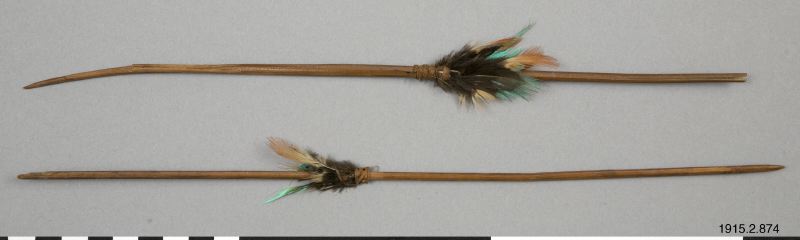
Two wooden rods or staves, each approximately 60 centimeters long, are laid horizontally against a neutral background with a metric scale at the bottom. Both rods are wrapped or bound with dark cordage at one end, creating a bulbous grip section. From each binding emerge bunches of feathers—the upper rod displays green, brown, and cream-colored plumage fanned outward; the lower rod has smaller, more subdued brown and cream feathers. The rods are bare wood, worn to a warm tan-brown by handling. No figures or dancers appear; these are implements, not a scene.
The dancing
No dancers are depicted. These are dance attributes—portable equipment or props—shown in a documentary style characteristic of museum cataloguing photography. The feathered ends suggest they were handled repeatedly, gripped at the bound sections during use.
The dance depicted
The object is titled a *dansstav* (dance staff or dance stick) and belongs to a category of dance implements used across European folk traditions, particularly in Scandinavian, Germanic, and Low Countries contexts. The feathered ends suggest these may have been used in processional or celebratory dances where the sticks themselves became visual markers or carried symbolic meaning. Without geographic or cultural attribution in the record, the precise tradition cannot be identified, but the form is consistent with folk-regional and carnival or festive contexts across northern Europe.
How it was made
This is a three-dimensional object photographed in raking light against a neutral background, a standard archival documentation method. The photograph is recent and clear enough to show wear, tool marks, binding technique, and feather species variation. The scale bar indicates these are museum collection documentation photographs, made for research and comparison rather than artistic display.
About this work
Two wooden dance staves with bound grips and feathered terminals, likely from a northern European folk tradition. They are preserved as artifacts of festive or processional dance practice and are shown here in museum documentation. The feathered ends and ergonomic binding suggest these were held and moved dynamically during performance, though without provenance or cultural attribution we cannot specify which tradition or period they represent. The collection of such implements—often miscellaneous or fragmentary—tells us about the material culture of dance practices that survive largely through oral tradition and occasional archaeological or ethnographic preservation.
How to look at it
Study the binding technique—the wrap is tight and deliberate, suggesting repeated gripping by human hands. Note the feather condition: the upper stick's plumage is fuller and more colorful, the lower's more worn. This difference may indicate different periods of use, different traditions, or different dancers. The raking light reveals surface gouges and wood grain variation that tell the history of handling. The scale bar is essential: these are portable objects, designed to be held and moved, not static decoration.
The period
The Europeana record provides no date or cultural origin. The photograph itself is modern (likely 20th or 21st century), but the staves themselves could span several centuries. Wooden dance implements were particularly valued in northern European carnival and seasonal celebration traditions—Shrovetide games, maypole festivals, and processions—where they marked social rank, regional identity, or ritual function. Folk dance revival movements of the 19th and 20th centuries led museums across Europe to collect and preserve such items, often without detailed documentation of their original use contexts.
Where it lives
The work is held in an unspecified Europeana member collection. Europeana is a distributed digital archive drawing from museums, libraries, and archives across Europe; the source institution for this object is not named in the available record. The photograph is clearly a modern archival document, but no accession number, date of acquisition, or attribution is provided.
Dance in this work
Questions about this work
Are these meant to be held by dancers?
Yes. The binding at one end is ergonomically designed for gripping, and the feathered ends suggest they were waved, struck together, or carried as part of the dance movement. The wear marks on the wood are consistent with repeated handling. They are functional props, not decoration.
What culture or tradition do these belong to?
The record does not specify. The form is consistent with northern European folk traditions—particularly Scandinavian, Germanic, or Low Countries practices—but without documentation of where they were collected or who danced with them, that remains provisional. Museums often hold such items without complete provenance records.
Why are the feathers different on each stick?
The upper stick has more vibrant, fuller plumage; the lower is smaller and more subdued. This could reflect different ages of the sticks, different dancers' preferences, different occasions, or simply the availability of feathers when they were made or repaired. Museum objects often show these kinds of variation.
How old are these?
Unknown. The record offers no date. The wood type, binding style, feather condition, and wear pattern might be datable by a conservator or ethnographer, but that work has not been published. They could be 18th-century, 19th-century, or 20th-century folk items.
More dance artwork