49 works in this view — arrow keys or swipe to move between them.
Dance in Art
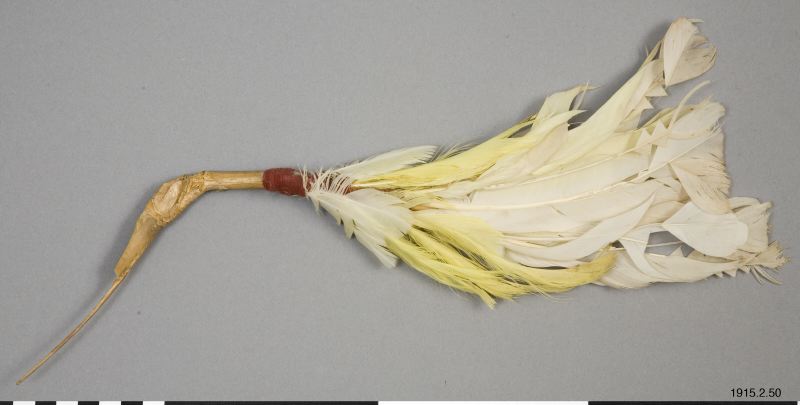
dansvippa dance attribute
Unknown artist
- Rights:
- Not recorded. Do not assume this image is free to reuse — check the source record.
This object matters as evidence of cataloguing error or collection confusion rather than as dance documentation. It raises questions about how non-dance objects enter dance collections and how digital aggregation platforms like Europeana can perpetuate or obscure such misattributions.
What you are looking at
This is a dried botanical specimen mounted on grey paper, not a dance image. The object consists of a single stem with a distinctive curved or hooked lower section, rendered in tan and brown tones, with an upper portion displaying pale yellow and cream-coloured dried petals or flower parts arranged in a loose spray. The specimen is identified by a catalogue number (1915.2.50) printed in the lower right. The botanical material appears brittle and flattened after drying and pressing, typical of herbarium specimens or teaching collections.
The dance depicted
This object does not depict dance. It is a preserved plant specimen, possibly a flower or seed head used for botanical study or display.
How it was made
This is a dried plant specimen mounted on paper, likely prepared as part of a herbarium collection or museum teaching resource. The preservation method—flattening and mounting on archival paper—was standard practice for botanical collections from the 19th century onwards and allowed specimens to be catalogued, stored, and studied without decay.
About this work
The catalogue record identifies this as a 'dansvippa dance attribute' and assigns it to a 'General Dance' category, but the physical object is a botanical specimen—a dried flower or plant part with no discernible connection to dance. The misidentification may reflect a cataloguing error, a misunderstanding of the object's function, or confusion between collections. The Europeana record offers no additional context to clarify the intended classification.
How to look at it
Approach this as a curatorial puzzle rather than a dance work. The specimen itself is visually clear—the hook-like stem and the pale dried petals are easily distinguishable—but the labelling as a 'dance attribute' contradicts what the eye sees. The mismatch between object and label is the real content here.
The period
The catalogue number and mounting style suggest early-to-mid 20th-century museum practice, when dried botanical specimens were actively collected and preserved. The practice of mounting specimens on paper followed protocols established in the 18th and 19th centuries.
Where it lives
The work is held in the Europeana digital collection. The catalogue record lists only a number (1915.2.50) and provides no information about the original holding institution, donor, or accession context.
Questions about this work
Is this actually a dance object?
No. The physical object is a dried botanical specimen—a preserved flower or plant part. The catalogue record's identification as a 'dansvippa dance attribute' does not match the visible evidence and appears to be an error in cataloguing or database transfer.
What is 'dansvippa'?
The term is not clearly explained in the catalogue record. 'Vippa' can refer to a type of fan in Scandinavian contexts, but the plant specimen shown here exhibits no characteristics of a constructed object, fan, or costume element.
How did a plant end up in a dance collection?
This is unclear. The specimen may have been mislabelled during digitisation, transferred between collections without proper documentation, or catalogued on the basis of a misidentified object or confused metadata.
More dance artwork