49 works in this view — arrow keys or swipe to move between them.
Dance in Art
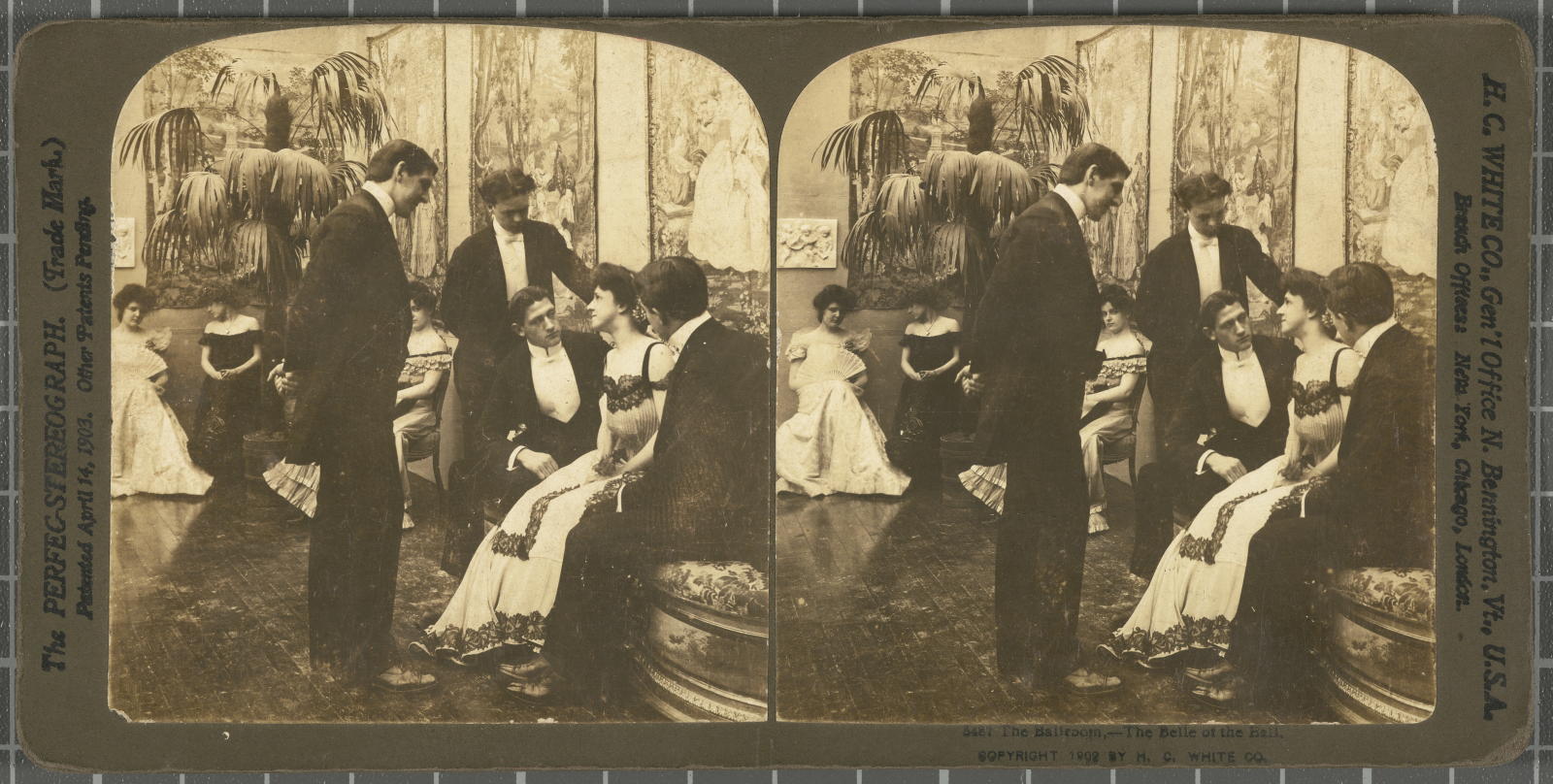
The Ballroom-The Belle of the Ball Justification of the titl
Unknown artist
- Rights:
- Not recorded. Do not assume this image is free to reuse — check the source record.
This work documents how ballroom culture functioned as a social technology for courtship and class display in the Edwardian era, revealing the ways that dance and formal dress worked together to construct and communicate social identity. For historians of dance and social history, it provides concrete evidence of the physical spaces, costume conventions, and gender dynamics that structured formal dance in this period. As a mass-produced stereoscope card, it also demonstrates how photographic technology made ballroom culture visually available to a broad middle-class audience, shaping their understanding of elegance and social aspiration.
What you are looking at
This stereoscopic photograph presents an elegant interior ballroom scene, one of a paired set meant to create a three-dimensional effect when viewed through a stereoscope. The setting is a grand room with tall curtained windows or wall panels in the background, decorated with potted plants including a prominent weeping willow-like specimen. Several couples and onlookers populate the space, dressed in formal Edwardian attire: the women in corseted gowns with high necklines and leg-of-mutton sleeves, adorned with feathered hats and elaborate jewelry; the men in dark tailcoats and waistcoats. The composition captures a moment of social courtship and formal dance—one couple is positioned prominently in the foreground, the woman seated or paused in a low-backed dress with decorative embroidery, while a man in formal dress stands attentively beside her. Other figures are scattered throughout the composition in varied poses of engagement: some standing in conversation, others watching. The lighting is soft and diffused, characteristic of studio or flash photography of the period. The overall tone is one of refined leisure and romantic possibility.
The dancing
The dancers and figures are positioned in the closed social spaces of turn-of-century ballroom etiquette rather than in active dance frame. The most prominent couple shows the woman in a relaxed, seated posture while the man stands in courteous attendance—a pose of social interaction rather than partnered movement. Other figures stand with the upright carriage and restrained arm positioning typical of formal Edwardian dress, with hands held at waist or engaged in gentle gesture. The composition emphasizes the social and courtship dimensions of ballroom culture rather than the physical technique of any specific dance. Bodies are arranged to show off the silhouettes of fashionable dress—the cinched waists, the volume of skirts, the proper posture expected in refined society.
The dance depicted
This is a documentation of ballroom society rather than a record of specific dance technique. The image captures the Belle of the Ball—a figure of social prominence and romantic desirability—in the context of an elegant formal dance or reception. The genre is ballroom social dance of the Edwardian era, most likely encompassing waltzes, quadrilles, or formal promenade dances that structured upper-class courtship and entertainment. The emphasis throughout is on social positioning, costume, and the ritualized interactions between genders in formal dress, rather than on footwork or partnered technique. What the photograph documents is the milieu and costume conventions of ballroom culture at a specific historical moment.
How it was made
This is a stereoscopic photograph, printed as a stereoscope card—a twin image pair positioned side by side, designed to be viewed through a hand-held optical device (stereoscope) that merged the two images to create the illusion of three-dimensional depth. Stereoscope cards were mass-produced and distributed as popular entertainment and educational material for the Victorian and Edwardian middle classes. The printing is albumen or gelatin print on card stock, a durable format suitable for repeated handling. The technique allowed photographers and publishers to circulate domestic and social scenes widely, making ballroom culture and fashionable society visually accessible to viewers who might not attend such events in person. The presence of the Underwood & Underwood publisher's mark identifies this as part of a large commercial series documenting contemporary life and leisure.
About this work
This stereoscopic photograph documents an Edwardian ballroom reception, capturing the formal social dynamics and fashion conventions of upper-class dance culture at the turn of the twentieth century. The image is significant not as a record of dance technique but as evidence of how ballroom culture functioned as a site of courtship, social display, and refined leisure for the era's elite. The work belongs in a gallery of dance in art because it shows the ballroom as a social institution, a space where dance and courtship were inseparable, and where the visual presentation of the body in fashionable dress was central to the meaning of the event.
The photograph's circulation as a stereoscope card means it was consumed by thousands of viewers in their homes, offering an intimate, three-dimensional window into a world of formal elegance and romantic possibility. For viewers without access to such society, the stereoscope made the ballroom visible and desirable. The image reveals the deep entanglement of dance with fashion, gender performance, and social hierarchy in this period.
How to look at it
The viewer should attend to the carefully composed spatial arrangement of the figures, which creates a sense of depth and social hierarchy even in a flat photograph. Notice how the most prominent couple—the Belle and her admirer—occupy the foreground and center, drawing the eye, while other figures are positioned to frame and contextualize them. The stereoscopic format is essential to understanding the work's original visual impact: the paired images are meant to merge in the stereoscope, creating a vivid sense of the room's spatial volume and the positioning of bodies within it. The photograph freezes a moment of social pause—not active dancing, but the social interaction and display that surrounded and framed the dance. The viewer should also note the meticulous attention to costume and dress as carriers of social meaning, which suggests that the photograph is as much about visual display and fashion as it is about documenting actual movement.
The artist
This work is attributed to Underwood & Underwood, one of the largest stereoscope card publishing firms of the late 19th and early 20th centuries. The company employed staff photographers and commissioned photographers to document contemporary scenes of social life, leisure, travel, and current events, producing images for mass distribution. Underwood & Underwood's stereoscope cards were known for their attention to narrative detail, posed staging, and their appeal to middle-class viewers seeking visual access to worlds of luxury and refinement. The company's business model depended on the production of compelling, viewable scenes that brought distant or exclusive social worlds into domestic space.
The period
The photograph dates to the Edwardian era (roughly 1901–1910), a period of pronounced formality in ballroom dance and etiquette. This was the height of the waltz, the quadrille, and the cotillion in upper-class social life, and also a period of intense attention to fashion, costume, and the visual display of wealth and status. Stereoscope cards were at their peak of popularity during this era, before cinema and mass-circulation magazines displaced them as the primary technology for visual entertainment in the home. The image reflects the conventions of studio or semi-staged photography that attempted to capture 'authentic' social scenes while maintaining aesthetic composition and narrative clarity. In art, the period saw a flourishing of genre scenes depicting contemporary leisure and social life, with photography increasingly competing with painting and illustration as a means of documenting society.
Where it lives
This work is held in Europeana, the European digital library, and is identified as a stereoscope card published by Underwood & Underwood, a major American stereoscope publisher based in New York. The photograph is part of a large commercial archive documenting contemporary life and leisure in the early 20th century, produced for mass consumption as a form of home entertainment.
Dance in this work
Questions about this work
What is a stereoscope card and how was it used?
A stereoscope card is a photographic print showing two nearly identical images side by side, designed to be viewed through a handheld optical device called a stereoscope. When viewed through the stereoscope, the two images merge and create the illusion of three-dimensional depth. These cards were extremely popular in Victorian and Edwardian homes as a form of entertainment and education, allowing viewers to experience distant places, social events, and leisure activities in vivid three-dimensional detail.
What is a 'Belle of the Ball' and what did the role represent?
The Belle of the Ball was a social distinction given to the most beautiful, elegant, or socially prominent young woman at a formal dance or reception. The title represented not just beauty but also refinement, wealth, and social standing. Being designated the Belle was a mark of social status and romantic desirability, and the Belle occupied a central position in the social rituals of courtship and display that structured ballroom culture.
What dances would have been performed at an Edwardian ballroom reception like this?
At the turn of the 20th century, formal ballroom receptions featured waltzes, quadrilles, cotillions, and formal promenade dances. The waltz was the dominant couple dance, characterized by a three-beat timing and a rotating motion around the ballroom floor. Quadrilles were group dances performed by sets of couples in squares or longways formations. These dances were governed by strict rules of etiquette and proper frame, and they were central to upper-class courtship and social life.
Why is this photograph posed rather than candid?
The posed, staged quality of this photograph is typical of stereoscope cards produced for mass consumption. Photographers working for publishers like Underwood & Underwood would carefully compose scenes to be visually readable and narratively coherent when viewed through the stereoscope. A candid photograph would lack the clear spatial composition and narrative focus that made stereoscope viewing appealing. The staging was intentional—it made the social scene legible and maximized the three-dimensional effect.
More dance artwork