49 works in this view — arrow keys or swipe to move between them.
Dance in Art
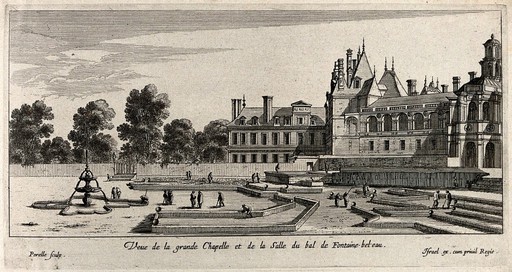
The Grand Chapelle and the ballroom at Fontainebleu Etching
Unknown artist
- Rights:
- Not recorded. Do not assume this image is free to reuse — check the source record.
For historians of court dance, this etching is valuable as evidence of the physical setting—scale, formality, architectural framing—in which Renaissance and early Baroque court dances unfolded. It shows the integration of dance and courtly gathering within a structure designed to display royal power, and documents how dance was understood as inseparable from architectural grandeur and court ceremony.
What you are looking at
This etching depicts the grand exterior of the Château de Fontainebleau, with its distinctive Renaissance architecture—turrets, peaked roofs, and ornamental chimneys—dominating the right side of the composition. In the foreground, a formal courtyard or garden space opens before the building, where numerous figures in period dress move across a paved ground. A central circular feature, possibly a fountain or ornamental pool, anchors the middle distance. The figures are distributed in small groups and pairs across the space, suggesting courtly promenade and social gathering rather than coordinated dance, though some clustered figures near the building's entrance may indicate formal movement. The sky is rendered with atmospheric clouds, and the entire scene is framed by trees on the left, creating a sense of the building's setting within its landscape. The etching's technique allows fine architectural detail while the figures remain somewhat schematic, suited to a documentation of a celebrated royal residence.
The dancing
The figures are rendered in small scale, limiting detail of individual posture and hold. Most appear to be walking, standing, or arranged in conversation clusters rather than executing recognizable dance steps. Some pairs visible near the building's entrance might suggest formal courtly coupling, but no clear ballroom positioning—closed holds, frames, or weight transfer—is evident. The dress appears to be court costume of the 16th or 17th century, with full skirts and structured garments visible on the women and tailored coats on the men. The scale of the etching and its documentary purpose mean that bodily nuance is sacrificed to architectural prominence.
The dance depicted
This work is titled as depicting 'the Grand Chapelle and the ballroom at Fontainebleau,' but the image itself shows the exterior courtyard and gardens, not an interior ballroom scene. What dancing may occur is not clearly depicted; instead, the work documents courtly movement and gathering in a formal architectural setting. If dancing took place in the ballroom named in the title, it is not visible here. The etching seems primarily concerned with celebrating the royal residence's design and the fashionable court activity it hosted, rather than documenting a specific dance form.
How it was made
This is an etching, a printmaking technique suited to fine detail and capable of wide circulation as a reproducible image. The artist has used the medium to render precise architectural features—the building's façade, windows, chimneys—while treating the human figures more summarily. The technique allows both the grandeur of the setting and the sense of courtly life to coexist on the same plate. As a print, this work was likely produced in multiple impressions and circulated among courtiers, collectors, and those interested in celebrated royal architecture, making it a document of court taste and magnificence rather than an intimate study of movement.
About this work
This 16th or 17th-century etching documents the Château de Fontainebleau's exterior and courtyard, showing the setting in which courtly dancing and social life took place. Though titled to reference both the chapel and ballroom, the image itself depicts the formal gardens and architectural splendor of the château, with numerous courtiers in period dress moving about the space. It belongs in a dance gallery not as a depiction of a specific dance, but as evidence of the architectural and social context in which Renaissance and Baroque court dances were performed, and as a record of how dancing was understood as part of courtly magnificence and public splendor. The work celebrates the space itself as the container of court life, of which dancing was a celebrated component.
How to look at it
Observe the scale and formality of the courtyard, which frames the movement of the figures within it. The artist chose a prospect view that emphasizes the building's architecture while showing the human activity scattered across the foreground—a composition that subordinates individual gesture to the grandeur of the setting. Notice how the figures' small scale and formal spacing suggest the decorous, regulated movement expected of courtiers rather than the exuberant physicality of a dance in progress. The etching documents a moment of courtly gathering and promenade, the prelude or context for dancing rather than its execution.
The artist
The artist is not recorded in the catalogue. The etching is attributed to the print tradition associated with documenting celebrated French royal residences in the 16th and 17th centuries. Such topographical and architectural etchings were often produced by printmakers working in Paris or Fontainebleau itself, circulating images of royal magnificence to courtiers and collectors across Europe.
The period
Fontainebleau was a major center of court culture under the Valois and early Bourbon dynasties, hosting elaborate court festivals, ballets, and dances as expressions of royal authority. The château's architecture, updated in Renaissance style under Francis I and his successors, provided the setting for the increasingly formalized court dances of the 16th and 17th centuries. Prints documenting the château's architecture and courtly activity were part of a larger project of celebrating royal residences and the cultured life within them. Dancing at court was understood not as a separate entertainment but as an integral part of the visual and ceremonial display of power.
Where it lives
The work is recorded in Europeana, suggesting it is held in a European collection, likely a museum or print cabinet specializing in old master prints and topographical documentation. As a print, it exists in multiple impressions and is a work of documentary and courtly interest rather than a unique object.
Questions about this work
Does this image actually show dancing?
No, it does not show dancing itself. The etching depicts the exterior courtyard and gardens of Fontainebleau, with courtiers in small groups or pairs moving about the space. The title references a ballroom, but that interior space is not visible. The work documents the architectural and social setting in which court dances took place, rather than the dances themselves.
What period is this from?
The style of the etching, the architecture of the château (which was renewed under Renaissance influence), and the dress of the figures all suggest the 16th or 17th century, though the exact date is not recorded. Fontainebleau was a major court center from the early 16th century onward.
Why is this in a dance archive if there's no dancing?
It documents the physical and social context of court dance—the magnificent architecture, the formality and spacing of courtly movement, and the integration of dance into court life and ceremonial display. For historians, the setting and the understanding of dance as part of courtly magnificence are as important as the steps themselves.
More dance artwork