49 works in this view — arrow keys or swipe to move between them.
Dance in Art
Waltz Symphony Orchestra 401 item ITWEF
Unknown artist
- Rights:
- Not recorded. Do not assume this image is free to reuse — check the source record.
The image is historically significant as formal documentation of an orchestra, offering insight into ensemble size, mixed-instrument composition, and concert-hall protocols in the early 20th century. For dance historians specifically, it provides context for the relationship between orchestral music and dance, showing the professional ensemble infrastructure that supported ballroom and theatrical dance repertoire. However, it does not itself depict dance and should not be catalogued as dance imagery.
What you are looking at
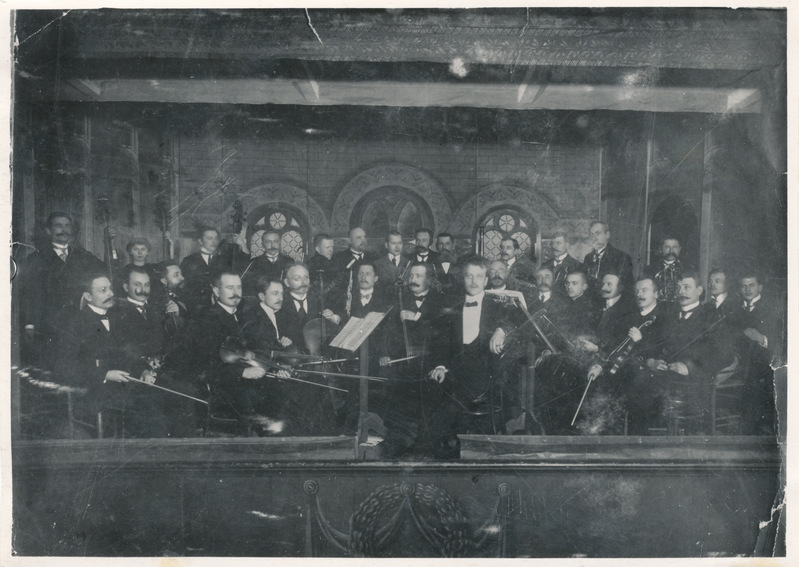
A formal orchestral performance captured in black and white photography, likely from the early 20th century. The ensemble occupies a concert platform with classical architectural detail visible in the background—arched alcoves and formal moldings suggest a grand concert hall or theatre. The photograph is taken from an elevated vantage point looking across the stage. Approximately forty musicians in formal dress (dark suits and white shirts) are arranged in a traditional orchestra layout, with string players prominent in the foreground and wind instruments visible deeper in the frame. The conductor, positioned centrally and slightly forward, appears to lead the ensemble. The lighting is even and documentary in character, characteristic of early flash photography.
The dancing
The musicians are seated and standing in conventional orchestral positions, holding instruments at playing height. The conductor's posture suggests active direction, though the freeze-frame nature of photography prevents clear reading of specific conducting gestures. String players occupy the front sections with instruments held vertically or at the shoulder; wind players are positioned further back. The overall arrangement is hierarchical and formal, with clear sightlines from conductor to all sections. There is no dancing or choreographed movement apparent.
The dance depicted
This is not a dance image. It documents an orchestral ensemble, not dancers or choreography. The title 'Waltz Symphony Orchestra' refers to the music being performed (waltzes are a compositional genre), not to a choreographed dance event. The image shows musicians performing music, which is distinct from dance documentation.
How it was made
This is a black and white photograph, likely taken with early 20th-century flash or studio lighting given the even, shadowless illumination and the slight graininess characteristic of the period. The technical execution suggests professional documentation rather than candid photography. The printing and composition indicate this was a formally recorded image, possibly commissioned to document the ensemble. The photographic medium allowed wide depth of field and wide angle capture, permitting the entire orchestra to be visible in a single frame.
About this work
This photograph documents a symphony orchestra in formal performance, likely during the early 20th century. While the title 'Waltz Symphony Orchestra' indicates the ensemble may have specialized in or was performing waltzes—a genre with deep connections to dance—the image itself shows only musicians in performance, not choreography or dancing. The work belongs in an archive of musical or theatrical documentation rather than in a dance image collection. It is valuable as evidence of orchestra size, instrumentation, and concert presentation during this period, but does not depict dance practice or performance.
How to look at it
Examine the orchestral layout to understand instrumentation and ensemble size. Note the formal dress code and the conductor's central positioning. The photographic technique—even lighting, sharp focus, and comprehensive framing—is designed to document the orchestra as an institution rather than to capture performance dynamics. This is administrative or publicity documentation rather than action photography.
The period
The photograph dates to an era when waltzes and other ballroom dances dominated social and theatrical dance, and when orchestras were the primary live source for dance music. Symphony orchestras expanded significantly in the late 19th and early 20th centuries, and concert photography became an established documentary practice. The image reflects the formal, hierarchical performance culture of the concert hall—a context distinct from but foundational to dance of the period.
Where it lives
The source is listed as Europeana, a digital aggregator of cultural heritage collections. The object type, holding institution, and original provenance are not recorded in the catalogue.
Questions about this work
Is this image of people dancing?
No. This is a photograph of a symphony orchestra in formal concert setting. The musicians are seated and standing, holding instruments, not dancing. The title refers to the musical repertoire (waltzes), not to choreography or dance performance.
What does the title 'Waltz Symphony Orchestra' mean?
The waltz is a ballroom dance, but it is also a musical form composed for orchestras to perform at concerts. This orchestra was likely known for performing waltzes as part of its concert repertoire. The title describes the music, not the visual subject of the photograph.
Why is this in a dance collection if it does not show dancing?
It should not be in a dance collection. This image has been misidentified or misfiled. It is a photograph of an orchestra, not a dance documentation. It may be confused with dance imagery because of its title and the historical link between waltzes and ballroom dance performance.
More dance artwork