49 works in this view — arrow keys or swipe to move between them.
Dance in Art
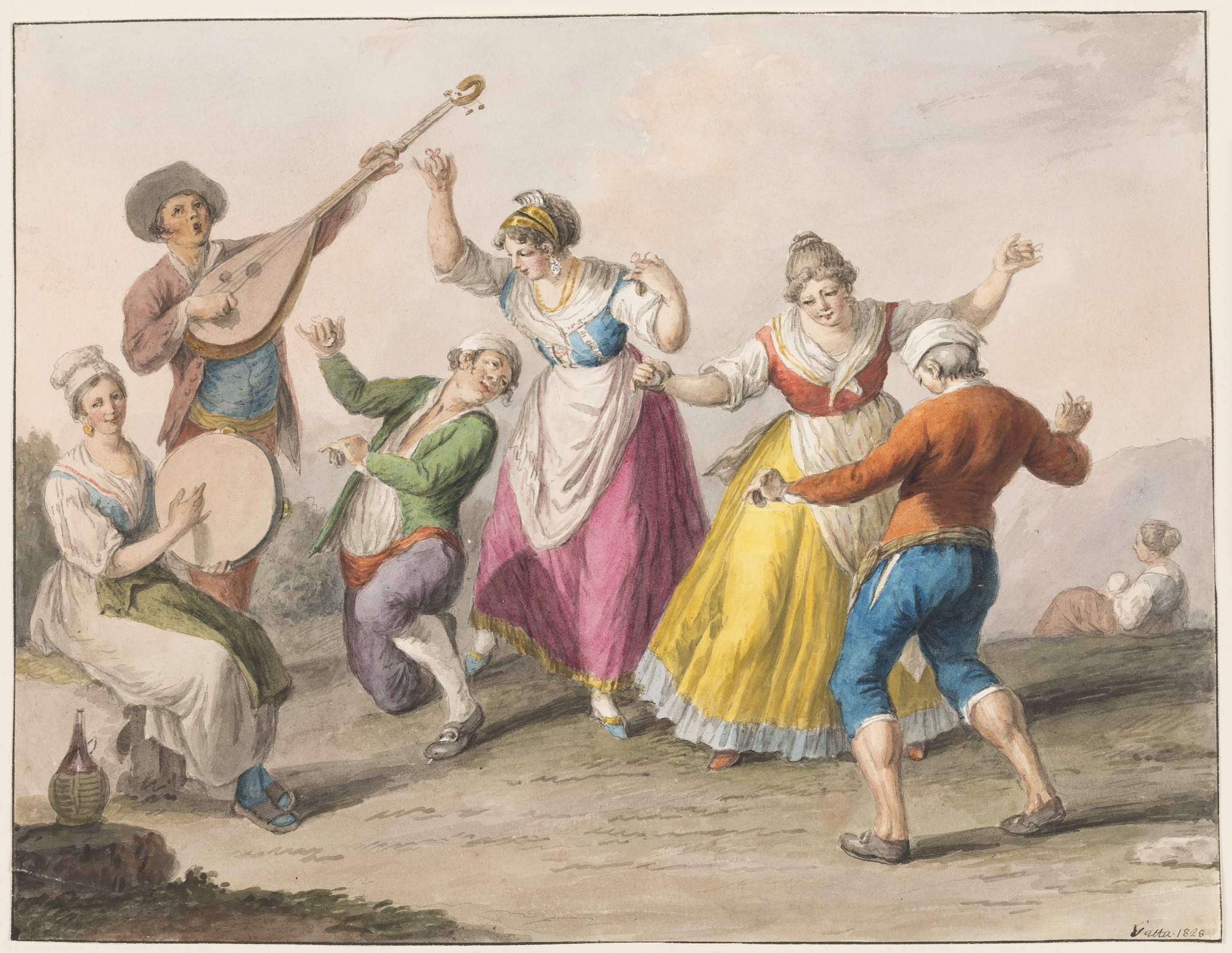
Water color Tarantella dancers ld1-164339
Unknown artist
- Rights:
- Not recorded. Do not assume this image is free to reuse — check the source record.
This watercolor is one of the few surviving visual records of tarantella as a living social practice in the early 19th century, before the dance was codified for theatrical performance. It documents the role of musicians, the informality of group participation, and the costume and outdoor setting that framed the dance as social ritual rather than entertainment spectacle. For dancers and historians, it is evidence of a moment in the dance's history when it had not yet been packaged for consumption.
What you are looking at
Six figures occupy a sunlit landscape, engaged in animated social dance. The scene appears to be a rural or rustic setting, with loose ground rendered in brown and green washes. A wine bottle sits in the lower left foreground. The dancers wear loose, high-waisted garments typical of early 19th-century southern Italian or peasant dress: women in white chemises with colored overskirts (pink, yellow, red), men in colored jackets and breeches. The group is arranged in loose formation rather than paired lines. One man at left plays a long-necked stringed instrument (likely a tarantella or guitar), while a woman beside him plays a frame drum. The remaining four figures are in various attitudes of dance: bodies bent, arms raised, weight shifting. The lighting is warm and diffuse, with minimal shadow, suggesting midday or outdoor festivity. The composition has the quality of a moment caught mid-celebration rather than a formal performance.
The dancing
The dancers display the flexible, grounded postures associated with folk dance rather than ballroom technique: hips are loose, torsos bend, knees flex, arms are raised with palms open or extended outward. Two figures are clearly musicians. Of the four dancing figures, bodies face in varying directions, suggesting spontaneous movement rather than synchronized steps. One woman on the right holds an extended arm position while turning; another raises both arms overhead. A man in the center leans back in a play-like posture. The group is unpartnered—no closed holds, no lead-and-follow frame. The feet are small in the rendering and footwork is not articulated with precision, but the overall stance is that of people dancing upright from the hip and knee rather than with ballroom posture.
The dance depicted
The title and costume strongly suggest tarantella, the rapid, celebratory dance of southern Italy and the Mediterranean. The presence of musicians (one with a long-necked lute, one with a frame drum) accords with tarantella performance practice. The informal grouping, the exuberance of gesture, the loose clothing, and the outdoor rural setting all match early 19th-century documentation of tarantella as a social village dance. However, the watercolor does not freeze a moment that reveals the precise footwork or rhythmic structure. The absence of the characteristic close partnering, rapid turns, and heel-led footwork seen in later tarantella imagery leaves some ambiguity, though the ethnographic costume and musical context make tarantella the confident reading.
How it was made
This is a watercolor on paper, executed with translucent washes and pen or pencil detail. The technique is consistent with early 19th-century European amateur or professional topical illustration: loose washes establish form and light, with pen lines defining edges and facial features. The paper shows the warm, slightly yellowed tone typical of period stock. The watercolor medium allowed rapid, gestural rendering suitable for capturing movement and outdoor light, and was well suited to the documentary or ethnographic purpose this image serves. Such works were commonly circulated as prints or in albums of costume and manners studies, indicating an audience interested in folk and foreign customs.
About this work
This watercolor depicts a tarantella celebration in early 19th-century southern Italy, capturing a moment of social dancing among rural figures. The scene documents the dance through costume, musical instruments, and body gesture rather than through technical precision. The work sits within a broader European tradition of ethnographic and costume illustration, particularly the study of folk customs and regional dances. It records how tarantella was understood and performed outside the concert hall or ballroom: as an exuberant, unpartnered, communal expression of celebration.
The piece is valuable as social history and as evidence of how northern European artists encountered and represented Mediterranean dance culture. It shows tarantella before it was standardized into a reproducible theatrical or ballroom form, when it remained a village practice animated by music, costume, and improvised motion.
How to look at it
Attend first to the musicians and their instruments: the artist has placed them at the center-left, making clear that the dance is inseparable from live music. Watch the varied postures and arm positions—notice that no two dancers mirror each other, and that the group has no geometric order. The loose, high-waisted clothing and the outdoor setting anchor the scene in rural life rather than urban entertainment. The artist chose a moment of visible exuberance rather than a peak of technical display; bodies are bent and informal. This captures tarantella as a social bond and shared physical release rather than as a display of skill.
The period
The early 19th century saw a surge of European interest in folk customs, regional dress, and national character, driven by Romantic nationalism and the growth of ethnographic curiosity. Southern Italy in particular was a destination for northern European travelers and artists seeking the picturesque, the authentic, and the exotic within Europe's own borders. Tarantella was already legendary in European culture—associated with the bite of the tarantula and the cathartic healing dance it supposedly triggered—but few northern observers had witnessed it firsthand. Watercolor was the dominant medium for travel artists documenting costume and manners. This work reflects that moment when folk dance was becoming a subject of artistic and scientific interest, yet before it was systematized into the standardized forms that would appear in ballroom manuals and theatrical choreography later in the century.
Where it lives
The work is held by the Smithsonian Institution. It is catalogued as a watercolor of unknown artist, date, and maker, suggesting it may have entered the collection as part of a larger album or bequest of travel studies or ethnographic illustrations.
Dance in this work
Questions about this work
Is this tarantella?
Yes, with high confidence. The title identifies it as such, and the costume, instruments, informal grouping, and outdoor rural setting all match early 19th-century documentation of tarantella as performed in southern Italy. The fast, stamping, partnered dance form most familiar today is a later theatrical standardization; this watercolor shows tarantella in its village social context, where it was more improvisational and communal.
Who made this?
The artist is not recorded in the catalogue. The style and technique suggest a professional or accomplished amateur European artist of the early 19th century, probably a traveler documenting folk customs, but without a signature or inscription visible in the image, no definitive attribution is possible.
When was it made?
The catalogue does not record a date. The style, costume, and medium are consistent with the early 19th century (1800–1830s). The warm, yellowed tone of the paper and the watercolor technique support this period, but precise dating would require expert examination of the materials and paper.
What is the instrument being played?
It appears to be a long-necked lute or guitar, a stringed instrument common in Mediterranean folk music. The second musician plays a frame drum or tambourine, another staple of tarantella accompaniment. The specific type of lute cannot be determined from the watercolor's level of detail.
More dance artwork