25 works in this view — arrow keys or swipe to move between them.
Dance in Art
Waltzing Couple (Edwardian watercolor)
Bill Fisher
- Dance:
- Waltz
- Era:
- 1900-1920 (Ragtime/Early Jazz)
- Source:
- perry_collection
- Rights:
- public_domain
The image provides visual evidence of how the waltz was performed, taught, and celebrated in the early 20th century—not as a folk or historical form, but as a living social and theatrical practice. For dancers and historians, it documents the physical frame, the use of extension and lift, and the gendered dynamics of the era in a single vivid moment. The work also reveals how ballroom dance was represented in commercial illustration and popular culture, showing the gap between stylized artistic depiction and actual social practice.
What you are looking at
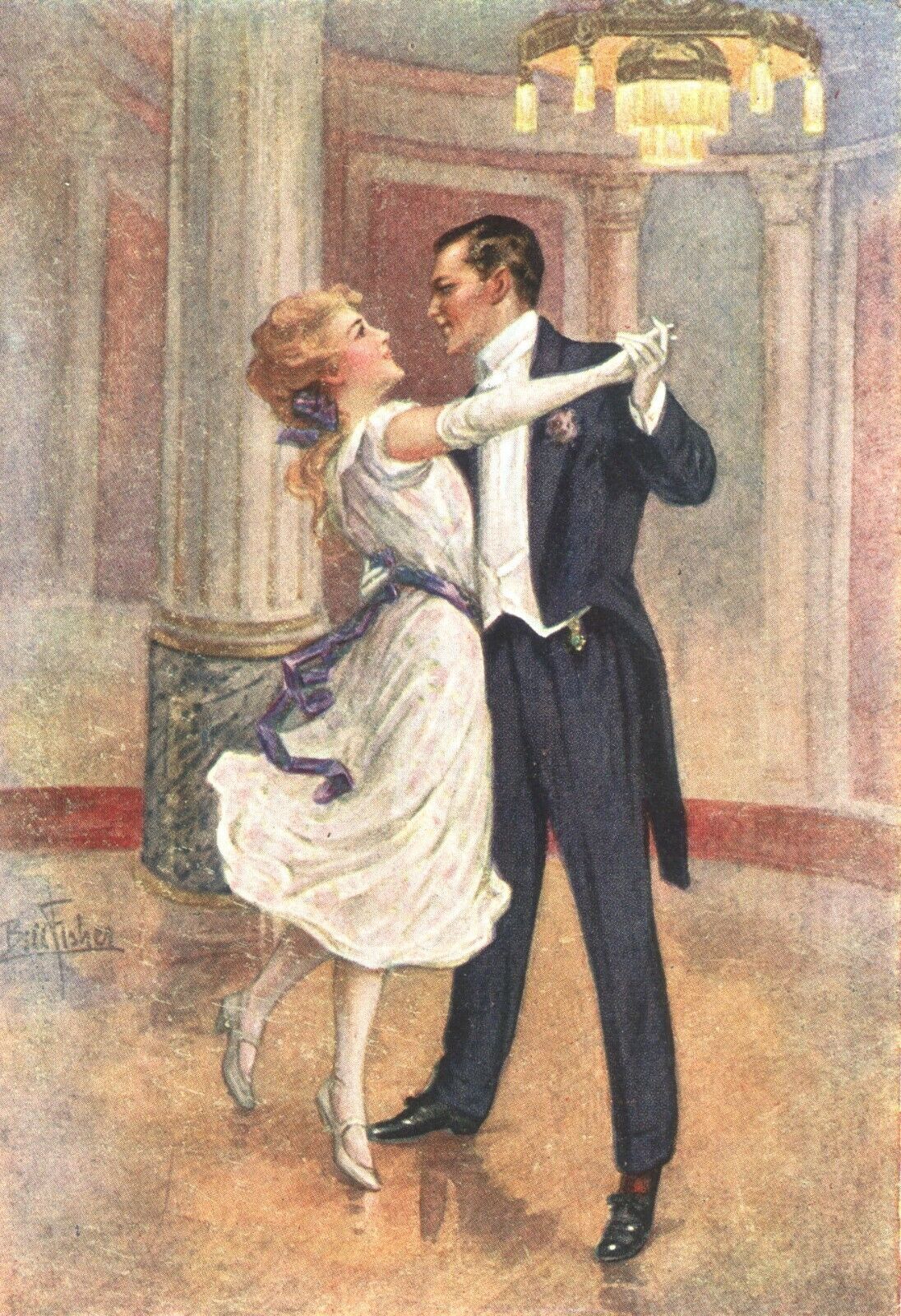
A man and woman dance in an elegant interior with classical columns and warm, muted tones of terracotta and cream. The woman, wearing a pale chemise-style dress with a purple ribbon at her waist and a matching bow in her reddish hair, leans back in an exuberant arch. The man, in formal evening dress with tailcoat and white shirt front, supports her with one arm while holding her extended hand, his body angled to follow her motion. The setting suggests a ballroom or formal drawing room, lit from above by what appears to be electric lighting. The composition captures a moment of dynamic lift and extension, with the woman's body creating a sweeping diagonal line across the frame. The watercolor has a soft, luminous quality typical of Edwardian illustration, with careful attention to the textures of fabric and the play of light on skin.
The dancing
The dancers are in a tight closed position with the man's right arm supporting the woman's back and his left hand grasping her right hand at chest height. The woman's left arm extends upward and outward in a flourish. Her weight appears to be transferred into the man's frame as she leans back in an extended arch—a movement requiring significant trust and control. The man's posture is upright and grounded, his frame providing the counterbalance. The woman's feet are off the ground or only lightly touching, suggesting a moment of lift or momentum rather than a planted weight-bearing position.
The dance depicted
This depicts the waltz, specifically a moment of dramatic extension and lift within the closed-position frame characteristic of late-19th and early-20th-century ballroom waltz. The exaggerated arch and the woman's apparent weightlessness suggest a theatrical or performance-level interpretation rather than the more restrained social waltz of the same era. The dress and setting place this firmly in the Edwardian period (1901–1910), when waltz remained the dominant ballroom dance but was beginning to acquire more showy, theatrical elements. The artist has captured not merely the dance but the romance and drama associated with it.
How it was made
This is a watercolor, as can be seen from the translucent washes of color, the luminous quality of the paper showing through, and the soft blending of pigments. The artist has used careful layering—background architectural elements are rendered sketchily while the figures are detailed and finished. The medium allowed the artist to work quickly enough to capture movement and emotion rather than static precision, and it was ideal for commercial illustration and reproduction, suggesting this was made for publication or as part of a commercial collection rather than as a unique fine-art object.
About this work
This Edwardian watercolor captures a moment in the ballroom waltz at its peak of cultural prominence and romantic idealization. The work is unsigned in the visible detail, though attributed to Bill Fisher in the catalogue. It belongs to a rich tradition of late-19th and early-20th-century dance imagery that celebrated the waltz as the supreme expression of elegance, intimacy, and modernity. The work sits at a threshold: the waltz was by 1900–1920 already established and respectable, yet new dances from the Americas were beginning to challenge its dominance. This image, with its theatrical lift and emotional intensity, captures the waltz at a moment when it was still culturally central but increasingly understood as requiring artistry and performance skill. It is a document of how educated Edwardian audiences understood and romanticized the dance they danced.
How to look at it
Notice the moment the artist chose: not a steady turning figure, but an exuberant arch and lift that makes the dance look spontaneous and emotionally expressive rather than formally controlled. The woman's extended arm and arched back emphasize the vertical and diagonal lines of her body, a compositional choice that makes the movement appear more dramatic than a strict waltz frame would be. The artist has also carefully rendered the support and tension between the two bodies—the man's steady stance and frame versus the woman's apparent surrender to momentum and gravity. This is waltz as romantic spectacle, not waltz as social function.
The artist
Bill Fisher is known as a commercial illustrator active in the early 20th century, contributing to magazines and collections of the Edwardian period. His work specializes in scenes of romance, courtship, and fashionable life, often featuring dance as a context for intimate social encounter. The style and subject matter suggest work created for middle-class consumption and circulation through print media. Little is currently recorded about Fisher's biography or career beyond the works themselves.
The period
The years 1900–1920 marked both the apotheosis and the beginning of the end for the waltz's dominance in ballroom culture. The dance had been the foundation of respectable social life for nearly a century, but the arrival of ragtime-influenced dances from the United States—the foxtrot, the one-step, the turkey trot—was reshaping what young people wanted to dance. Visually, this period saw the rise of commercial dance illustration, particularly in magazines and advertisements, which idealized and romanticized ballroom dancing as a marker of sophistication and courtship. Watercolor illustration was a popular medium for this kind of imagery, reproduced and distributed widely. The soft, romantic aesthetic of this work reflects the cultural moment when the waltz was still dominant but increasingly contested.
Where it lives
The work is held in the LODance founder's personal collection and was sourced from the perry_collection. It is catalogued as a work from the Ragtime/Early Jazz era (1900–1920), a periodization that reflects the cultural context of dance history rather than the dance depicted, which is waltz, not jazz.
Dance in this work
Questions about this work
Is this a photograph?
No. This is a watercolor illustration, as can be seen from the translucent pigments, the soft blending, and the visible brushwork. The style and technique are typical of commercial illustration and fine-art practice of the Edwardian period. Photography of dance during this era was technically limited and usually static; this work's dynamic quality and emotional focus are characteristic of illustration.
Did people actually dance like this?
Yes, but not always. The exaggerated arch and lift show a theatrical or performance-level interpretation of the waltz, likely what a skilled dancer or couple might execute at a dance academy or public ball. Social waltz among ordinary dancers was usually more restrained. This image reflects the idealized and romanticized version promoted by dance teachers and illustrated in popular media.
Why is she leaning so far back?
The extended arch is a hallmark of ballroom technique: it shows the skill of both partners—her ability to maintain tension and control while leaning, his ability to support and lead through that extension. It also creates a visually striking composition that emphasizes the intimacy and drama of the dance. In theatrical or exhibition waltz, such extensions were common. The watercolor format allowed the artist to capture and exaggerate this moment for maximum emotional effect.
What does the purple ribbon signify?
The ribbon at her waist and in her hair indicates the formality of the occasion and her fashionable dress. The pale chemise-style gown and careful grooming are markers of a respectable, educated woman dancing in a proper ballroom setting, not a casual or working-class context. The color and details authenticate the Edwardian date.
More Waltz artwork