39 works in this view — arrow keys or swipe to move between them.
Dance in Art · 1816
Waltz1816 72
unknown engraver
- Medium:
- Oil Painting
- Dance:
- Waltz
- Era:
- Early 1800s (Waltz Revolution)
- Source:
- Wikimedia Commons
- Rights:
- Public domain — free to use, share and adapt.
- Recorded as:
- Public Domain
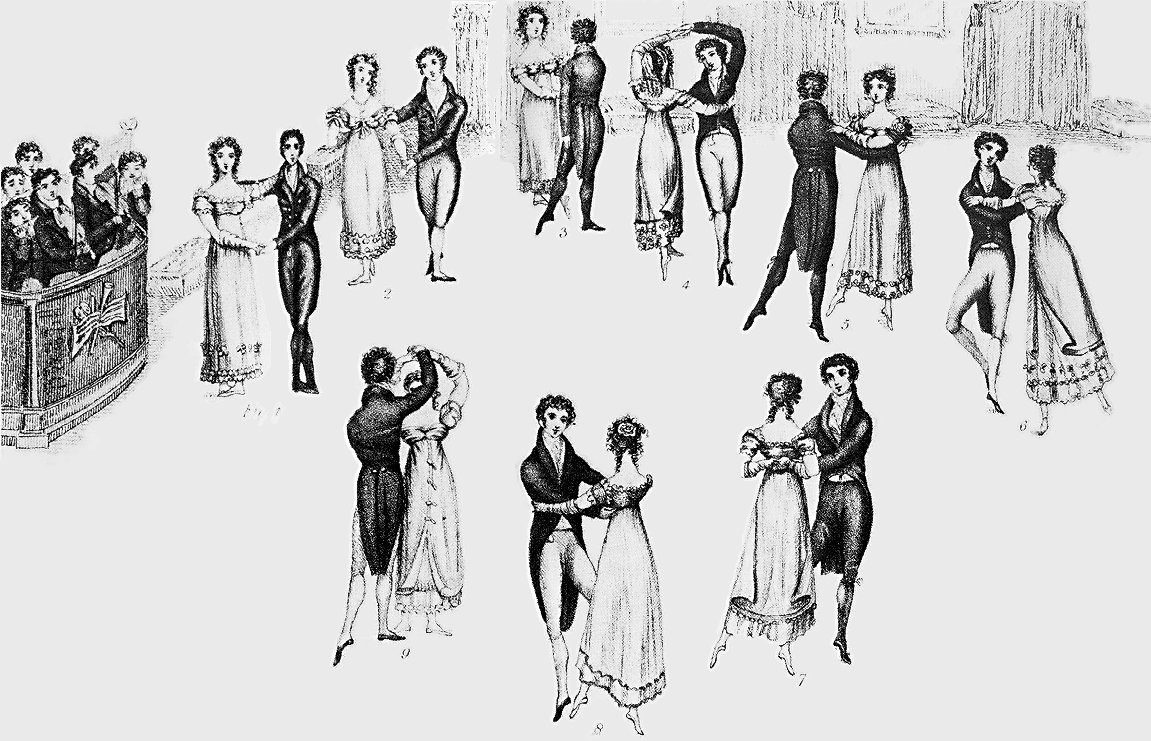
For dance historians, this engraving is evidence of how the Waltz was introduced to English society: not through theatrical performance or ballroom gossip, but through systematic instruction made visible in print. For social historians, it captures the exact moment when bodily intimacy between men and women became socially sanctioned on the dance floor — a shift that reflects deeper changes in courtship and gender relations. The plate shows that the Waltz was not spontaneous or intuitive but was actively taught, which means resistance to it was resistance to a deliberate pedagogical campaign.
What you are looking at
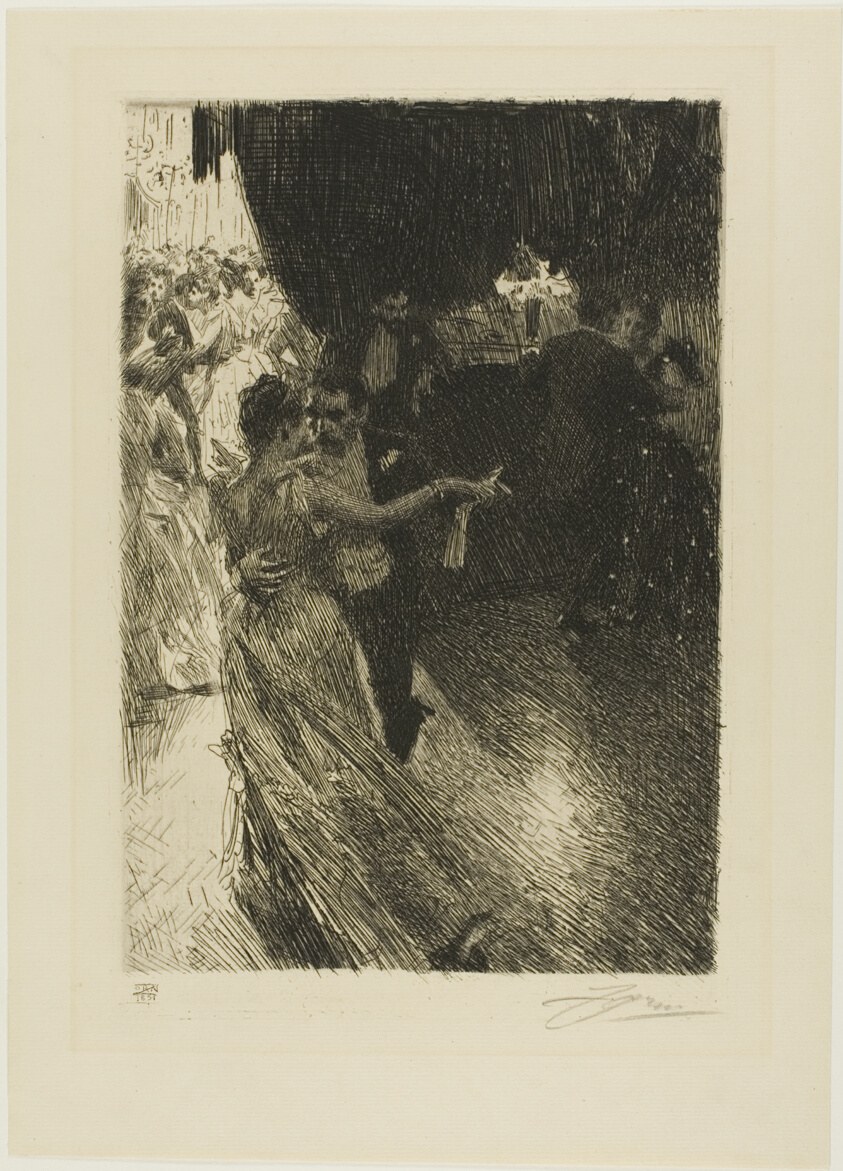
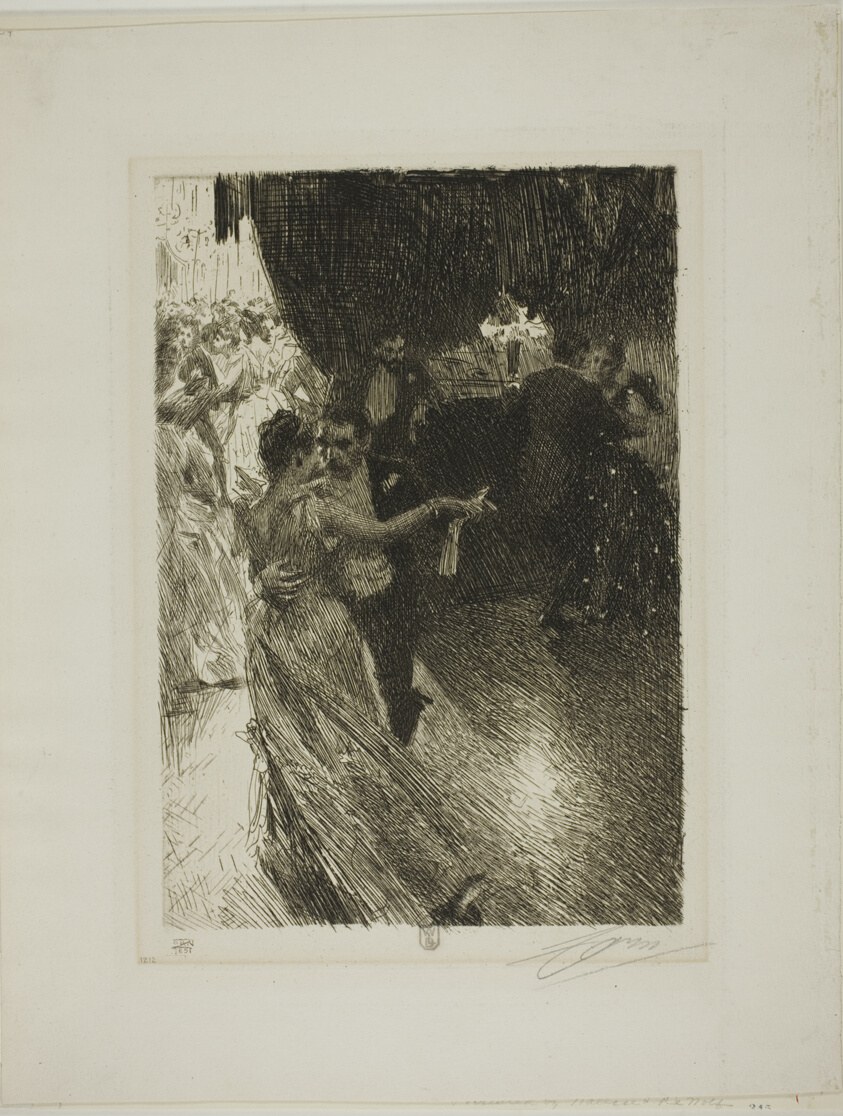
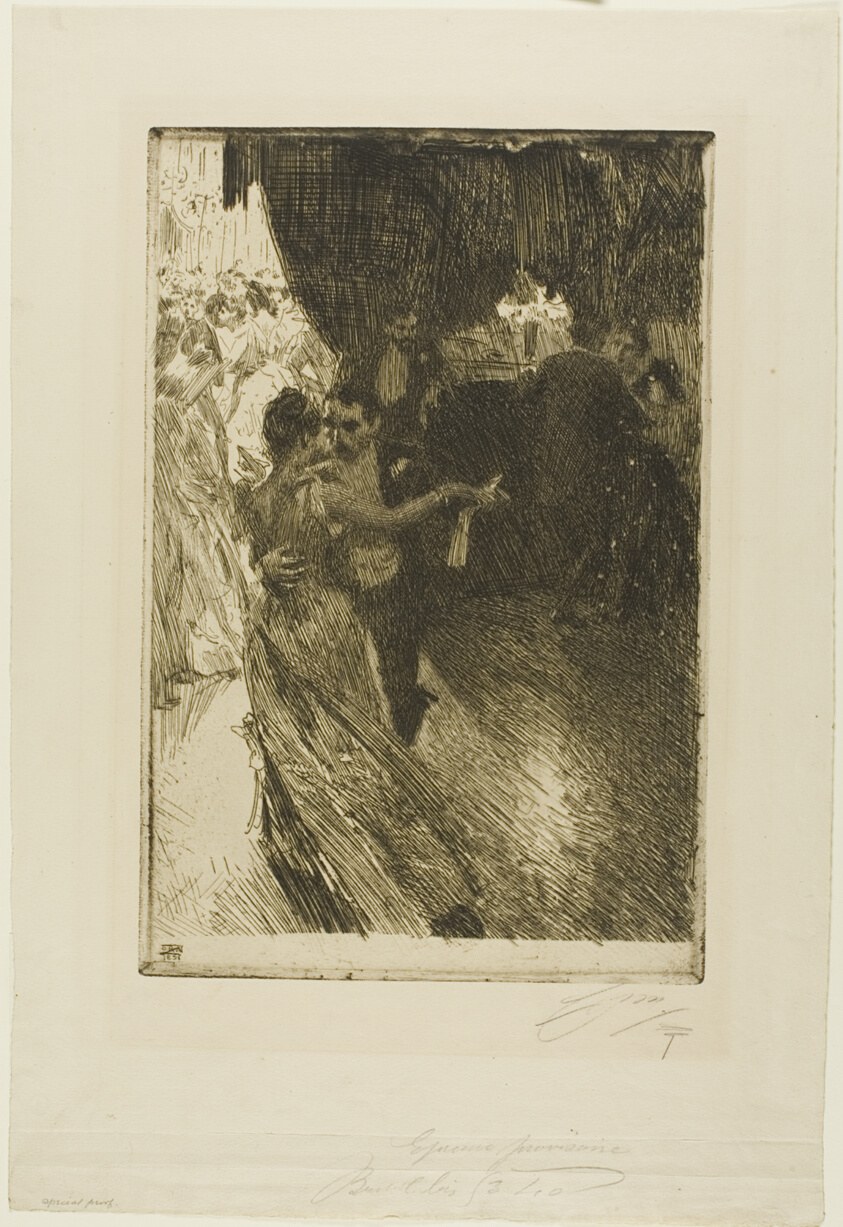
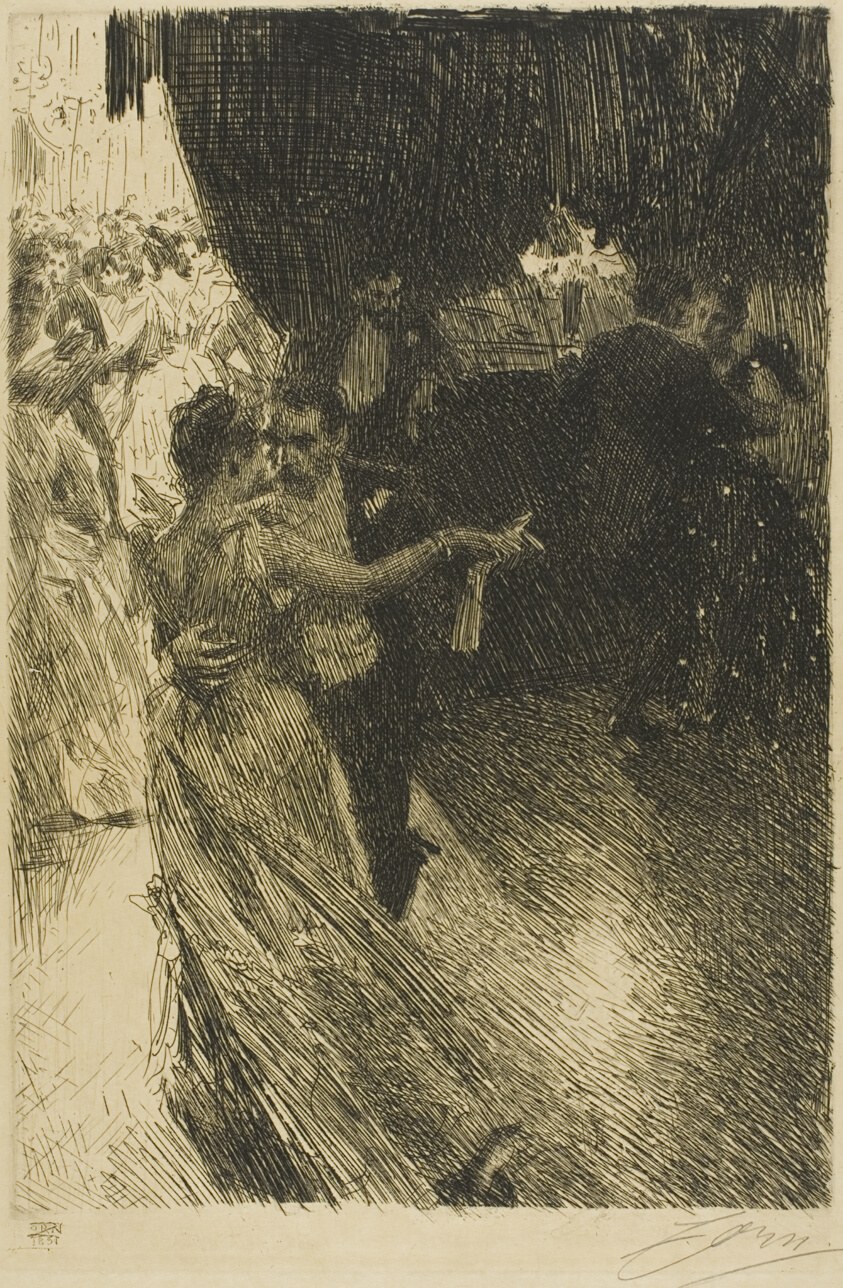
A pedagogical engraving showing nine numbered positions of the Waltz, arranged across the page with a group of musicians visible at the far left. The figures are rendered in neat outline style typical of dance instruction plates. Each pair demonstrates a different moment or position within the dance: some show the couple at a distance, some in close proximity with the gentleman's arm around the lady's waist, others depict the rotational movement characteristic of the waltz. The dancers wear Regency-era dress — the women in high-waisted muslin gowns with puffed sleeves and elaborate headdresses or bonnets, the men in tailcoats with tight breeches and shoes. The composition is systematic rather than theatrical, designed to be read as a sequential guide rather than a snapshot of social life. No background or setting is indicated; the focus is entirely on body position and proximity.
The dancing
The couples maintain closed position throughout: the gentleman's right arm clasps the lady's waist from behind or at the side, while their other hands join at approximately shoulder height. The frame is notably close and intimate for Regency propriety — the dancers face the same direction and rotate as a unit. In several positions the couple is shown mid-turn, the woman's skirts swinging outward from the rotation, the man's posture upright and leading. Weight and stance suggest a traveling motion rather than stationary steps. The engraver has clearly studied the mechanics of the hold and the bilateral symmetry required.
The dance depicted
This is a teaching plate for the Waltz in its early English reception, circa 1816. The Waltz originated in Germany and Austria but met resistance in England, where the closed couple position and the gentleman's hand on the lady's waist were considered scandalously intimate. Thomas Wilson's *Correct Method of German and French Waltzing* was a landmark instructional work that legitimized the dance by codifying its positions and technique in print. The nine positions here show the fundamental geometry of the waltz turn: the couple's locked frame, the rotational momentum, and the traveling action that distinguishes it from static group dances like the quadrille. The engraving served dancers, teachers, and curious society figures learning a dance that was both fashionable and controversial.
How it was made
This is a line engraving, a medium of precision and reproducibility well suited to instructional publication. Engraving allows fine detail in costume and anatomy while maintaining clarity across multiple impressions — essential for a teaching manual that would be consulted by readers across Britain. The technique imposes a clean, diagrammatic aesthetic: no shading, no atmospheric perspective, no psychological depth. Each figure is rendered with equal clarity regardless of position in the composition, making the work feel more like a technical drawing than an artistic representation. This was the standard medium for dance instruction plates from the late 18th century through the 19th, ensuring wide circulation among the literate and dancing classes.
About this work
This engraving documents the English encounter with the Waltz at the moment of its cultural breakthrough. The Waltz was genuinely transgressive — a couple dance in which a man held a woman at the waist in full view of society — and its adoption in England during the Regency period marks a rupture in dance conventions that had survived for two centuries. By presenting the nine positions in diagrammatic clarity, Wilson's instruction plate served a dual purpose: it provided technical guidance for dancers learning unfamiliar footwork and frame, and it normalized the dance by rendering it as a rational, teachable system rather than an exotic or morally suspect import. The work thus sits at the intersection of dance pedagogy, social history, and the anxiety about bodily contact that shaped Regency society.
How to look at it
Begin by reading the positions in numbered order, tracing the rotational motion implied across the nine frames — notice how the couple's orientation changes and how the woman's skirts respond to the turning action. Then look closely at the hold itself: the placement of the gentleman's hand, the angle of the woman's shoulders relative to his, the way their other hands connect. These details were controversial enough to require explicit visual instruction. Finally, consider the blank background and the neat, uniform engraving style: this is not a painting of a ball or a romantic scene, but a technical diagram, which in itself is a statement that the Waltz was a teachable, rational system rather than an expression of passion or disorder.
The artist
The engraver is not identified in the surviving record. The work appears in Thomas Wilson's 1816 publication, and the style is consistent with the work of London dance instruction engravers of the period, but attribution remains open. Wilson himself was a master of ceremonies and dance teacher of considerable standing, and his decision to commission such a detailed instructional plate reflects both his investment in legitimizing the Waltz and his understanding of how print could shape dance practice.
The period
The years 1810–1820 saw the Waltz's emergence from German and Austrian aristocratic circles into Western European ballrooms, with England as a particular site of cultural negotiation. The dance arrived during the Regency period, a moment of high fashion and social formality, and it provoked genuine moral controversy — clergy and conservative social commentators objected to the closeness of the hold. Simultaneously, the Waltz coincided with the rise of the couple dance as the dominant social form, displacing the group formations (quadrilles, country dances, cotillions) that had defined Regency ballroom culture. Wilson's 1816 publication is one of the earliest systematic defenses of the Waltz in English, using the authority of print and diagram to legitimize a practice that many found shocking. By the 1820s, the Waltz had won, and the instructional urgency of this plate had passed.
Where it lives
This is a detail from the frontispiece to Thomas Wilson's *Correct Method of German and French Waltzing*, published in London in 1816. The engraving served as both a visual advertisement for the book and a practical teaching aid for purchasers. It reflects the work's original circulation among dance teachers, ambitious amateurs, and the fashionable public of London.
Dance in this work
Questions about this work
Why was the Waltz so controversial in England?
The primary objection was physical proximity. In ballroom dances of the 18th century, couples rarely touched; they moved in proximity and exchanged partners frequently. The Waltz required a closed hold in which the gentleman's arm was around the lady's waist, sustained throughout the dance. To critics, this was an appalling intimacy, effectively a public embrace. The fact that it was a couples dance that excluded group participation also violated the egalitarian mixing expected in English ballrooms.
Who used instruction plates like this one?
These were used by professional dance teachers working with pupils, by ambitious amateurs learning at home with a partner or with the aid of a teacher, and by the curious — people who had read or heard about the Waltz and wanted to understand what the fuss was about. The plate's appearance in the frontispiece of Wilson's book meant it reached literate, middle-class and upper-class readers, reinforcing the message that this was a respectable, teachable practice.
How does the Waltz shown here differ from the Waltz danced today?
The frame and general principle — the closed hold, the three-beat timing, the rotational movement — remain consistent. The main differences are in speed (modern ballroom Waltz is faster), in the frame's height and angle (modern International Standard Waltz has a more tilted, extended frame), and in footwork precision (modern competitive Waltz emphasizes specific foot placements within each measure that may not have been formalized in 1816). This engraving shows the Waltz at its moment of emergence, before the standardization that comes with competitive sport.
More Waltz artwork