32 works in this view — arrow keys or swipe to move between them.
Dance in Art
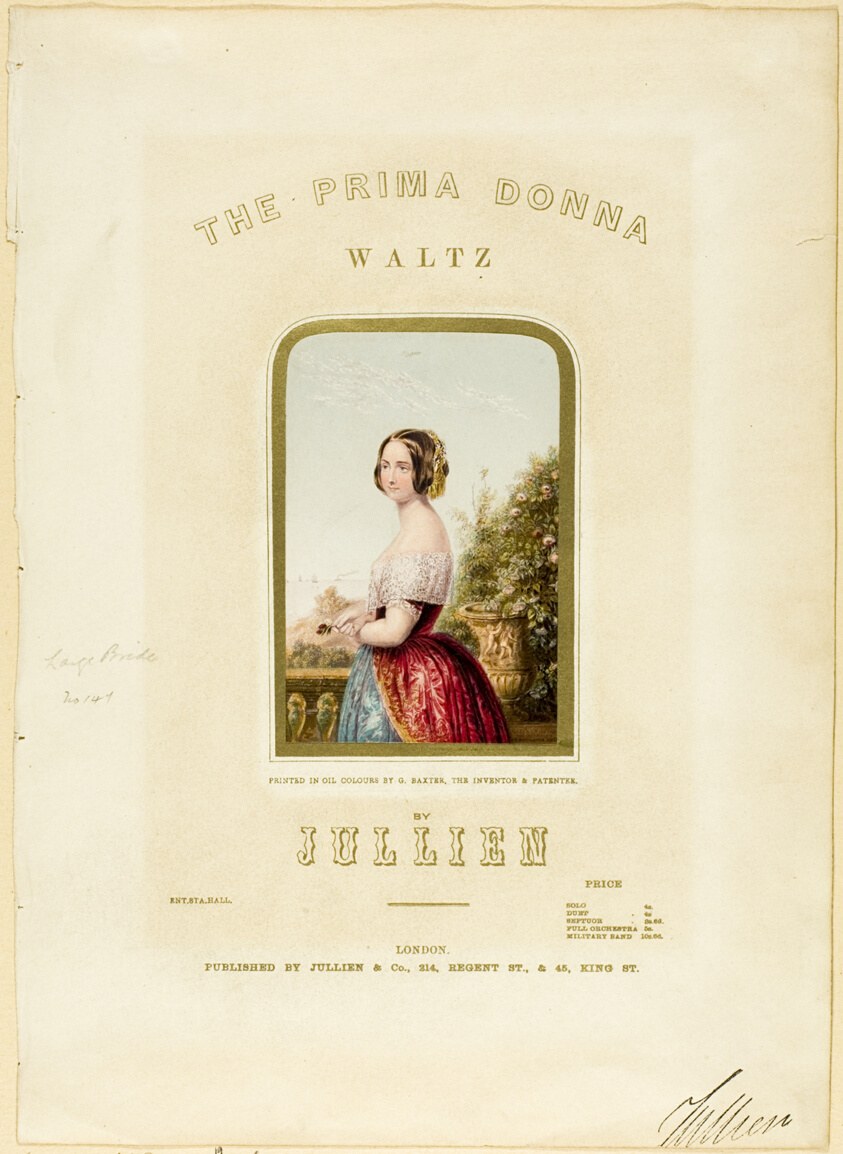
The Bride cover for The Prima Donna Waltz sheet music
George Baxter
- Dance:
- Waltz
- Source:
- Art Institute of Chicago
- Rights:
- Public domain — free to use, share and adapt.
- Recorded as:
- CC0 (Public Domain)
This work documents the material culture of early 19th-century dance: what waltz music looked like when sold, how the dance was marketed to the middle class, and how the image of the female performer was used to sell compositions. It also exemplifies a major printing innovation—Baxter's process—that made colour reproduction affordable enough to support a thriving trade in decorated sheet music, one of the period's most distributed forms of visual culture.
What you are looking at
This is the cover illustration for sheet music of *The Prima Donna Waltz*, rendered in oil colours and printed. A young woman in Regency-era dress stands three-quarter length against a light sky, positioned at an ornamental stone balustrade. She wears a pale pink off-shoulder evening gown with a deep red silk skirt gathered at the waist, and her dark hair is styled with a gold ornament or tiara. Her posture is upright and composed, one arm folded across her front, the other hanging naturally at her side. To her right stands a classical stone urn with ivy or climbing plants, establishing an Italianate garden setting. The background suggests a distant landscape or seascape. The figure occupies the centre of a rounded-rectangle frame printed in gold, with the title arched above in decorative lettering. Below the frame is publication information: printed in oil colours by G. Baxter (the inventor of the Baxter print process), and published by Jullien & Co. in London.
The dancing
A single female figure, stationary and posed rather than captured mid-movement. Her stance is frontal and dignified, with weight evenly distributed, shoulders back, and head turned slightly to address the viewer. The arms are relaxed and unstudied—this is a portrait pose, not a dance frame. There is no hold, no partner, no visible footwork. The figure presents herself as a prima donna would on stage: composed, elegant, and available for admiration.
The dance depicted
The image does not depict dance in action. It is a portrait of a prima donna—a leading female vocalist or performer—presented as the nominal subject of a waltz composition. The waltz was the dominant social dance of the Regency and early Victorian periods, and waltz sheet music often bore female portraits on the cover, particularly of celebrated singers or dancers. This figure is dressed as a performer of the period would be—in evening costume suitable for the concert hall or opera house—but she is posed statically rather than shown dancing. The work functions as advertisement and decoration for the music rather than as documentation of how the waltz was danced.
How it was made
This is a Baxter print, created using the oil-colour printing process invented and patented by George Baxter in the 1830s. The process allowed for the production of coloured prints with the richness and subtlety of oil painting, but at a cost and scale suitable for mass publication. The credit line confirms this: 'Printed in Oil Colours by G. Baxter, the Inventor & Patentee.' The technique involved multiple wood blocks or metal plates, each applying a different colour in register, allowing for gradations of tone and a painterly effect impossible in simple chromolithography. This made the cover economically viable as a commercial product—decorative enough to appeal to middle-class purchasers of sheet music, but reproducible in quantity.
About this work
This is a commercial sheet-music cover from the Regency or early Victorian era, featuring a portrait of an idealized prima donna in evening dress. The waltz was reaching the height of its popularity in fashionable drawing rooms and ballrooms during this period, and publishers competed to issue waltz compositions with attractive, often celebrity-endorsed covers. The figure is not shown dancing but posed as a performer—a reminder that waltzes were composed works to be played by musicians and danced by couples in formal settings, and that the 'prima donna' title likely refers to a famous singer whose name or reputation lent prestige to the musical composition. The use of the Baxter printing process signals the work's status as a quality commercial product aimed at a literate, affluent audience.
How to look at it
Look at the stillness and frontality of the figure. This is not a moment caught mid-turn or mid-step, as a dance scene would show; it is a composed portrait in the manner of 19th-century fashion plates or theatrical portraits. The off-shoulder gown and the classical setting (the urn, the balustrade) place the figure outside time and place—not in a specific ballroom or social setting, but in an idealized realm of taste and refinement. The gold ornament in the hair and the careful arrangement of the skirt suggest costume and artifice. Compare this to action-based dance imagery of the same period: the stillness here is instructive about how dance was represented in commercial media versus in narrative or documentary art.
The artist
The catalogue record does not identify the artist of the illustration, only the printer (G. Baxter). The work was published by Jullien & Co., a major London music publisher and printer of the 1830s–1850s, known for high-quality sheet-music covers. Jullien specialised in dance music and worked closely with Baxter to produce visually striking covers that would attract buyers. The anonymity of the cover artist was typical for commercial sheet music of the period; artistic reputation attached to the composer and publisher, not the illustrator.
The period
The 1830s–1850s were the period of the waltz's triumphant entry into fashionable European and American society. Once considered shockingly intimate—the dance involved a closed hold and spinning motion—the waltz had by this era become the standard of ballroom propriety and was danced at every formal event. Sheet music was a major commodity in middle-class households; a piano and a collection of the latest dances were marks of gentility. Publishers invested heavily in beautiful covers to compete for customers. At the same time, this period saw the rise of Romantic ballet, which celebrated the ethereal, otherworldly female dancer. The portrait here reflects that aesthetic: pale, delicate, idealized, positioned as an object of admiration rather than as an agent of movement.
Where it lives
The work is held in the collection of the Art Institute of Chicago. The source is listed as 'aic,' indicating it entered the museum collection at an unknown date. Sheet music and covers of this kind survive in quantity in music libraries and museum collections; they are windows into the economics and aesthetics of 19th-century popular entertainment.
Questions about this work
Is this a photograph?
No. This is a Baxter print, a colour printing process that produced results resembling oil painting or high-quality hand colouring, but from engraved blocks or plates. Photographic processes were not in common use for sheet-music covers until later in the 19th century. The warmth and painterly quality—and the credit to Baxter—confirm this is a print.
What is a prima donna waltz?
A waltz composition published with a title linking it to a celebrated female performer—usually a singer, though sometimes a dancer. The 'prima donna' title did not necessarily mean the performer danced the waltz; it was a marketing strategy, trading on the fame and prestige of the named artist to sell sheet music. The cover portrait often depicted or evoked that performer.
Why is she not dancing?
Sheet-music covers typically presented the performer as a portrait subject rather than in action. The cover was a commercial product and advertisement, not a document of performance or technique. A static, frontal pose was easier to compose and print, and the formal portrait conveyed elegance and status more reliably than a dynamic dance scene would have.
Who was the composer?
The title page does not identify the composer, only the publisher (Jullien & Co.). Many waltz compositions of this era were published anonymously or pseudonymously, or credited only to the publishing house. The focus was on the famous performer or 'prima donna' associated with the work, not the composer.
More Waltz artwork