43 works in this view — arrow keys or swipe to move between them.
Dance in Art
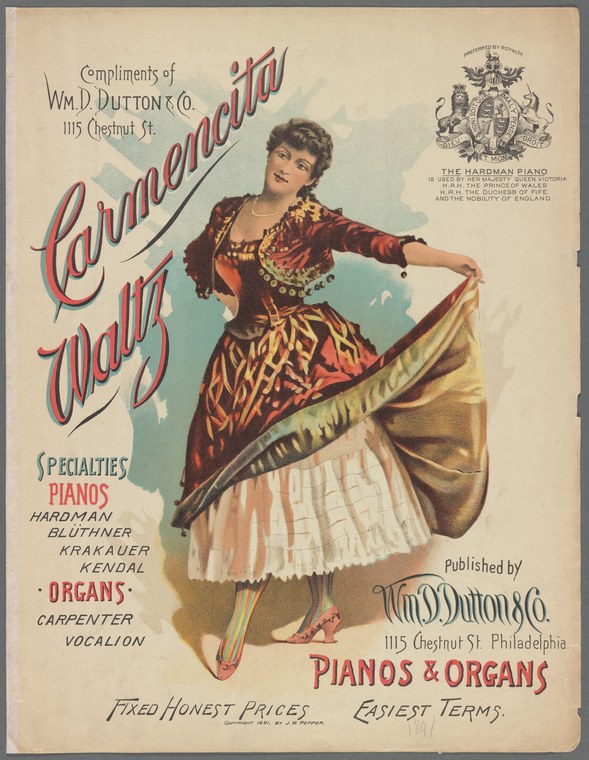
Carmencita waltz
Unknown artist
- Medium:
- Lithograph
- Dance:
- Waltz
- Era:
- Early 1800s (Waltz Revolution)
- Source:
- New York Public Library
- Rights:
- Public domain — free to use, share and adapt.
- Recorded as:
- public_domain
For historians of popular music and dance culture, this cover documents how the waltz was packaged and sold to American middle-class consumers in the 1890s—not as instruction but as aspiration. For dance historians, it reveals the gap between documented dance practice and commercial imagery: the sheet-music cover selling a ballroom dance form uses theatrical posturing and fantasy rather than actual dance technique, showing how performance and marketing shaped public ideas of dance.
What you are looking at
A chromolithograph advertising cover for sheet music, centered on a fashionably dressed woman in a luxurious red-and-gold brocade dress with a low neckline and puffed sleeves, characteristic of the 1890s. She is captured mid-movement, her body twisted in a graceful contrapposto pose with her left arm extended outward and her right arm holding up a length of shimmering gold fabric that billows across her body like a scarf or train. Her dark hair is styled in the high pompadour typical of the period, and she wears a jeweled necklace. The background is a soft blue-grey wash suggesting atmospheric depth. The composition is theatrical and flattering, designed to sell both the music and the fantasy of refined entertainment. Text surrounds the figure in elaborate fonts advertising the "Carmencita Waltz," Hardman pianos and organs, and the publisher Wm. D. Dutton & Co. of Philadelphia.
The dancing
A single female figure is shown in a standing position with her body at a three-quarter angle to the viewer. Her posture is upright but elegant, with a slight sway that suggests movement rather than a frozen pose. The extended left arm and the sweeping motion of the gold fabric create a sense of fluid, horizontal momentum. The gesture is fundamentally that of display and self-presentation rather than partnered or social dance mechanics—there is no partner visible, no closed position or ballroom frame, and no footwork visible. The pose reads as a moment of spinning or turning, with the fabric motion suggesting rotational energy.
The dance depicted
This is a promotional lithograph for a piece titled the "Carmencita Waltz," indicating the waltz as the advertised dance form. Carmencita was a famous Spanish dancer of the 1890s who performed in New York and Europe and was known for bringing flamenco and Spanish dance to American audiences; the title may reference her popularity or reputation rather than her actual choreography. The waltz itself was the dominant ballroom dance of the era—a partner dance in triple time, performed in a closed embrace. However, nothing in this image depicts actual waltz technique: there is no partner, no closed ballroom frame, no visible footwork in the characteristic rise-and-fall pattern. Instead, the image shows a fantasy of elegance and femininity designed to appeal to sheet-music buyers, likely amateur pianists and singers. The depicted gesture—the extended arm, the sweeping fabric, the upright carriage—is theatrical posturing rather than social-dance documentation.
How it was made
This is a chromolithograph (color lithograph), a printing technique that allowed for multiple colors and fine gradations of tone, making it ideal for commercial advertising of the 1890s. The soft modeling of the face, the careful rendering of fabric textures (the matte brocade of the dress versus the glossy flow of the gold fabric), and the subtle color transitions in the background all showcase lithography's capability for tonal subtlety. The technique was relatively fast and affordable compared to hand-coloring, making it the industry standard for high-volume sheet-music covers, fashion advertising, and theatrical promotion. This piece would have circulated widely among middle-class American households—people who owned pianos, attended performances, and purchased popular music for home entertainment.
About this work
This is a color lithographic cover for a piano composition titled the "Carmencita Waltz," published by Wm. D. Dutton & Co. (Philadelphia) and printed with compliments of a Hardman piano manufacturer. It dates to the 1890s, when such covers were mass-produced as advertisements for both the music itself and the instruments on which it would be played. The image does not document actual waltz dancing but rather uses dance and movement as a motif of sophistication and theatrical glamour. The single female figure, dressed in period high fashion and posed in a moment of elegant turning or display, was intended to appeal to the aspirations and tastes of amateur musicians and consumers of popular entertainment.
The work exemplifies a common collision in the dance image archive between commercial fantasy and social reality. The "Carmencita Waltz" was music for ballroom or parlor performance, requiring two partners in a precise hold and frame; but the cover image shows a solo, theatrical fantasy that bears no structural resemblance to the actual dance it advertises. It is valuable not as a record of waltz technique or choreography, but as evidence of how dance was marketed, imagined, and consumed in late-19th-century America.
How to look at it
Attend to the fundamental discord between the dance being advertised (waltz—a partner dance, ballroom, closed frame) and the image shown (solo theatrical fantasy, open posture, flowing fabric as spectacle). The artist has chosen to capture a moment of turning or spinning, using the extended arm and billowing gold fabric to create visual momentum and elegance rather than to document dance mechanics. The contrast between the stiff, dark brocade of the dress and the fluid movement of the fabric creates the illusion of motion. Note also the gaze of the figure: she looks outward toward the viewer with a direct, engaging expression, inviting identification and aspiration rather than documenting actual social interaction or partnership. This is a fantasy of dance, not a record of it.
The artist
The artist is unknown, which is typical for commercial chromolithographic covers of this period. These works were produced by publishing houses and print shops in service of marketing rather than individual artistic authorship. The quality of the lithographic work—the subtle modeling of the figure, the sophisticated color palette, and the careful hand-drawn typography—indicates professional commercial production rather than hack work, but the designer would not have been credited on the cover itself. The cover was printed by a commercial shop, likely in Philadelphia where the publisher was based, to accompany the piano score.
The period
The 1890s were the height of the waltz's popularity in America, especially among middle-class urban households. The waltz had arrived from Europe earlier in the century and by the fin-de-siècle was the dominant ballroom dance, taught in dancing academies and performed at social events. At the same time, the 1890s saw a fascination with Spanish and Latin American exoticism, partly driven by the success of performers like Carmencita, whose appearances in New York theaters introduced American audiences to flamenco and Spanish dance. Piano sheets and parlor music were major consumer goods, and covers with fashionable, theatrical imagery were crucial marketing tools. Chromolithography had made color printing affordable enough to make such covers standard for even modestly priced sheet music, so mass-produced imagery of women in fashionable dress became a dominant visual form in American homes. The Hardman piano company, whose name appears on this cover, was a major American manufacturer and major advertiser on music packaging.
Where it lives
This chromolithograph is held in the New York Public Library collection. It is a commercial sheet-music cover, one of thousands produced for piano compositions published in America during the 1890s. The cover bears the imprint of Wm. D. Dutton & Co., publishers in Philadelphia, and was printed with compliments of Hardman pianos as a form of manufacturer advertising.
Questions about this work
Was Carmencita a real dancer?
Yes. Carmencita was a Spanish dancer who performed in New York and Europe in the 1880s and 1890s, and was known for bringing Spanish flamenco to American audiences. The waltz is named after her, suggesting she was famous enough to have commercial music titled in her honor, though she was not primarily known as a waltz dancer.
Is this showing how people actually waltzed?
No. The waltz is a partner dance performed in a closed ballroom frame with specific footwork patterns. This image shows a single woman in a theatrical pose, which is fantasy advertising rather than documentation of dance practice.
What was chromolithography and why was it used for sheet music?
Chromolithography was a color printing process that allowed multiple colors to be printed affordably in high volume. It made illustrated sheet-music covers feasible as mass-market products, turning them into major consumer goods and advertising vehicles in the 1890s.
Who would have bought this music?
Piano-owning households, primarily middle-class and urban, bought sheet music for parlor performance and entertainment. The cover's appeal was part of the marketing: fashionable imagery and celebrity association (here, Carmencita's name) helped sell the music itself.
More Waltz artwork