49 works in this view — arrow keys or swipe to move between them.
Dance in Art · 2023
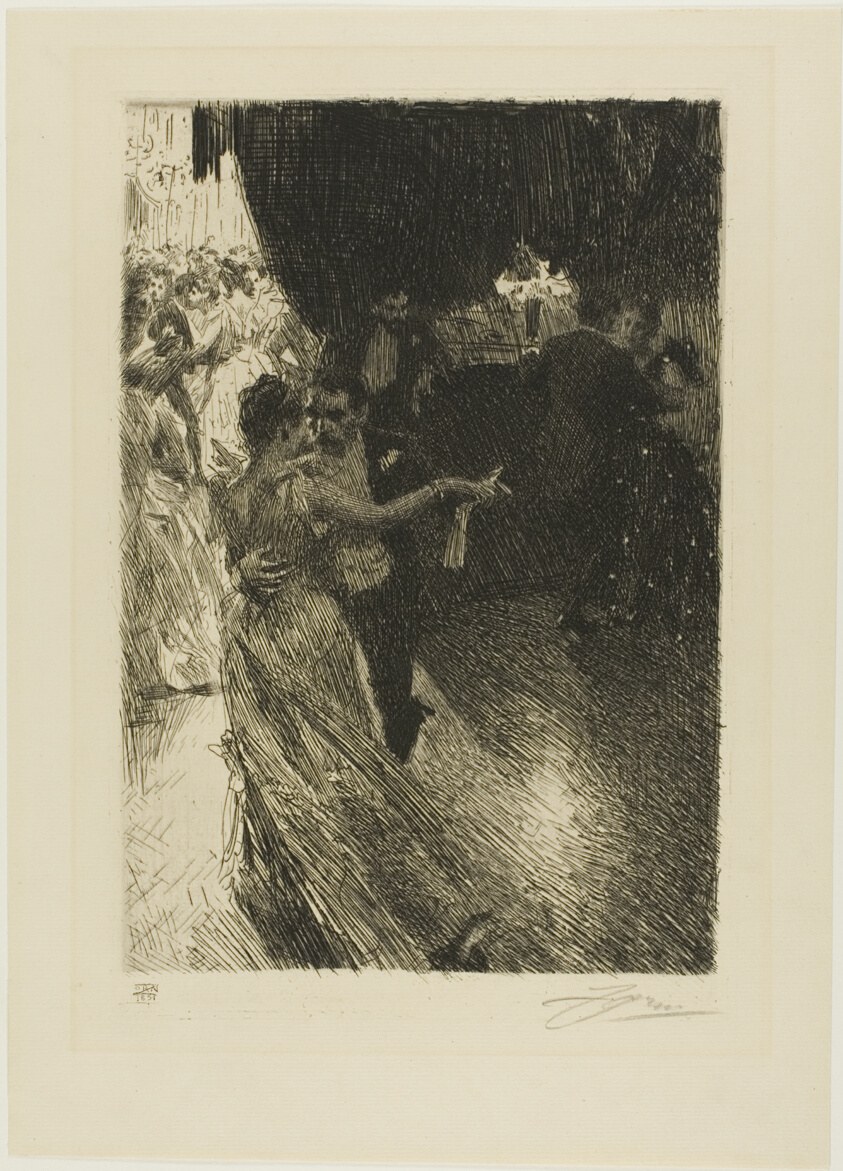
The Waltz of the Toreadors
Unknown artist
- Dance:
- Waltz
- Era:
- Early 1800s (Waltz Revolution)
- Source:
- New York Public Library
- Rights:
- Public domain — free to use, share and adapt.
- Recorded as:
- public_domain
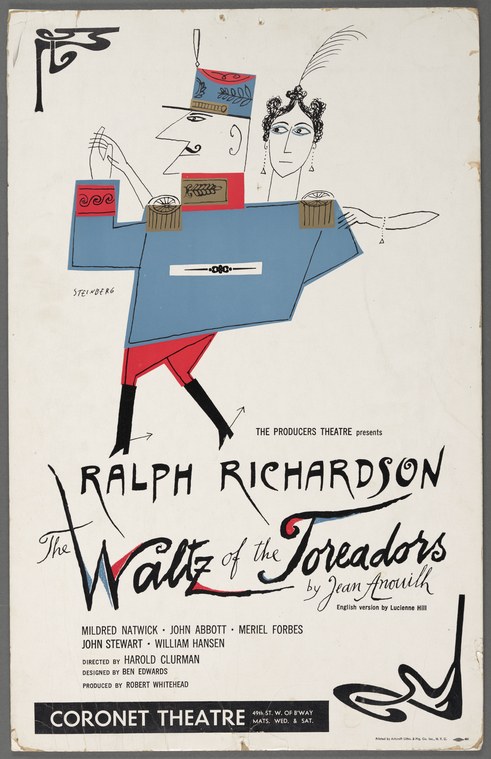
This poster illustrates the boundary between dance as a visual motif and dance as a choreographic practice. For historians of twentieth-century visual culture, it shows how the dancing body became a standardized symbol of theatrical glamour and modernity, independent of whether dance was central to the work being advertised. The execution demonstrates the sophistication of Art Deco graphic design in rendering the human figure for public appeal.
What you are looking at
This is a theatrical poster for a play rather than a depiction of actual dance. The central figure is a stylized, elongated male dancer in military dress—a blue tunic with red trim, gold epaulettes, and black boots—shown in a dramatic contrapposto stance with one leg extended and arms spread wide. His face is rendered in profile with exaggerated features and a tall military cap topped with a plume; his expression is theatrical and slightly grotesque. He wears what appears to be military insignia and holds an ornate sword or saber. The figure is shown against a cream background with decorative Art Deco line work in the upper left and lower right corners. The composition is typical of 1920s theatre advertising: the dancing figure dominates the composition and demonstrates movement through the extended limbs and dynamic posture, while the typography below—identifying the play as *The Waltz of the Toreadors* by Jean Anouilh, starring Ralph Richardson, presented by the Producers Theatre at the Coronet Theatre—is integrated into the design. The stylization is distinctly modern, with elongated proportions and simplified line work characteristic of Art Deco graphic design.
The dancing
The single figure demonstrates an exaggerated balletic stance—one leg raised and turned out, arms extended asymmetrically, weight shifted into an extreme contrapposto. This is not a naturalistic representation of waltz or any authentic dance technique, but rather a theatrical shorthand for 'dancer' or 'choreographed movement.' The posture suggests lightness and artifice rather than ballroom technique. The costume—military dress rather than dance wear—indicates that this is a character dancer, not a concert dancer.
The dance depicted
The image depicts a character from a theatrical production, not ballroom waltz itself. *The Waltz of the Toreadors* is a play, not a ballet or dance work, and the image advertises the work as a theatrical vehicle for the actor Ralph Richardson. The title plays on the famous orchestral interlude from Bizet's *Carmen*, suggesting Spanish and dance themes, but the visual content here is one character's dramatic pose, not documentation of dance-making. The 'waltz' in the title is referential rather than central to the dramatic action.
How it was made
This is a lithographic theatre poster, a commercial print medium that allowed for bold colour separation, simplified forms, and high-contrast design suitable for street visibility and rapid reproduction. The technique—likely colour lithography—is evident in the flat areas of colour (blue tunic, red trim, cream background), the crisp black line work, and the integration of typography as a compositional element. The style and printing process place this firmly in the interwar commercial poster tradition, when theatre advertising adopted modernist and Art Deco aesthetics to compete visually in urban environments.
About this work
This is a theatrical poster advertising a performance of Jean Anouilh's play *The Waltz of the Toreadors* at the Coronet Theatre in London, likely from the 1950s based on the production details. The poster uses a stylized, dancing figure in military costume as its visual anchor—a convention of theatre advertising that invokes movement and spectacle even though the work advertised is not itself a dance production. The image demonstrates how dance imagery functioned as shorthand for theatrical excitement and modernity in twentieth-century advertising. While not a document of actual dance practice, the poster is significant for what it reveals about how dance was deployed as a visual and cultural symbol in theatre promotion.
How to look at it
Attend to the exaggeration: the impossibly long legs, the tilted head, the spread arms. This is not naturalistic movement but theatrical shorthand—the artist is signalling 'this is a show' through distortion rather than observation. Notice how the military costume both anchors the figure to the play's narrative (a military officer is at the play's centre) and provides a framework for the extended limbs and dynamic pose. The poster assumes that viewers will read a dancing figure as inherently exciting and modern, regardless of whether the play contains dance.
The artist
The poster is credited in small script to an artist whose signature appears to read 'Feliks' or similar (lower right corner). No further information on the artist is recorded. The style is consistent with the commercial poster design of the 1950s London West End, when bold stylization and simplified form were standard in theatre advertising.
The period
This poster dates to the post-war London theatre scene, likely the early 1950s. *The Waltz of the Toreadors* was first performed in France in 1952 and reached London shortly after. The theatrical world was in ferment: ballet companies like the Royal Ballet and Festival Ballet were establishing themselves, while straight theatre embraced modernist aesthetics in both production design and advertising. The poster's Art Deco vocabulary—itself now retrospective, as the style had peaked in the 1930s—persisted in theatrical contexts as a marker of glamour and cosmopolitan taste. The choice to advertise a non-dance play with a dancing figure reflects the cultural prestige of dance in the early 1950s and the visual appeal of the moving body to commercial designers.
Where it lives
The poster is held in the New York Public Library collection and is catalogued as theatre advertising from the mid-twentieth century. It is a commercial printed object, produced for street display and public advertisement, and survives as a record of theatrical promotion practices and graphic design of the period.
Questions about this work
Is this a ballet or a dance work?
*The Waltz of the Toreadors* is a comedic play by the French playwright Jean Anouilh, not a dance work. The poster uses a dancing figure as a visual advertisement strategy, but the work itself is straight theatre. The title alludes to the famous orchestral interlude from *Carmen*, giving the play a theatrical and vaguely Spanish flavour, but dance is not central to the performance.
Who designed this poster?
The artist's name appears in small script on the poster but is difficult to read with certainty from the image. No full attribution is recorded in the catalogue.
Why would a theatre poster show a dancing figure if the play isn't about dance?
In twentieth-century theatre advertising, the dancing body became a visual shorthand for excitement, modernity, and entertainment value. A leaping or graceful figure would appeal to audiences and suggest spectacle, regardless of whether dance appeared in the production. The stylized, athletic pose signals that this is a theatrical event worth attending.
What is the waltz of the toreadors?
The title references Bizet's *Carmen*, particularly the 'Toreadors' March.' Anouilh's play is a comedy of manners set in France, centred on an aging general and his romantic entanglements. The title is playfully ironic rather than literal—there is no actual waltz of toreadors in the play, but the reference evokes Spanish passion and operatic melodrama, which Anouilh satirizes.
More Waltz artwork