49 works in this view — arrow keys or swipe to move between them.
Dance in Art
The Waltz of the Toreadors
Unknown artist
- Dance:
- Waltz
- Era:
- Early 1800s (Waltz Revolution)
- Source:
- New York Public Library
- Rights:
- Public domain — free to use, share and adapt.
- Recorded as:
- public_domain
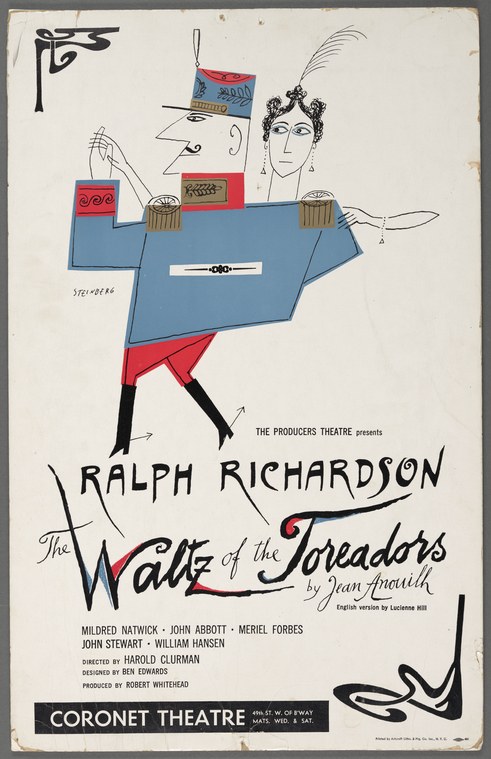
The poster demonstrates how dance and theatrical culture intersect in early-to-mid 20th-century commercial design: the waltz is named but not shown, while the torero—a non-dance male performance role—is visualized as the emblem of Spanish theatre and international glamour. It shows the period's appetite for European theatrical imports and the way modernist graphic design flattened and abstracted the human body for commercial effect.
What you are looking at
This is a theatrical poster for a stage production featuring a stylized, abstracted figure of a bullfighter (torero) rendered in an Art Deco or modernist style. The central figure wears the distinctive traje de luces—the sequined jacket, breeches, and stockings of a torero—depicted in blue with red and gold accents. The figure strikes a dramatic, confrontational pose with arms extended outward, one hand gesturing assertively. The body is elongated and flattened, treated almost as a decorative shape rather than naturalistic anatomy. A tall red flag or cape element rises from behind the figure's head like a plume or crest. The composition is frontal and symmetrical, treating the torero as a heraldic emblem of Spanish theatrical culture. The poster advertises a production called "The Waltz of the Toreadors" by Jean Anouilh, produced at the Coronet Theatre. Production credits are printed below, including Ralph Richardson in the lead role. The design employs bold outlines, primary colors, and angular geometry characteristic of early-to-mid 20th-century graphic design.
The dancing
A single figure dominates the composition, depicted frontally with arms spread wide in an exuberant, confrontational stance. The body is schematized and flattened rather than three-dimensional—the torso becomes a geometric shape, the legs are rendered as linear forms in black stockings and heeled shoes. There is no realistic weight distribution or grounding; instead, the figure appears to float or stand at an impossible angle, its dynamism conveyed through linear gestures and the spread of the arms rather than through anatomical conviction. This is design, not dance notation, yet the spread-armed pose and the theatrical flourish suggest performance energy.
The dance depicted
The image does not depict actual dance movement, though it advertises a theatrical work titled "The Waltz of the Toreadors." This is a stage play, not a dance piece, though the waltz is referenced in the title. The torero costume and posture are theatrical symbols of Spanish culture and masculine bravado rather than representations of waltz or bullfighting choreography. The poster makes no claim to show how either waltz or toreador movement was actually performed; it is a stylized emblem designed to attract an audience through visual impact and cultural association.
How it was made
This is a lithographic poster, a medium that dominates theatrical advertising in the early-to-mid 20th century. The technique allows bold, flat areas of color separated by strong black outlines—economical to print and striking in display. The simplified, graphic treatment of the figure is both a stylistic choice and a technical necessity of lithography, which favors bold shapes over gradation. The artist's signature and date notation are visible but partially unclear. The condition suggests this is an archival object, likely preserved from a theatrical archive or collection, and it circulated as a street poster and lobby advertisement for a live theatrical production.
About this work
This is a theatrical poster from the mid-20th century advertising Jean Anouilh's play "The Waltz of the Toreadors" starring Ralph Richardson. Rather than depicting the play's action, it presents an abstracted, heraldic image of a torero (bullfighter) in full theatrical dress, treated as a modernist design object. The torero becomes a symbol of Spanish theatrical culture and masculine performance rather than a representation of actual movement. The poster belongs in a dance history collection not because it documents dance, but because it uses the cultural imagery and bodily gesture of a culturally specific male performance role to sell theatrical entertainment, and because the waltz—a ballroom dance form—is invoked in the title despite the image showing neither waltz nor ballroom content.
How to look at it
Observe the artificiality of the pose: the arms extended impossibly wide, the body flattened into a silhouette, the weight hanging nowhere in particular. This is not a naturalistic rendering of a human body but a heraldic or emblematic treatment, treating the torero as a symbol rather than a person. The choice to show the figure frontally, arms spread, creates a mirror-symmetry that makes the image both stable and theatrical—a coat of arms of Spanish culture. The red flag or plume rising from behind the head reads as both costume detail and purely decorative element, suggesting both the capote (bullfighter's cape) and a stage flourish.
The artist
The artist is not identified in the record or legible on the poster image provided. The work is credited to The Producers Theatre and designed by Ben Edwards (set designer) and Robert Whitehead (producer). The graphic style is consistent with mid-20th-century American theatrical poster design, which drew on European modernist and Art Deco conventions.
The period
Jean Anouilh's "La Valse des Toréadors" premiered in Paris in 1951; this is an American production at the Coronet Theatre. The postwar period saw a flourishing of European theatrical imports to Broadway and off-Broadway venues, particularly French comedies and dramas. The visual language of the poster—geometric, flattened, using primary colors and bold outlines—reflects the influence of European modernism (particularly Art Deco and the Vienna Werkstätte) on American commercial design of the 1950s. The waltz itself had long ceased to be a living social dance in this period but persisted as a nostalgic, cosmopolitan reference in theatrical and literary contexts.
Where it lives
This poster is held in the New York Public Library collection and is likely a preservation copy from a theatrical archive or the library's own collections of American theatre materials. It is a primary document of American theatrical production and graphic design from the mid-20th century.
Questions about this work
Is this about dance?
Not directly. This is a poster for a theatrical play (Jean Anouilh's comedy) that happens to reference the waltz in its title and features the costume and pose of a Spanish bullfighter. It is included here because the waltz and theatrical male performance are invoked, but the poster itself shows neither waltz movement nor actual choreography.
Why is the figure drawn this way?
The flattened, geometric style is both a modernist artistic choice and a technical feature of lithographic printing, which economically separates bold shapes and colors. The heraldic treatment—symmetrical, frontal, with spread arms—makes the torero an emblem or symbol rather than a naturalistic figure, fitting for theatrical advertising that aims to intrigue and attract rather than narrate.
What is 'The Waltz of the Toreadors'?
A French comedy by Jean Anouilh, first staged in Paris in 1951 and later produced on the American stage. It is a play about romantic entanglement and masculine vanity, not a dance piece. The title uses the waltz as a poetic reference to European sophistication and social ritual.
More Waltz artwork