32 works in this view — arrow keys or swipe to move between them.
Dance in Art
Ernestine Wuthier
Unknown artist
- Collection:
- Prints depicting dance
- Source:
- New York Public Library
- Rights:
- Public domain — free to use, share and adapt.
- Recorded as:
- Public Domain
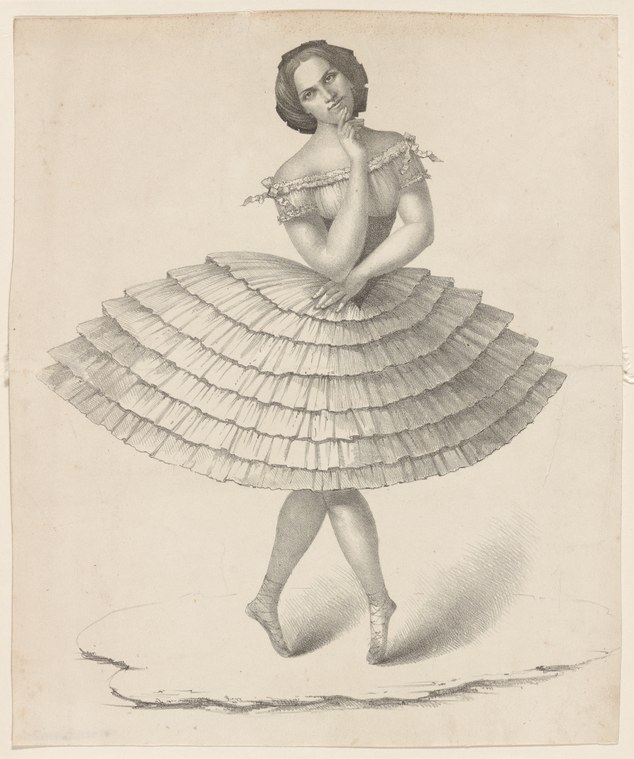
This engraving is valuable as a named record of a mid-19th-century theatrical dancer and the specific costume conventions of her era. The extreme attention to the pleated skirt—rendered with near-architectural precision—is itself a historical document of the textile and structural engineering required for theatrical costume at a moment when such garments defined a performer's stage presence and technical demands.
What you are looking at
A single female dancer, identified as Ernestine Wuthier, poses in a moment of suspended movement against a plain background. She wears a short-sleeved dress with a low neckline and a dramatically voluminous skirt composed of dozens of precisely rendered horizontal pleats or flounces that extend to mid-calf. Her posture is elegant and composed: weight appears to rest on the balls of both feet, and her left arm is raised to frame her face in a gesture of reverie or contemplation. Her head tilts slightly upward. The figure is rendered in fine engraving technique with careful attention to the texture of fabric and the modeling of skin. The composition is a studio portrait; the dancer occupies the center of the sheet, isolated against white space, with a shadow line at the base suggesting a floor line but no other setting. The overall effect is one of refined display—a record of both the dancer and the distinctive technical costume of her era.
The dancing
The dancer stands in an almost stationary pose, weight distributed evenly on both feet with legs straight but not rigidly so. The upper body is composed and upright, with the left arm curved gracefully upward to the head. The right arm hangs by the side. The head tilts back slightly, and the gaze is directed upward, creating an impression of lightness and escape. There is no obvious tension in the frame; the overall effect is of stillness caught between moments of motion rather than a moment of active dancing.
The dance depicted
This appears to be a theatrical dance portrait from the mid-to-late 19th century, likely from the romantic ballet or theatrical dance world. The costume—particularly the expansive skirt with its geometric, precisely pleated flounces—suggests a promotional or memorial engraving of a named dancer, a common format for recording celebrated performers of the ballet stage. The pose itself does not depict a specific technical step but rather the kind of graceful, composed attitude favored in theatrical portraiture: the artist has chosen a moment that displays the costume and the dancer's elegance rather than technique in action. The raised arm and tilted head are characteristic of the theatrical pose vocabulary of romantic-era ballet.
How it was made
This is a fine engraving, rendered in line work with careful cross-hatching and stippling to create tone and shadow. The technique allows for precise reproduction of fine detail—the individual pleats of the skirt are counted and rendered individually, and the fabric texture and skin modeling are highly refined. The work has the character of a commercial theatrical engraving, the kind produced for circulation as a souvenir or promotional print of a named performer. Such engravings were a primary means of documenting and promoting dancers before the advent of photography, and they typically combined portraiture with costume display.
About this work
This is a named theatrical portrait engraving of the dancer Ernestine Wuthier, produced as a studio recording and circulation print from what appears to be the mid-19th century. The image documents both the dancer's celebrated presence and the distinctive voluminous pleated skirt that defines her costume—a garment that required significant technical control to manage on stage. The work is characteristic of theatrical dance portraiture from the romantic ballet era, a period in which engravings of celebrated dancers were produced and distributed as promotional and commemorative objects, analogous to modern photographic theater stills. Wuthier herself appears to have been a performer of note whose name was considered sufficient to identify the work, though few biographical details survive in the present record.
How to look at it
Attend first to the skirt: the artist has devoted extraordinary labor to rendering each pleat individually and with precision, suggesting that this garment was itself a marvel of costume engineering and a significant part of what audiences came to see. Notice the dancer's upper body and pose—she is not captured mid-leap or mid-turn, but rather in a composed, stillness that emphasizes grace and control. The upward tilt of the head and the raised arm are elements of theatrical pose vocabulary; this is a formal presentation rather than a moment of dynamic action. The isolation of the figure against white space and the careful attention to light and shadow are hallmarks of theatrical portraiture designed to record a named performer for circulation and memory.
The period
This work dates from an era in which theatrical dance, and particularly ballet, was at the height of its cultural prominence and market value. Named dancers were celebrated figures, and engravings and lithographs of performers were a standard commercial product—collected by enthusiasts, used as promotional material by theaters, and preserved as souvenirs. The mid-19th century saw the flowering of romantic ballet, characterized by ethereal movement vocabulary, tutus and other elaborate costumes, and a focus on the individual dancer as a celebrated star. Engraving was the primary medium for mass reproduction and circulation of theatrical images before photography became standard in the 1870s–1880s.
Where it lives
The work is held in the NYPL's collection of prints depicting dance. It is catalogued by the name of the dancer, Ernestine Wuthier, rather than by known artist, suggesting that the engraver's identity has not been recorded or preserved in the collection's metadata.
Dance in this work
Questions about this work
Who was Ernestine Wuthier?
Ernestine Wuthier was a theatrical dancer active in the mid-19th century, celebrated enough to have her portrait engraved and circulated as a commemorative print. Beyond this image, few biographical records survive in public collections, a common fate for performers whose fame was primarily local or whose careers were ended by the advent of photography and new forms of celebrity documentation.
Why is the skirt so elaborate?
The voluminous pleated skirt was a signature element of theatrical costume in the romantic ballet era. Such garments required considerable technical control to move in, and their visual spectacle—the way they caught light, moved, and created silhouette—was a central part of the aesthetic effect. The precision of its rendering here suggests it was as important to how audiences understood the dancer as her technique was.
What dance style does this represent?
This appears to be romantic-era theatrical ballet or theatrical dance, likely from the mid-19th century. The pose and costume align with stage conventions of that period rather than depicting a specific named step or technique. The portrait format prioritizes the dancer's presence and elegance over the documentation of a particular movement vocabulary.
Why use an engraving instead of a photograph?
This work predates the widespread commercial use of photography for theatrical portraiture, which became standard only in the 1870s–1880s. Engraving allowed for fine detail, careful composition, and the kind of idealized presentation that theaters and dancers favored; the artist could emphasize costume and pose while controlling tone and line in ways that early photography could not easily match.
More dance artwork





