33 works in this view — arrow keys or swipe to move between them.
Dance in Art
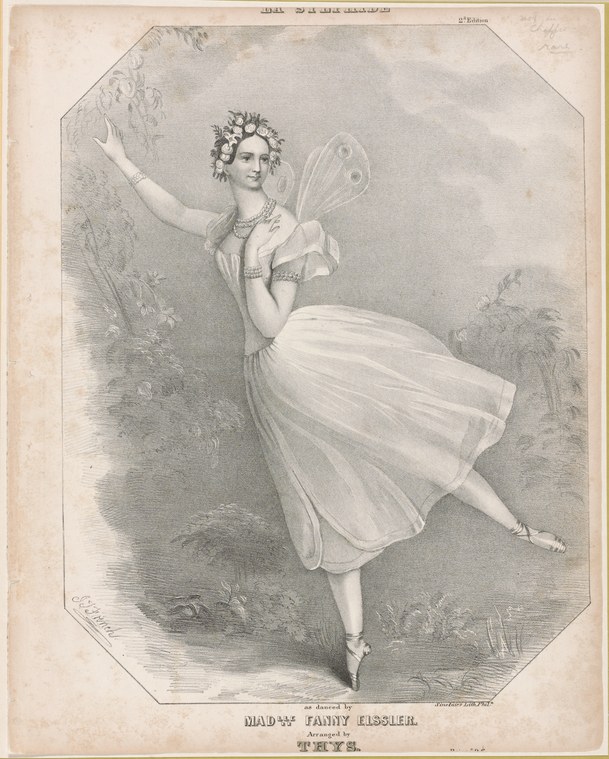
La sylphide, 2d edition as danced by Madlle Fanny Elssler
Unknown artist
- Collection:
- Prints depicting dance
- Source:
- New York Public Library
- Rights:
- Public domain — free to use, share and adapt.
- Recorded as:
- Public Domain
Fanny Elssler was one of the two greatest Romantic ballerinas of the 1830s–40s (the other being Marie Taglioni), and this image documents her performance in the most iconic Romantic ballet. For dancers and historians, the image shows the actual silhouette, costume, and carriage of a legendary performer; for art historians, it exemplifies the Romantic fascination with the supernatural and the feminine. The engraving also reveals how theatrical celebrity was created and circulated before photography: through mass-produced prints that fixed an image of a star and a role in the public imagination.
What you are looking at
A young woman in Romantic-era theatrical dress stands alone against a misty woodland backdrop, captured mid-movement in a pose of ethereal suspension. She wears a short-sleeved white muslin dress with a voluminous skirt extending to mid-calf, and a wreath of flowers crowns her head. Her right arm extends upward in an arc of greeting or benediction, while her left arm reaches to her side; her body tilts slightly, and her legs are positioned as though she is rising onto the balls of her feet. Behind her, indistinct trees and shrubs fade into soft shadow. The engraving's fine cross-hatching creates an impression of gauzy lightness and romantic melancholy. The whole composition—the solitary figure, the woodland setting, the uplifted gaze—evokes the supernatural world of the Romantic ballet.
The dancing
A single dancer shown in profile and three-quarter view, her body weight appearing to transfer onto her right leg while the left extends behind or beneath her skirts. Her arms frame her body in an open position, neither held in a classical balletic frame nor in folk positions. The upward reach of her raised arm, combined with the forward tilt of her torso and the lift through her legs, suggests a moment of elevation or flight rather than a grounded stance. The pose has the elongation and verticality characteristic of Romantic ballet technique, with emphasis on the illusion of weightlessness.
The dance depicted
This is a portrait of the Sylphide, the central character from the 1832 ballet *La Sylphide* (choreography by Filippo Taglioni, music by Jean-Madeleine Schneitzhoeffer). The inscription confirms this is the work "as danced by Madlle Fanny Elssler," one of the era's greatest Romantic ballerinas. Elssler danced the role of the Scotch Sylph (a supernatural female spirit) in this narrative ballet, which depicts a mortal's tragic infatuation with an ethereal creature. The costume and pose show the hallmarks of Romantic ballet: the ethereal white dress (the *tutu* of the period), the flower crown suggesting both nature and otherworldliness, and the verticality and arm placement associated with the pointe-work and épaulement of the Taglioni school. The engraving immortalizes not the formal technique but the romantic *character* and the effect of weightless grace that was the whole point of the role.
How it was made
This is a steel or copper engraving, printed from a plate and distributed as a commercial theatrical souvenir—likely a lithographed print hand-colored with watercolor or tempera. The medium allowed mass reproduction of a celebrated performance image for a paying audience, and the fine line-work and careful modeling of light create the soft, almost dreamlike quality appropriate to the subject. The inscription and publication information would have been engraved or added lithographically. As a mass-produced theatrical print, this work documents not a historical performance or a specific night, but the *idea* of the Sylphide as Elssler embodied it—the canonical image of this most famous Romantic role.
About this work
A romantic-era theatrical engraving of the Sylphide, the supernatural heroine of the 1832 ballet *La Sylphide*, depicted in the iconic costume and pose associated with the role's most celebrated interpreter, Fanny Elssler. The work is a commercial theatrical print designed to circulate an image of a celebrated performer and a canonical Romantic ballet character to the theatregoing public. It belongs in a dance history collection both as documentation of a landmark work in ballet history and as evidence of how Romantic ballerinas were marketed, remembered, and imagined by audiences of the time. The engraving captures the aesthetic of Romantic ballet—its emphasis on lightness, ethereality, and the feminine supernatural—in a medium that made the image widely available and enduring.
How to look at it
Note the precise moment the engraver chose: not a leap or a turn, but a moment of stillness and grace—a pose that suggests both presence and evanescence. Observe how the artist rendered the muslin skirt with fine parallel lines to suggest its translucency and how the body emerges from it with an impression of height and lift. The pose itself is not a classical ballet position; instead, it conveys the *feeling* of Romantic ballet—the sense that the dancer is suspended between the earthly and the supernatural. The woodland background and the solitude of the figure reinforce the narrative context: this is the Sylph as she appears to the mortal protagonist, isolated and otherworldly.
The artist
The engraver is not recorded in the catalog. Theatrical souvenir prints of this era were often unsigned or attributed only to the lithographic house. The style and inscription suggest this was made in Paris or London in the 1830s or early 1840s, in the commercial theatrical print trade that flourished during the height of Romanticism.
The period
The 1830s and 1840s were the golden age of Romantic ballet. *La Sylphide* (1832) was the defining work of the movement, pioneering the use of pointe-work, the short white tutu, and the ethereal female spirit as a central character. The ballet arrived just as Romantic painting, poetry, and music were celebrating the supernatural, the natural world, and the purity and fragility of the feminine ideal. Fanny Elssler, an Austrian dancer, became an international star through her interpretations of Romantic roles, particularly this one. The commercial print industry that produced images like this one capitalized on the celebrity of great dancers and the hunger of audiences to own images of their favorite performers.
Where it lives
The New York Public Library holds this engraving as part of its collection of theatrical prints and dance imagery. It is a commercial souvenir print, likely one of many issued during Elssler's performing years or shortly after. Such prints were sold at the theater or through print shops and were affordable enough for a broad audience.
Dance in this work
Questions about this work
Who was Fanny Elssler?
Fanny Elssler (1810–1884) was an Austrian ballerina who became one of the two greatest stars of the Romantic era, alongside Marie Taglioni. She was famous for her technical brilliance, her dramatic intensity, and her ability to dance both ethereal supernatural roles (like the Sylphide) and more grounded, earthly characters. She toured internationally and was a celebrity of her time.
What is *La Sylphide* and why is it important?
*La Sylphide* (1832), choreographed by Filippo Taglioni and danced by his daughter Marie, was the first great Romantic ballet. It established the aesthetic that defined the era: the white tutu, pointe-work as a standard technique, and the supernatural female spirit as a dramatic character. The ballet has been restaged continuously since and remains central to the ballet repertory.
What is a theatrical print, and why are they important to dance history?
Theatrical prints were commercial engravings or lithographs sold to audiences as souvenirs of celebrated performances. Before photography, they were the primary way audiences could own an image of a favorite dancer or remember a performance they had seen. They document the aesthetics, costume, and celebrity of historical dance.
What does the pose tell us about Romantic ballet technique?
The pose—with its emphasis on verticality, elongation, the reach of the arms, and the apparent lightness of the body—shows the key technique of Romantic ballet: making the dancer appear weightless and ethereal. The lifted, almost floating quality, achieved through pointe-work and precise épaulement (arm and shoulder placement), was the whole point of the style.
More dance artwork





