39 works in this view — arrow keys or swipe to move between them.
Dance in Art
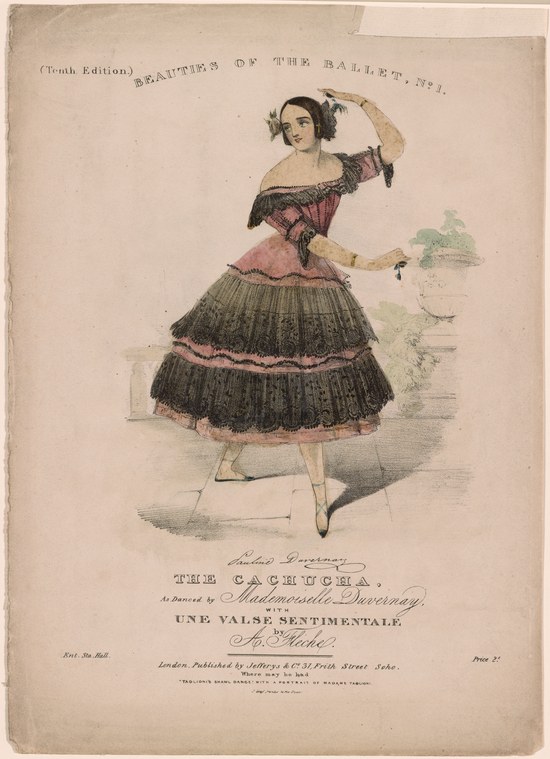
The cachucha as danced by Mademoiselle Duvernay, with Une valse sentimentale by A. Flèche
Unknown artist
- Collection:
- Prints depicting dance
- Source:
- New York Public Library
- Rights:
- Public domain — free to use, share and adapt.
- Recorded as:
- Public Domain
The cachucha was one of the most celebrated and controversial dances of the Romantic era—admired for its technical brilliance but criticized for its hip-centered movement and sensuality. Images like this one show how the dance was packaged for respectable middle-class audiences through the aesthetics of Romantic ballet: elongated lines, ethereal costuming, and the presentation of the dancer as a composed, elegant figure. The print itself is a document of how dance fame circulated in the nineteenth century, before photography, through hand-colored theatrical prints distributed to the public.
What you are looking at
A single female dancer in a theatrical pose dominates the composition, captured mid-movement against a pale background with minimal scenic elements. She wears a striking off-shoulder dress with a fitted bodice in rose or mauve silk and a voluminous skirt composed of multiple tiers of dark fabric—likely black or deep charcoal—with pink or mauve ribbon trim between the layers, creating a dramatic silhouette. Her dark hair is styled with ringlets and adorned with what appears to be a jeweled or feathered ornament. She raises one arm gracefully above her head while the other extends to the side, her body angled in a posture of elegant repose or frozen motion. Her legs are extended, showing the characteristic turned-out alignment of theatrical dance. A small landscape vignette appears in the background at lower right, suggesting a romantic or pastoral setting. The work is executed as a hand-colored engraving or lithograph, with soft tones that heighten the theatrical glamour of the presentation.
The dancing
The dancer stands in a carefully composed, balletic stance with turned-out legs and pointed feet. Her frame is open, with one arm raised in a graceful arc overhead and the other extended outward at shoulder height, suggesting a moment of sustained, controlled elevation or poise rather than vigorous action. The positioning of her body suggests the pulled-up posture and elongated line expected of a trained theatrical dancer of the period. Her weight appears centered and balanced, characteristic of the formal, stylized presentation typical of Romantic-era dance imagery.
The dance depicted
This is a portrait of Mademoiselle Duvernay performing the cachucha, a Spanish-inflected theatrical solo that became one of the signature roles of the Romantic ballet era. The cachucha was a spectacular display piece—a rapid, footwork-heavy dance with energetic hip action and rhythmic precision, often performed in ballets set in Spain or featuring Spanish characters. However, this image captures the dancer in a moment of arrested, elegant poise rather than the frenetic action the dance itself required. The inscription indicates this is paired with 'Une valse sentimentale' by A. Flèche, suggesting the print documented a specific performance or role. The printed text credits the choreography or arrangement to 'Mademoiselle Duvernay,' possibly indicating her role in creating or adapting the version performed.
How it was made
This is a hand-colored engraving or lithographic print, a medium that allowed for mass production and wide circulation among the theatergoing public and dance enthusiasts. The technique of selective hand-coloring over a printed base—visible in the careful attention to the costume's rose and mauve tones against the dark skirt layers—was typical of theatrical portraiture from the 1840s, when demand for images of celebrated dancers was high. The inscription at the base follows the conventions of commercial theatrical prints, with the dancer's name, the dance titles, and publication information included for identification and marketing. Such prints served as both souvenirs and promotional materials, extending a dancer's celebrity beyond the theater.
About this work
This is a theatrical portrait print of a celebrated mid-nineteenth-century dancer in one of the Romantic era's most glamorous and technically demanding roles. The cachucha was a vehicle for virtuosity and exotic allure—it allowed dancers to display rapid footwork, rhythmic precision, and a sensuality coded as Spanish in an era fascinated by romantic nationalism and picturesque setting. The print captures not the violence and speed of the actual dance, but the poised, elongated elegance of the trained Romantic ballerina, presenting her as an object of aesthetic admiration. It belongs in a gallery of dance art because it documents both a specific historical performance tradition and the visual culture through which that tradition was consumed and celebrated by audiences and collectors.
How to look at it
The image asks you to attend to the tension between the dance's known character—rapid, rhythmic, hip-centered, sensual—and the body the artist has chosen to show: elongated, composed, balletically formalized. This is not a documentary image of the cachucha in motion, but a portrait of a celebrated dancer in a moment of poised elegance. Notice the costume: the voluminous tiered skirt would have allowed and concealed the hip rotation the cachucha required, while the off-shoulder bodice presents the dancer as both accessible and elevated. The raised arm and extended leg follow the conventions of Romantic ballet portraiture, signaling sophistication and refinement to a middle-class viewer. The small landscape vignette anchors the figure in a romantic or exotic setting, even as the formal pose removes the dancer from the heat of actual performance.
The artist
The artist is not recorded. The print was published by Jeffreys & Co. of Frith Street, London, a commercial publisher of theatrical and fashion prints in the mid-nineteenth century. Such firms employed engravers and colorists as skilled artisans in a workshop system; the quality of execution suggests a competent if not exceptional practitioner of the theatrical print tradition.
The period
This print dates to the height of the Romantic ballet era, when the cachucha achieved peak popularity in London and continental Europe through the performances of dancers like Fanny Elssler (1840s). The Romantic movement had shifted ballet away from purely classical spectacle toward character dances and exotic settings that promised authenticity and national color. Spanish-themed dances like the cachucha occupied a special place in this imagination—they offered the allure of sexual energy and folk authenticity while remaining safely contained within the formal structures of theatrical spectacle and the balletic body. The print's style and inscriptions suggest it dates to approximately the 1840s, during the height of Romantic ballet's popularity and the commercial expansion of theatrical celebrity culture.
Where it lives
This is a hand-colored theatrical print from the collection of prints depicting dance held by the New York Public Library. It represents the type of commercial theatrical souvenir produced in London and distributed to audiences, collectors, and the theater world during the Romantic ballet era. Such prints were affordable, widely circulated, and served as both records of celebrated performances and objects of fandom.
Dance in this work
Questions about this work
What is the cachucha and why was it so famous?
The cachucha is a rapid, rhythmic Spanish dance that became a signature role for Romantic-era ballerinas in the 1840s. It was celebrated for its technical difficulty—particularly its fast footwork and rhythmic precision—and for its sensuality, which thrilled and scandalized respectability-conscious audiences. The dance exemplified the Romantic era's fascination with 'national color' and exotic authenticity, allowing dancers to display virtuosity while performing a version of ethnic otherness.
Who was Mademoiselle Duvernay?
The inscription credits the choreography or arrangement to 'Mademoiselle Duvernay,' but the specific identity and career of this dancer cannot be confirmed from the print alone. She was likely a celebrated London or continental dancer of the 1840s, celebrated enough to warrant a commercial theatrical print. Theatrical prints of this era often featured first-rank dancers from major houses.
Why does this image look so posed and formal if the cachucha was fast and energetic?
This is not a documentary image of the dance in action, but a portrait of the dancer as a celebrated performer. Romantic-era theatrical prints typically presented dancers in a composed, balletically formalized manner—elongated, elegant, and controlled—rather than attempting to capture the actual movement of performance. This approach made the print more suitable for display and sale to a middle-class audience, and it emphasized the dancer's training and refinement rather than the raw sensuality or folk authenticity the dance itself implied.
How was this print made and how many copies were produced?
This is a hand-colored engraving or lithograph, a technique that allowed the printer to produce multiple copies with a printed base image that was then selectively hand-colored by colorists. This method was cheaper and faster than hand-painting individual portraits, making it possible to produce affordable theatrical prints for a mass market. The exact print run is unknown, but such commercial prints were produced in quantities sufficient to be found in collections today.
More dance artwork





