47 works in this view — arrow keys or swipe to move between them.
Dance in Art
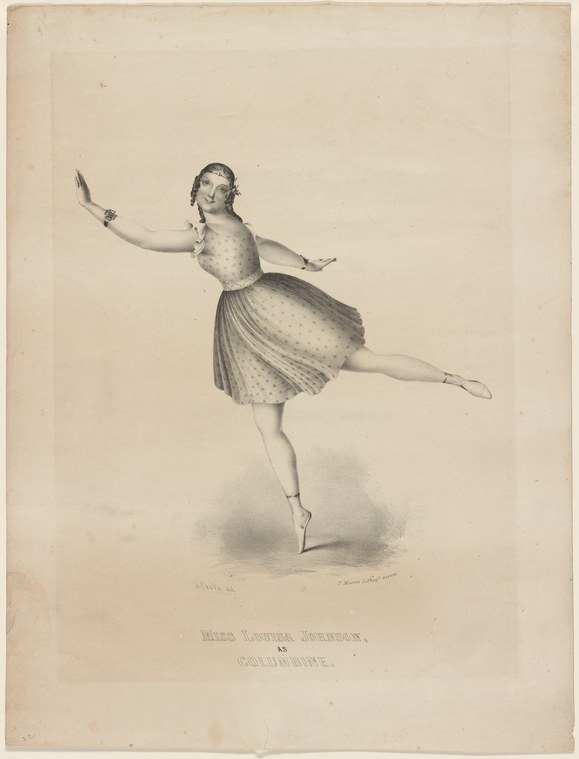
Miss Louisa Johnson as Columbine
Unknown artist
- Collection:
- Prints depicting dance
- Source:
- New York Public Library
- Rights:
- Public domain — free to use, share and adapt.
- Recorded as:
- Public Domain
This image is a direct record of how Romantic-era ballet dancers actually performed—their technique, their costume, the specific roles in which they achieved fame. For any student of early ballet history or of the transition from pantomime to pure dance, this portrait is primary evidence of both the movement vocabulary and the professional status of a working dancer. The image also documents the role of lithography in disseminating performance culture to a mass audience during a period when theatre was the primary public entertainment.
What you are looking at
A young woman in theatrical costume is captured mid-leap, her body suspended in a moment of graceful ascension. She wears a fitted bodice dotted with sequins or jewels and a voluminous skirt gathered at the waist, rendered in soft pencil tones that suggest the shimmer of silk. Her left arm extends upward and to the side in an expressive gesture, while her right arm reaches forward; her head is turned slightly, with her gaze directed outward. Her right leg extends behind her in a balletic line, while her left leg appears to push off from the ground. The figure is set against a blank, cream-colored background typical of theatrical portraiture, with only a faint shadow beneath her feet anchoring her in space. The composition emphasizes the lightness and apparent effortlessness of her movement—the very quality that made such dancers celebrated in the early nineteenth century.
The dancing
A single female dancer shown in profile and mid-jump, with an extended leg line suggesting balletic training. Her upper body is upright and mobile; the arm positions—one raised, one forward—create an open, celebratory frame. The pointed foot and the height and shape of the jump indicate rigorous classical technique. Her posture and the control visible in the suspension suggest she is not a pantomime actress but a dancer trained in the ballet vocabulary of the period.
The dance depicted
This is a Romantic-era ballet dancer, almost certainly performing the role of Columbine—a character inherited from the commedia dell'arte tradition but thoroughly absorbed into early nineteenth-century ballet vocabulary. The name and costume (fitted bodice, billowing skirt) place her in the theatrical fashion of the 1830s–1840s. The pose chosen—a soaring jump with open arms—represents the lightness and aerial quality that defined Romantic ballet aesthetics, emphasizing the dancer's apparent weightlessness and ethereal grace. The image documents the movement vocabulary and performance style that made dancers like Louisa Johnson celebrated figures in early Victorian London.
How it was made
This is a lithograph or engraving, rendered in fine pencil or crayon work on paper. The technique allows precise delineation of the figure while preserving the impression of movement through graduated tone and the studied placement of shadow. The quality of the line work—particularly in the definition of the fabric and the delicate rendering of the face—is consistent with a hand-drawn lithograph or a finely executed engraving from the 1830s–1840s. Such prints were widely distributed and affordable, making them the primary means by which theatre-goers could own and display images of celebrated performers.
About this work
This is a portrait of the dancer Louisa Johnson in her celebrated role as Columbine, a commedia dell'arte character transformed into a vehicle for Romantic ballet technique. The print documents both a specific performer and a moment in theatrical history when ballet was establishing itself as the dominant form of spectacle on the London stage, and when images of dancers were among the most popular prints in circulation. The lithograph captures the aesthetic ideals of early nineteenth-century ballet—weightlessness, grace, technical brilliance, and the subordination of the body to the representation of ethereal beauty. Johnson was a dancer of sufficient reputation to warrant a printed portrait, marking her as one of the professional women who made the London theatres culturally significant during the Romantic era.
How to look at it
Attend to the moment in the jump: the artist has chosen not the moment of takeoff or landing but the apex of flight, where the dancer appears momentarily to defy gravity. This choice is deliberate and consistent with Romantic ballet aesthetics, which valued the illusion of weightlessness. Notice also the precision of the line work in rendering the skirt—the artist has understood and depicted the specific way such tutus moved and settled in flight. The open arms and raised chin convey confidence and joy, emotions the Romantic ballet associated with lightness and freedom.
The artist
The artist is not recorded in the catalogue, but the quality and style of the work—the precision of the figure, the period-correct costume rendering, the theatrical portraiture conventions—suggest a professional print-maker or theatre illustrator working in London in the 1830s–1840s. Portraits of celebrated dancers were a commercial enterprise during this period, and such prints were often made without attribution to the individual artist, credited instead to the theatre or the publisher.
The period
This print dates to the height of the Romantic ballet era in Britain, when dancers like Marie Taglioni and Clara Vestris were international celebrities and the ballet had eclipsed pantomime as the form most likely to draw crowds and command high ticket prices. The role of Columbine, while inherited from earlier theatrical tradition, had become thoroughly integrated into the classical ballet repertory by the 1830s, providing an opportunity for the display of jumps, turns, and the lightness of movement that Romantic aesthetics prized. The commercial production of such prints—often hand-colored and distributed to theatres and sold to admirers—reflects the nascent modern celebrity culture, in which the dancer became an object of public fascination and commercial reproduction.
Where it lives
This print is held by the New York Public Library in a collection of prints depicting dance. It is a lithograph or engraving from the early nineteenth century, part of the commercial print culture of London theatre during the Romantic era.
Dance in this work
Questions about this work
Was Louisa Johnson a famous dancer?
She was celebrated enough in London theatre to warrant a printed portrait, which indicates professional status and public recognition. Many such prints were produced during the 1830s–1840s of dancers who performed in the major London theatres, and Johnson's name has survived in the print record.
What is Columbine, and why would a ballet dancer play this role?
Columbine is a character from the commedia dell'arte tradition, a stock figure in pantomime. By the 1830s, such characters had been integrated into ballet vocabulary, becoming pretexts for the display of classical technique. The role of Columbine offered opportunities for jumps, turns, and the light, quick footwork that Romantic ballet prized.
How does the costume in this print reflect ballet fashion of the period?
The fitted bodice and full skirt were standard ballet costume during the Romantic era. The length—knee-to-mid-calf—is typical of ballet before the tutu lengthened in the later nineteenth century. The dotted or jeweled surface suggests the sequins or spangles that were sewn into stage costumes to catch light under the gas lamps that lit Victorian theatres.
Why are so many prints of dancers from this period theater portraits?
Dancers were among the most celebrated performers of the early nineteenth century, and their images sold well to theatre-goers. Lithography made it economically feasible to produce such prints in quantity, allowing admirers to own images of their favorite performers. These prints are often our best surviving evidence of how dancers of the period actually looked and moved on stage.
More dance artwork





