49 works in this view — arrow keys or swipe to move between them.
Dance in Art
Le bal des nations
Unknown artist
- Collection:
- Prints depicting dance
- Source:
- New York Public Library
- Rights:
- Public domain — free to use, share and adapt.
- Recorded as:
- Public Domain
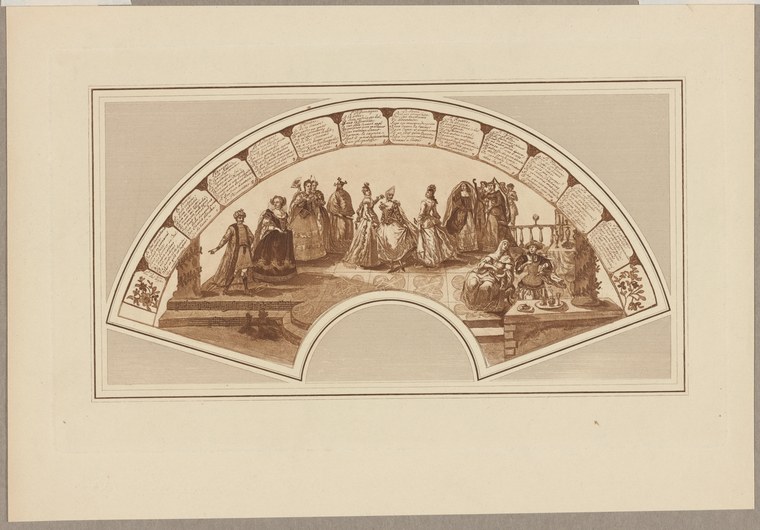
This work is a rare example of dance instruction or commemoration in an intimate, portable form, preserving knowledge of 18th-century ballroom choreography that would otherwise be known only through written sources and formal dance manuals. The fan itself—as object, not just as image—was part of the social world of dance: fans were used as props, carried to balls, and exchanged as gifts, making this a document of both dance practice and the material culture in which it lived.
What you are looking at
This is a fan-shaped design, the kind that would be printed on paper and mounted to a folding fan for the hand. The composition shows a ballroom or garden party scene across the curved field, with approximately fifteen figures arranged in a social gathering. The setting appears to be a formal interior or loggia, with classical architecture suggested by columns or a balustrade visible at the right. The figures wear the voluminous gowns and coats of the 18th century—women in wide skirts with fitted bodices, men in long coats and breeches. Some figures stand in conversation; others appear to be dancing or preparing to dance. The scene is rendered in brown or sepia tones with fine linear detail. The border of the fan is divided into small rectangular cartouches, each filled with text (the titles of the dances, presumably), and ornamental flourishes fill the corners. This is a titled and labeled document, not a generic dance scene: *Le bal des nations* suggests that each dance represents a different nation or region.
The dancing
The figures vary in pose and proximity. Some stand in closed or near-closed hold, facing one another in the formal posture of couple dances; others cluster in groups of three or four, suggesting the formations of group dances or cotillions. The women's arms are positioned variously—some raised or extended, others at the side. The men's postures are generally upright and formal. The density and arrangement of figures suggests a sequence of distinct dances or moments rather than a single continuous movement, which is consistent with the labeled sections around the border. No figures appear to be in extreme motion or asymmetrical weight-shift; all are depicted in the restrained, composed manner of 18th-century formal dance.
The dance depicted
This is a document about 18th-century ballroom dance, most likely the French coterie of country dances and contredanses (line and set dances) that dominated fashionable ballrooms from the 1690s through the 1750s, alongside minuets and quadrilles. The title *Le bal des nations* and the labeled cartouches suggest that different regions or nations had distinct dances, each represented here as a vignette. The formal dress and the ballroom setting confirm a courtly or aristocratic context. The specific dances cannot be identified with certainty from the figures alone—the postures are too generalised—but the framing device and the period point toward documented group dances like the cotillon, anglaise, or passepied, or possibly toward a series of minuet variations. This is an instructional or commemorative artifact rather than a record of a single event.
How it was made
This is a hand-colored engraving or etching on paper, mounted or meant to be mounted onto a folding fan. The technique is fine-line engraving with light cross-hatching for tone. The curved composition and the bordered cartouches are characteristic of fan-leaf design from the 17th and 18th centuries. Such fans were luxury objects—expensive, portable, and highly social. This object would have circulated among the aristocracy and wealthy merchant class, serving simultaneously as a functional object, a status symbol, and a record of fashionable dance practice. The engraved technique allowed mass production of the base image, though hand-coloring and mounting were likely bespoke.
About this work
This is an engraved fan design depicting a fashionable ballroom gathering of the 18th century, with figures arranged to illustrate different national or regional dances under the collective title *Le bal des nations*. The work is both a practical object—a fan—and a cultural document, recording the dances of the period in a format designed for display and use. It sits at the intersection of material culture, social history, and dance documentation: it tells us what people danced, how they dressed while dancing, and what it meant to own and carry an image of such refinement.
How to look at it
Look first at the labeled cartouches around the border—they are the key to reading the image. Each section of the fan corresponds to a named dance, and the figures below represent that dance in action. Notice the formal postures and the gender-segregated groupings: men in coats and breeches, women in full skirts. The artist has chosen not to freeze a moment of fast movement but rather to show the composed, upright bearing of ballroom dance, with figures often facing one another or arranged in lines. The fan shape itself matters—this is a functional object, not a framed picture, and the curved composition was designed to be held, opened, and read in the hand.
The period
This work was made during the height of the contredanse and cotillon craze in European ballrooms, a period when dances originating in England and France were standardized, codified, and exported across the continent. The 18th century saw the rise of printed dance instruction and the commercialization of dance imagery—engravings of ballroom scenes, dance notation, and instructional prints became fashionable commodities. Simultaneously, the fan had become a standard accessory in aristocratic and upper-middle-class dress, and fan designers began to commission scenes of contemporary life, including dance scenes, as subjects. This fan sits at the intersection of those two trends: the demand for dance knowledge and the appetite for portable, decorative objects that showed fashionable society in action.
Where it lives
This work is held in the NYPL's collection of prints depicting dance. It is a fan design, probably printed in the 18th century, possibly later. No accession number, artist name, or date is recorded in the catalogue.
Dance in this work
Questions about this work
What is *Le bal des nations*?
It is an engraved design for a folding fan that shows a ballroom scene labeled with different dances, each representing a different nation or region. The cartouches around the border—the small boxes with text—would have named each dance. It is a cultural document of 18th-century fashionable ballroom practice, not a record of a single, specific event.
What dances are shown here?
The specific dances cannot be identified with certainty from the image alone, but the period, dress, and formal postures point to 18th-century contredanses, cotillons, minuets, or anglaises—the standard repertory of European ballrooms in this era. The labeled cartouches around the border would have identified each one, but the text in those cartouches is too small to read in most reproductions.
Why is this a fan?
Fans were essential social objects in 18th-century elite society—functional tools for regulating heat and gesture, status symbols, and often gifts. Commissioning fan designs with scenes of fashionable life, including dance, was common. Owning and carrying a fan that depicted the dances you danced was a way of displaying knowledge, taste, and social belonging.
How would this have been used?
The engraving would have been printed on paper, then hand-colored and mounted to wooden or ivory sticks with a binding that allowed the fan to fold and open. The owner would have carried it to balls and social events, where it could be opened, displayed, and read while dancing or observing others.
More dance artwork





