49 works in this view — arrow keys or swipe to move between them.
Dance in Art
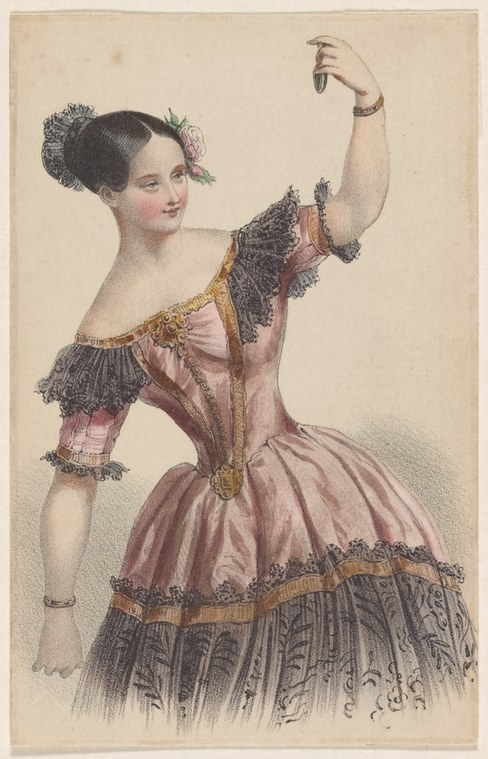
Fanny Elssler dancing the cachucha
Unknown artist
- Collection:
- Prints depicting dance
- Source:
- New York Public Library
- Rights:
- Public domain — free to use, share and adapt.
- Recorded as:
- Public Domain
Fanny Elssler was one of the first international dance superstars, and the cachucha—introduced to European audiences through her performance—became a turning point in ballet history, expanding what was considered suitable material for a prima ballerina and foregrounding the dancer's technical virtuosity and sensual presence. This print is evidence of how dance celebrities were marketed and remembered in the pre-photographic era, and of the visual culture that surrounded one of the 19th century's most famous performers.
What you are looking at
A young woman in theatrical dress stands in a three-quarter pose against a plain background, her body angled to present herself to the viewer. She wears a short pink silk skirt with black lace trim at the hem and waist, paired with a black lace off-shoulder sleeve or shawl that drapes down her left arm. Her dark hair is styled up and back with a pink flower at the crown. Her right arm is raised, with her hand held delicately near her ear in a gesture of refined attention or listening. Her left leg is bent slightly, supporting her weight, while the other is extended. The figure is rendered in hand-colored lithograph or engraving technique, with careful attention to the texture of fabrics, the contours of her figure, and the subtle modeling of flesh tones. The composition isolates the dancer against white space, emphasizing her costume and bearing as the sole focus.
The dancing
The dancer stands in a balletic posture with lifted carriage, weight primarily on one leg while the other extends, suggesting the refined turnout and verticality of early 19th-century theatrical training. Her raised right arm is held with the elbow slightly bent, the hand near the head in an attitude of grace or flirtation. The left arm hangs loosely with the gathered lace fabric creating visual interest and movement despite the stillness of the pose. The overall frame is upright and composed, with no violent action or partnering—this is a portrait stance designed to display the dancer's elegance and the intricacy of her costume.
The dance depicted
The title identifies this as a depiction of Fanny Elssler performing the cachucha, a Spanish dance that became a sensation when Elssler danced it in Paris and London in the 1830s–40s. The cachucha is a lively, rhythmic solo dance with rapid footwork and sharp hip and shoulder movements, traditionally performed to guitar or castanets. What we see here, however, is not the dance in motion but a moment of posed repose or introduction—the dancer presenting herself before or between passages of active movement. This is consistent with theatrical convention of the period, where a featured dancer would be shown in her costume and with her characteristic bearing rather than mid-phrase. The image captures the visual spectacle that made Elssler famous: the contrast between the refined, balletically trained upper body and the provocative flash of leg beneath the short skirt.
How it was made
This is a hand-colored engraving or lithograph, a mass-produced print of the kind that circulated widely in the 19th century as celebrity merchandise. The base image is printed in black or dark brown line, with the colors—particularly the pink of the skirt and the skin tones—applied by hand afterward, likely by workshop staff rather than the original artist. This technique allowed prints to reach a broad audience at modest cost, making images of celebrated dancers accessible to the theater-going public, collectors, and those who could not afford original paintings. The care taken in coloring suggests this was a higher-grade commercial product, aimed at fans and collectors of dance imagery.
About this work
This is a promotional or souvenir print of the celebrated dancer Fanny Elssler, who revolutionized European ballet and theatrical dance in the 1830s and 1840s. The image shows her in costume for the cachucha, the Spanish solo that became her signature role and a cultural phenomenon. Rather than depicting the fast, flirtatious footwork of the dance itself, the print presents Elssler as a poised, elegant figure—a fashion plate and celebrity icon. This reflects how dance was circulated and consumed in the 19th century: through prints, engravings, and other images that preserved not the movement itself but the dancer's presence, costume, and cultural status. Elssler was at the height of her fame when this print was made, and such images were both artistic tributes and commercial commodities.
How to look at it
Notice the tension between the refined, balletic posture—upright, turned out, controlled—and the hint of the exotic, flirtatious costume beneath. The short skirt and lace detail were relatively daring for a prima ballerina of the 1830s, suggesting sensuality and foreignness. The artist has chosen to show Elssler in a moment of stillness rather than action, which emphasizes her bearing and beauty and allows the costume to be fully admired. Pay attention to the treatment of fabric: the way the pink silk reflects light, the delicate rendering of the black lace, and the careful modeling of her pale skin. This is a portrait as much as a dance image—Elssler presenting herself to an adoring public.
The artist
The artist is not recorded. The print was likely produced by a commercial printmaking workshop in Paris, London, or another major theatrical center, possibly shortly after Elssler's debut in the cachucha (1834 in Paris). Such prints were often unsigned or bore only the name of the publisher or printer. The quality and finish suggest the work of an experienced printmaker with knowledge of theatrical dress and the ability to render fabric texture convincingly.
The period
The 1830s and 1840s were a pivotal moment in European dance history. The Romantic ballet—emphasizing ethereal, supernatural, or exotic themes—dominated the Paris Opéra and influenced theaters across Europe. Within this context, Elssler represented something new: a technical virtuoso who could dance classical ballet with perfect form but who also embraced national and folk idioms like the Spanish cachucha. Her rivalry with the French dancer Marie Taglioni (associated with weightless, otherworldly roles) defined the era. At the same time, lithography and hand-colored prints were becoming the primary means of circulating images of contemporary performers, predating photography by decades. This print is a product of that moment when dance was becoming a mass cultural phenomenon and when dancers could achieve celebrity comparable to modern film stars.
Where it lives
This work is held in the New York Public Library's collection of prints depicting dance, a major resource for 19th-century theatrical imagery. As an unsigned commercial print, it represents the vast category of mass-produced dance ephemera that survives in institutions but often lacks cataloguing detail.
Dance in this work
Questions about this work
Who was Fanny Elssler and why was she famous?
Elssler (1810–84) was an Austrian dancer who became an international superstar in the 1830s–40s. She was a supremely trained classical ballerina but also famous for performing national and folk dances, especially the cachucha. She represented a new type of dancer: technically perfect but also sensual and worldly, with an appeal that crossed class and national boundaries. She toured Europe and America, and her performances were major social events.
What is the cachucha and how was it danced?
The cachucha is a Spanish solo dance with rapid footwork, sharp hip movements, and flirtatious energy. It was traditionally a folk or court entertainment. When Elssler performed it on stage, she elevated it to high art while preserving its character: fast, rhythmic, sensual. It became her signature role and made her famous across Europe. Other dancers copied the role, but Elssler's version set the standard.
Why does the print show the dancer posed and still rather than dancing?
19th-century prints were typically made from drawings or paintings, not from photographs, and the goal was often to create a portrait or display of the dancer in costume rather than to capture a specific moment of action. This allowed the costume to be clearly seen and admired, and the image to serve as a lasting memento. Elssler's bearing and beauty were part of her appeal; the pose conveys her elegance and control.
How were these prints made and distributed?
This is a hand-colored lithograph or engraving, a print made by a commercial workshop. The design was carved or drawn onto a stone or plate, printed in quantity, and then colored by hand. These prints were sold in theaters, through print shops, and by subscription. They were affordable to middle-class collectors and theaters, making them a major form of advertising and fan merchandise for dancers.
More dance artwork





