49 works in this view — arrow keys or swipe to move between them.
Dance in Art
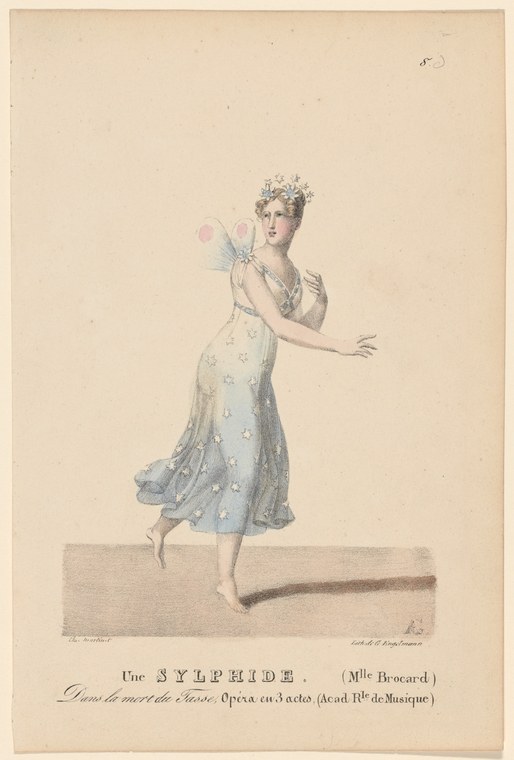
Une sylphide (Mlle Brocard) dans La mort du Tasse, opéra en 3 actes
Unknown artist
- Collection:
- Prints depicting dance
- Source:
- New York Public Library
- Rights:
- Public domain — free to use, share and adapt.
- Recorded as:
- Public Domain
The romantic sylph became the archetype of the ethereal ballerina, and this image captures the exact moment and costume that defined her: weightless, adorned, and present only as a vision. For anyone studying romantic ballet, the evolution of pointe technique, or how ballet dancers were marketed and remembered, this lithograph is primary visual evidence of what the role looked like and how it was sold to the public.
What you are looking at
A single female dancer stands in three-quarter profile against a plain background, positioned on a shallow platform. She wears a pale, diaphanous empire-waist gown decorated with small floral sprigs, and her blonde hair is crowned with a wreath of flowers. In her left hand she holds a delicate fan with pink and blue shading. Her right arm is extended gracefully outward in an attitude of weightless ease, while her body appears to float rather than stand—the pose and the ethereal quality of her costume suggest she is meant to be airborne or in the process of alighting. The rendering is a hand-colored engraving or lithograph, rendered in soft greens, blues, and flesh tones on cream paper, with careful attention to the translucence of her skirts and the ornamental details of her dress. The absence of any stage setting—no wings, no other dancers, no props—emphasizes the solitary, dreamlike quality of the figure.
The dancing
The dancer is presented in an idealized vertical alignment with one leg extended (likely en dégagé or in an equivalent soft pointed position) and the torso held upright but unsupported. Her port de bras shows a soft, open arm position with the extended arm at roughly shoulder height, fingers relaxed. There is no visible floor contact or weight bearing; the dancer appears suspended, which is the defining technical challenge of the role. Her frame is delicate and the line is continuous from her crown through her extended limbs, conveying an ethereal, almost supernatural weightlessness.
The dance depicted
This is a romantic-era sylphide, a character from the ballet *La Sylphide* (1832) that became iconic in the 1830s–1840s. The inscription confirms the sitter is Mlle Brocard, who danced this role in the French theatrical production *La mort du Tasse* (The Death of Tasso), a three-act opera. The sylph character is fundamentally defined by apparent weightlessness and aerial quality—the dancer must project an otherworldly, non-human presence. The costume (pale dress, wreath, gossamer skirts) and the suspended pose with soft extension are the visual vocabulary of the romantic sylph.
How it was made
This is a hand-colored engraving or lithograph, printed in black outline and then tinted by hand in watercolor or gouache with pale greens, blues, and flesh tones. The technique allowed for wide circulation of theatrical portraits and was a standard method of documenting dancers and roles in the 1830s–1840s. The signature reads 'lithographié à Paris' or similar (bottom right), indicating Parisian production. Hand-coloring meant each print was individually finished, giving slight variation to each copy and creating a halfway stage between unique artwork and mass-produced image—ideal for selling to ballet patrons and theater audiences.
About this work
This is a hand-colored lithograph of Mlle Brocard as the Sylphide in a French theatrical production, dating to the 1830s–1840s. The sylph was the defining character type of romantic ballet—a supernatural, weightless spirit-woman—and this portrait freezes the essential visual moment: the dancer suspended in mid-air, supported by nothing but the convention of the stage and the viewer's willing suspension of disbelief. The work documents both a specific performance and a new aesthetic ideal that revolutionized dance and its visual representation. It is among thousands of similar lithographed portraits that served as souvenirs and advertisements for the theaters and dancers of the romantic era, and it shows how carefully the romantic sylph costume and pose were codified and replicated across different productions and singers.
How to look at it
Notice the absolute stillness and verticality of the pose: there is no movement frozen mid-action, but rather a sustained, impossible moment of suspension. The extended leg and open arm are soft and weightless, not powerful or grounded. Look at the costume: the pale color and diaphanous folds are essential to the effect—this is not a human woman but a creature made of air and light. The wreath of flowers and the decorative fan situate her as both a romantic heroine and something beyond nature. The isolation on the blank platform is key: she exists in a dream world, not on the actual stage.
The artist
The artist is not recorded in the catalogue. The signature indicates a Parisian lithographic workshop, likely one of several that specialized in theatrical portraiture in the 1830s–1840s. Such prints were produced as commercial products for theater patrons and were rarely attributed to individual artists; the lithographer's name was subordinate to the dancer's name and the role title, which appear prominently in the text below the image.
The period
This lithograph was created during the height of the Romantic era in European theater (c. 1830–1850), when ballet was undergoing a radical transformation. *La Sylphide* (1832) and *Giselle* (1841) created new female character archetypes—supernatural, passive, otherworldly—that displaced the human heroines of classical ballet. The lithographic portrait became the standard form of theatrical publicity and souvenir, and images like this were collected, traded, and displayed in home albums. Opera and ballet were deeply intertwined in French theater: the same dancers might perform in both, and plot devices (the supernatural woman, the vision, the ghost) crossed freely between the genres.
Where it lives
The work is held in the New York Public Library's collection of prints depicting dance (collection code given as 'Prints depicting dance'). It is an example of the vast body of theatrical portraiture produced for and consumed by theater audiences in the mid-19th century, surviving as evidence of how specific performers and roles were visually fixed and circulated.
Dance in this work
Questions about this work
Who was the Sylphide and why does she matter?
The Sylphide is a supernatural spirit-woman who appears to a human man in the 1832 ballet *La Sylphide*. She became the archetype of the ethereal, passive female dancer in Romantic ballet—weightless, otherworldly, and ultimately untouchable. The role required new technical abilities (especially pointe work) and a new aesthetic: the dancer had to look as if gravity did not apply to her.
Why was this role also performed in an opera?
In 19th-century European opera houses, ballet and opera were closely integrated. Famous dancers performed in opera productions, often in divertissement scenes or as part of the plot. *La mort du Tasse* was an opera, but it clearly included a ballet scene or act featuring the Sylphide character, which is what Mlle Brocard is shown performing here.
How was pointe technique represented in images like this?
Lithographs rarely show pointe shoes explicitly (the rendering is too soft and small-scale), but the raised, weightless pose and the ethereal quality of the costume conveyed the idea of pointe work to viewers. The extended leg, the verticality, and the apparent absence of effort were all visual codes for the new technical demands of Romantic ballet.
Why were so many theatrical portraits lithographed?
Lithography was fast, affordable, and could be hand-colored to capture the dancer's appearance and costume in color. Prints were sold as souvenirs at the theater, collected in albums, and used as publicity. They were the equivalent of modern photographs or playbills, and thousands survive because they were made in large quantities and meant to be kept.
More dance artwork





