49 works in this view — arrow keys or swipe to move between them.
Dance in Art
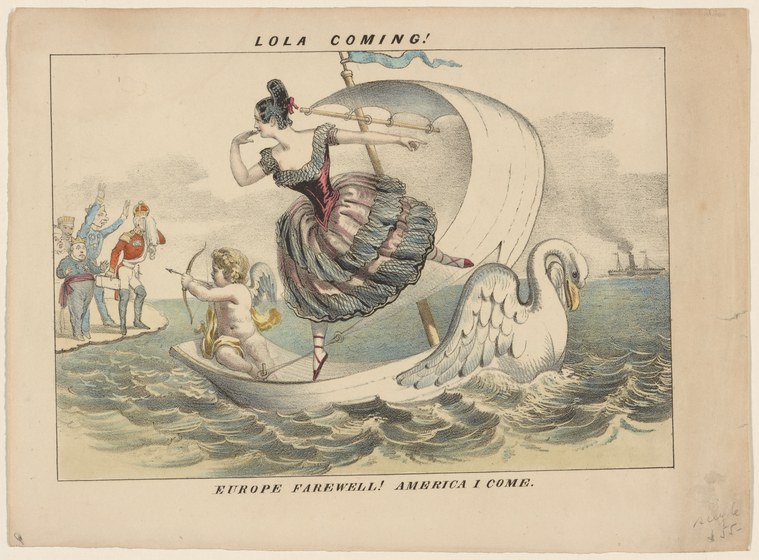
Lola coming!
Unknown artist
- Collection:
- Prints depicting dance
- Source:
- New York Public Library
- Rights:
- Public domain — free to use, share and adapt.
- Recorded as:
- Public Domain
Lola Montez was one of the first performers to achieve notoriety as much for her scandalous private life and political influence as for her dance, and this print documents how the visual language of Romantic ballet became synonymous with female transgression and power in the mid-nineteenth century. It shows that dance imagery in the period was inseparable from celebrity, sexuality, and anxieties about female agency.
What you are looking at
A theatrical satire depicting the arrival of Lola Montez, the famous dancer and courtesan whose scandalous liaisons shaped European politics in the 1840s. The print shows her descending from the sky in a shell-drawn chariot pulled by a winged cherub, arriving above a coastal shore where military and aristocratic figures await her on the beach. The composition is a classical apotheosis—Montez reclines in luxurious drapery, her body arched with theatrical abandon, one leg extended as she gestures toward the assembled dignitaries below. The sky opens above; ships and smoke signal her momentous arrival. The inscription "Europe Farewell! America I Come" frames this as a comment on her departure from Europe in 1851, fleeing political upheaval and scandal. The work is rendered in hand-colored engraving or lithography, with careful attention to the grotesque contrast between Montez's sensual, weightless pose and the rigid formality of the uniformed men below, who gesticulate in alarm or recognition.
The dancing
Lola Montez occupies the dominant compositional position: her body extends diagonally across the upper half of the print, draped in clinging silk that defines her torso and legs. Her weight is entirely suspended in the chariot; one arm extends back toward Europe while her gaze and body lean forward toward America. Below, the military and courtly figures are rendered in stiff, perpendicular poses—quite unlike Montez's fluid, sensual arch. Her body demonstrates the Romantic ballet aesthetic of weightlessness and impossible extension; the artist understood the visual language of theatrical dance of the 1840s, even as the print mocks the spectacle of Montez's performances.
The dance depicted
This is not a depiction of actual dance, but a satirical print that trades on Lola Montez's fame as a performer and the cultural resonance of her stage presence. Montez was known for the Spider Dance, a theatrical novelty piece performed in tight costumes, and more broadly for her role as muse, seductress, and political influence. The print uses the visual language of the Romantic ballet—the weightless, arched, extended body; the impossible vertical lift; the sensual drapery—to satirize her as a figure of dangerous female power and transgression. The artistic convention invokes theatrical-ballet visual language to mock Montez as spectacle rather than as a serious artist.
How it was made
This is a hand-colored engraving or lithograph, likely produced in the early 1850s for popular distribution. The technique allowed for quick satirical response to current events and scandals, reaching a broad audience across Europe and America. The use of hand color—particularly the flesh tones and the blue water—adds visual emphasis to Montez's body and the nautical setting. The fine line work of the engraved or lithographed base, overlaid with color, was characteristic of mid-nineteenth-century satirical and theatrical prints, which depended on both graphic clarity and affordable mass production to succeed as social commentary.
About this work
A satirical hand-colored print from circa 1851 depicting the arrival of Lola Montez, the Romantic-era dancer and courtesan, as a mythological apotheosis. She descends from heaven in a shell chariot, her body extended in the weightless, sensual pose of Romantic ballet, while uniformed dignitaries below react with alarm to her coming. The print uses the visual language of theatrical dance—the impossible arch, the extension, the sensuous drapery—to satirize Montez as a figure of transgressive female power. It belongs in a dance gallery because it captures how Romantic ballet aesthetics had entered popular visual culture as a shorthand for seduction, danger, and spectacle; Montez was famous less as a technically skilled dancer than as a performer whose body and presence transfixed audiences and shaped political events.
How to look at it
Note the contrast between Montez's weightless, sensuous arch and the rigid verticality of the men below. The artist chose the moment of her suspended ascent, emphasizing the impossible ease and grace of her departure—she does not flee or scramble, but rises. Observe how the drapery clings to her body, defining it in the manner of Romantic ballet imagery, and how her extended leg and arched back create a silhouette that reads as both powerful and vulnerable. The uniformed men's gestures—pointing, gesticulating, waving flags—are comic and futile against her serene elevation. This is an engraving or lithograph designed for popular consumption, using exaggerated gesture and clear compositional hierarchy to make its satirical point immediately readable.
The period
This print was produced in the early 1850s, at the height of the Romantic ballet movement in Europe. Dancers like Marie Taglioni and Fanny Elssler had established the aesthetic of weightlessness, ethereal beauty, and sensual extension that defined the era. Lola Montez, who rose to fame in the 1840s, represented a different kind of theatrical transgression: she was not a technically classical dancer but a performer whose exotic-inflected pieces (notably the Spider Dance) and highly publicized affairs with royalty and politicians made her a figure of scandal across Europe. Her departure for America in 1851, fleeing the political aftermath of the 1848 revolutions and personal outrages, was a major event in the popular press. The print captures the moment of her exit from European society, using the visual conventions of Romantic ballet—the apotheosis, the mythological chariot, the extended body—to satirize her as a figure of dangerous seduction departing one continent for another.
Where it lives
The print is held in the New York Public Library's collection of prints depicting dance. It is catalogued by title alone, with no recorded artist, date, or medium, suggesting it is a historically significant image whose creation and circulation details have not yet been fully documented.
Dance in this work
Questions about this work
Who was Lola Montez and why was she famous?
Lola Montez (1821–1861) was an Irish dancer and courtesan who rose to prominence in Europe during the 1840s. She was known for her exotic-inflected performances, particularly the Spider Dance, and for her highly publicized affairs with King Ludwig I of Bavaria and other European nobility. Her personal scandals and political influence made her one of the most notorious public figures of the mid-nineteenth century, more famous for her transgressive lifestyle than for her actual dancing ability.
What does the inscription mean?
The inscription "Europe Farewell! America I Come" refers to Montez's departure for the United States in 1851. She fled Europe in the aftermath of political upheaval (the 1848 revolutions) and personal outrages, seeking refuge and a fresh start in America. Her departure was widely covered in the press and became a subject of popular satire and commentary.
Why does the artist show her in the pose of a Romantic ballet dancer?
By the 1850s, the visual language of Romantic ballet—weightlessness, sensual extension, ethereal drapery—had become synonymous in popular culture with seduction and transgressive female power. Using this pose to depict Montez was a way of satirizing her as a figure of dangerous attraction and influence. The artist was not claiming she was a great classical dancer, but rather invoking the visual shorthand of Romantic spectacle to mock her as a seductress whose body and presence had swayed kings.
Is this a serious artwork or a popular satirical print?
It is a popular satirical print designed for mass distribution and consumption. The technique—hand-colored engraving or lithography—was ideal for quick, affordable production of topical images responding to current events and scandals. The clear compositional hierarchy, exaggerated gestures, and obvious satirical intent mark it as a work of popular commentary rather than fine art, though it is historically significant as a document of how dance imagery was used in nineteenth-century visual culture.
More dance artwork





