49 works in this view — arrow keys or swipe to move between them.
Dance in Art
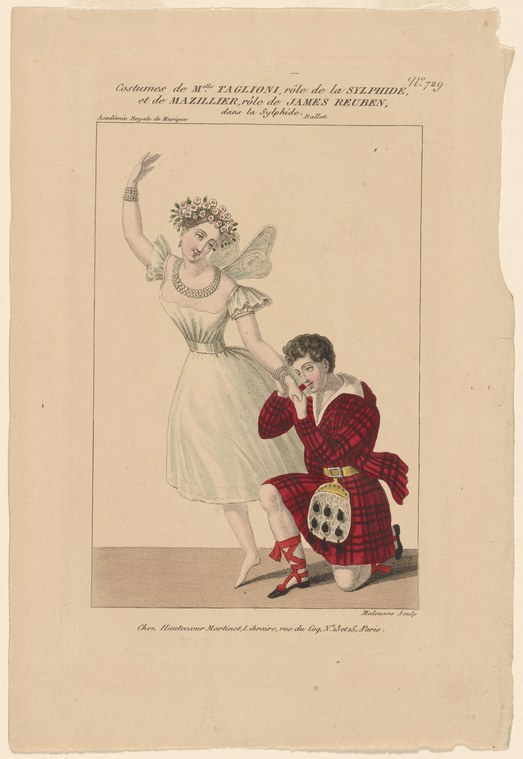
Costumes de Melle. Taglioni, rôle de la sylphide, et de Mazillier, rôle de James Reuben, dans La sylphide, ballet
Unknown artist
- Collection:
- Prints depicting dance
- Source:
- New York Public Library
- Rights:
- Public domain — free to use, share and adapt.
- Recorded as:
- Public Domain
This print is essential evidence for how Romantic ballet was seen and understood in its own time. It shows us what the public was meant to remember about Taglioni's performance and reveals the centrality of the sylph's weightlessness and otherworldliness to the ballet's meaning. For dance historians, it documents the costume, staging, and emotional tenor of a work that remains foundational to ballet vocabulary today.
What you are looking at
A hand-colored engraving showing two figures in a theatrical moment. On the left stands a sylph in a pale, ethereal dress with a wreath in her hair, her body tilted forward in an attitude of weightless flight, one arm raised expressively overhead. On the right, kneeling in profile, is a male dancer in a deep burgundy plaid or tartan costume, his hand raised to his face in a gesture of sorrow or longing, gazing upward toward the sylph. The composition is spare—set against a neutral background with a simple groundline—which focuses all attention on the emotional interaction between the two figures and the contrast between the sylph's ascending, ethereal quality and the man's earthbound, grief-stricken pose.
The dancing
The female dancer's body is arched and buoyant, with her weight appearing to lift away; her raised arm and tilted torso create an illusion of flight characteristic of Romantic-era ethereal roles. The male dancer is grounded, his body bent forward on one knee in a posture of devotion or despair. His raised hand frames his face, focusing emotion into the upper body while his legs remain stable beneath him. The two figures are separated by a clear spatial distance, emphasizing the supernatural or impossible nature of their encounter. No contact or partnering hold is shown; instead, the relationship is one of yearning across a gap.
The dance depicted
This image documents *La Sylphide*, the foundational Romantic ballet first performed in 1832 with choreography by Filippo Taglioni. The title inscription confirms the role of the Sylphide was danced by Marie Taglioni and the role of James (here called James Reuben) was performed by a male dancer—likely during one of the most famous scenes in the ballet, in which James watches the sylph from earth, unable to hold or keep her. The staging here—the sylph's weightless, upward-reaching quality and the man's grounded, emotional response—captures the central theme of the Romantic ballet: the unbridgeable gulf between human desire and the supernatural feminine ideal. The male role is rendered with particular attention to pathos and expressive upper-body gesture rather than virtuosity.
How it was made
This is a hand-colored engraving (or possibly stipple engraving), a print medium that allowed for wide circulation of dance imagery during the 1830s–1840s. The line work is precise and delicate, defining the flowing drapery of the sylph's skirt and the details of the male dancer's tartan costume with equal clarity. Hand coloring added the theatrical palette—the pale cream of the sylph's dress, the deep red of the man's jacket—after printing, which means each copy could vary slightly. This technique was the standard way theatrical imagery reached the public before photography; such prints hung in homes and studios and documented the look and feeling of celebrated performances for audiences who had or hoped to see them.
About this work
This hand-colored engraving preserves a moment from *La Sylphide*, the 1832 ballet that defined Romantic theatre and established the ethereal female dancer as a central figure in European culture. The print documents how the role of the Sylphide was visualized and sold to the public: weightless, otherworldly, and positioned always beyond the male dancer's reach. It is both a record of Marie Taglioni's famous interpretation of the role and a theatrical souvenir—a print that could be purchased, framed, and kept as a memento of a transformative performance. The work captures not just a moment of dance, but the emotional and aesthetic ideology of Romanticism itself: the longing for the unattainable, the supremacy of the feminine ideal, and the visual language of the body in flight.
How to look at it
Look first at the sylph's body: notice how the artist has drawn her as if weightless, with her torso tilted and her arm reaching upward in a way that suggests she is being lifted or floating away. The male dancer's posture—kneeling, reaching, gazing upward—tells a story of longing and loss without any physical contact. The spatial gap between them is crucial; the artist has chosen the moment of separation, the impossible desire, rather than any moment of partnership. The extreme contrast between the ethereal pale dress and the earthy tartan below emphasizes the unbridgeable divide between the sylph's supernatural world and the human realm.
The artist
The artist is not recorded in the catalogue. However, the print bears the inscription 'Imp. Daziaro de Bourgeois' and a publication credit, suggesting it was produced by a commercial print house in Paris. Such theatrical prints were typically drawn from sketches made during rehearsals or performances, or sometimes adapted from other published images. The hand-coloring was often done by workshop assistants rather than the original artist, making such prints collaborative products of theatrical commerce rather than singular artistic creations.
The period
By the 1830s, *La Sylphide* had become the defining work of the Romantic ballet era. The ballet's premiere in 1832 with Marie Taglioni in the title role revolutionized what audiences expected of female dancers: weightlessness, elongation, otherworldly grace. The Romantic movement in visual art was contemporaneous, emphasizing emotion, the supernatural, and the feminine ideal. This print was made during the peak of Taglioni's fame and when the cult of the Romantic ballerina was at its height. Prints like this one were a primary means of disseminating images of celebrated dancers to a wide public; they appeared in shop windows, were collected in albums, and circulated internationally.
Where it lives
This print is held in the New York Public Library's prints collection, where it is catalogued among prints depicting dance. It is a theatrical souvenir and advertisement from the Paris theatrical print trade, likely from the 1830s or early 1840s, made to capitalize on the fame of *La Sylphide* and its star dancer.
Dance in this work
Questions about this work
Who was Marie Taglioni and why was she important?
Marie Taglioni (1804–1884) was the most celebrated ballerina of the Romantic era and the first great star of *La Sylphide*. Her performance in the title role, created for her by her father Filippo Taglioni in 1832, revolutionized ballet by establishing the ethereal, weightless female dancer as the ideal. She was celebrated across Europe and her image was reproduced in prints, sculptures, and lithographs more than any other dancer of her time.
What is a sylphide and why does it matter in ballet?
A sylph is a supernatural female spirit from Romantic literature. In ballet, the Sylphide represents the unattainable feminine ideal—beautiful, weightless, and ultimately unreachable by the mortal male hero. *La Sylphide* uses this figure to express the core Romantic belief that human desire can never be satisfied, that the ideal exists always beyond our grasp. The role became a template for Romantic ballerina roles across Europe.
How do we know this shows *La Sylphide* and not another ballet?
The inscription at the top of the print explicitly states 'Costumes de Mlle. Taglioni, rôle de la sylphide, et de Mazillier [or similar], rôle de James Reuben, dans La sylphide, ballet.' The print's own label documents what it depicts. Additionally, the visual elements—the ethereal pale dress of the female figure, the tartan costume of the male dancer, and the emotional pose of longing—are all consistent with the known iconography of this ballet.
What is a hand-colored engraving and why was it common for dance imagery?
A hand-colored engraving is a print made from an engraved metal plate, then colored by hand after printing. Before photography, this was the primary way theatrical images reached the public. Hand-coloring allowed each print to be slightly different and made the images more vivid and appealing. Such prints were inexpensive enough to be bought as souvenirs but fine enough to frame and hang, making them ideal for disseminating images of celebrated performers.
More dance artwork





