49 works in this view — arrow keys or swipe to move between them.
Dance in Art
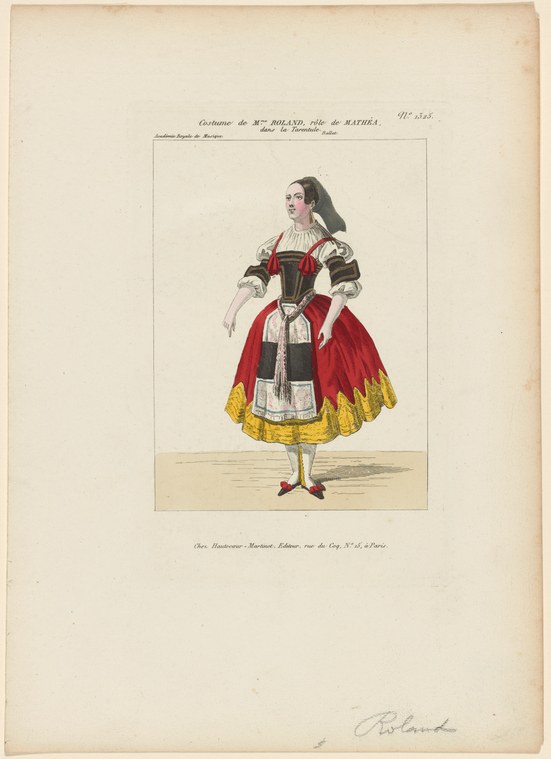
Costume de Mme. Roland, rôle de Mathéa, dans La tarentule: ballet, Académie Royale de Musique
Unknown artist
- Collection:
- Prints depicting dance
- Source:
- New York Public Library
- Rights:
- Public domain — free to use, share and adapt.
- Recorded as:
- Public Domain
Costume documentation prints like this are primary sources for understanding how Romantic ballet roles were actually dressed and how dancers presented themselves on stage. They reveal the designer's choices in color, silhouette, and ornamentation that contributed to the visual identity of celebrated roles—information not always visible in surviving costumes and rarely documented in written sources.
What you are looking at
A single female dancer stands in a three-quarter pose against a plain background, wearing elaborate mid-19th-century theatrical dress. She wears a dark corseted bodice with puffed sleeves trimmed in white lace, paired with a voluminous skirt of deep red silk with a wide band of golden-yellow fabric at the hem. A white lace collar frames her neck. Her dark hair is pulled back smoothly. She stands with her weight on one leg in a relaxed stance, her arms held naturally at her sides with hands visible, one gloved. Her posture suggests a moment of repose rather than active dancing—she faces forward with a composed, almost portrait-like quality. The hand-colored print has been executed with careful attention to the rich reds and golds of the costume, which dominate the composition.
The dancing
The single figure stands in a neutral, upright posture with minimal dynamic tension—weight settled on one leg, the other leg straight but not engaged. Her arms hang naturally without the lift or extension typical of ballet positions. Her gaze is direct and her bearing is stately rather than animated. The overall body alignment suggests a moment of stillness or presentation rather than a captured instant of dancing movement.
The dance depicted
This is a costume study for a theatrical ballet, specifically for the role of Mathéa in the ballet *La Tarentule* (*The Tarantula*), performed at the Académie Royale de Musique (the Paris Opéra). *La Tarentule* was a popular Romantic-era ballet, and this image documents the stage costume rather than depicting the dancer in action. The figure's static pose and frontal presentation suggest this is a costume plate intended for publication or archival record, showing the character's dress rather than illustrating choreography or movement quality.
How it was made
This is a hand-colored engraving or lithograph, characteristic of 19th-century theatrical documentation. The linear precision of the figure's outlines and the careful hand-coloring of the costume fabrics—with particular attention to the luminous yellows and reds—indicate a print intended for circulation among the theater world, dancers, and collectors. The technique allowed multiple copies to be made, making such costume records more widely available than a painting would have been.
About this work
This is a costume documentation print for a principal female role in a Romantic-era ballet performed at the Paris Opéra. The image serves not as a representation of dance in motion but as a record of theatrical dress—a practical and archival function that was central to 19th-century ballet documentation. Such prints circulated among dancers, designers, and enthusiasts, providing a visual reference for the appearance of famous roles and performers. The work belongs in a dance gallery because it captures the material culture of theatrical dance and the aesthetic choices that shaped how Romantic ballet was presented and understood.
How to look at it
Look at the precision with which the costume's construction is rendered: the seaming of the bodice, the layering and weight of the skirt, the texture of the lace collar. The print's stillness and frontal presentation are not limitations but rather the point—this is documentary illustration, designed to be read as a costume blueprint. The hand-coloring technique allows the fabric's color and visual impact to dominate, emphasizing how the costume would read from the theater's audience distance.
The artist
The artist is not recorded in the catalogue. The print's careful execution and the fact that it documents a specific performance at the Académie Royale de Musique suggest it was made by a professional theatrical illustrator or print publisher working in Paris during the height of Romantic ballet, likely in the 1830s–1840s. Such costume prints were often produced by specialized theatrical publishers who worked from designs or from sketches made during rehearsals or performances.
The period
This print dates to the Romantic era in ballet (early-to-mid 19th century), when Paris was the center of the ballet world and the Opéra was its most prestigious venue. During this period, costume became increasingly elaborate and symbolic—the silhouette, fabrics, and colors of a role's dress were as important to its identity as the choreography. Theatrical prints served as a primary means of documenting and publicizing these costumes, circulating images of famous roles and the dancers who performed them. *La Tarentule* itself was popular across Europe, and such costume documentation prints would have been collected by enthusiasts and professionals alike.
Where it lives
This print is held in the New York Public Library's collection of prints depicting dance, which focuses on theatrical and social dance documentation from the 18th and 19th centuries. Such prints were often sold individually or in bound sets, circulating through theater networks and among collectors of theatrical ephemera.
Dance in this work
Questions about this work
Was this meant to show a dancer dancing?
No. This is a costume documentation print—it shows the dress of a role, not a performance moment. The figure's static pose and frontal presentation are typical of theatrical costume plates, which were designed to be clear and readable rather than to capture movement.
What was *La Tarentule* about?
The ballet was based on the folk superstition of tarantism—the belief that a tarantula bite caused uncontrollable dancing. The story typically involved a young woman afflicted by a tarantula bite and the attempts to cure her, allowing for scenes of frenzied dancing and dramatic costume. Mathéa appears to have been a principal female role.
Why were these prints made?
Costume prints served multiple purposes: they documented the visual design of celebrated roles for posterity, advertised the Opéra's productions, provided reference material for dancers and designers, and satisfied the hunger of ballet enthusiasts for images of famous roles and performers. They were a form of theatrical promotion and fan culture.
Is this a portrait of a specific dancer?
The catalogue does not name the dancer, and the print's style—the idealized face, the formal presentation—suggests it is more a costume study than a portrait. However, it may represent a specific performer known for the role.
More dance artwork





