49 works in this view — arrow keys or swipe to move between them.
Dance in Art
Les noces de Pelée et de Thétis
Unknown artist
- Collection:
- Prints depicting dance
- Source:
- New York Public Library
- Rights:
- Public domain — free to use, share and adapt.
- Recorded as:
- Public Domain
For historians of court ballet and festival culture, this print is a primary record of how mythological narrative was staged and how movement and ceremony were framed. The engraving documents the theatrical conventions of the period and shows the integration of processional grandeur, allegorical meaning, and formal bodies that characterized court entertainment—a form that shaped the development of ballet itself.
What you are looking at
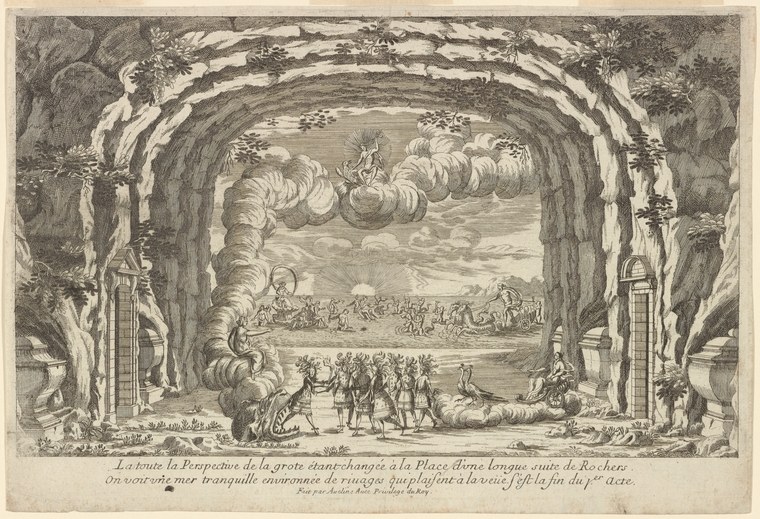
A theatrical scene framed by a monumental natural archway of white stone or marble, with foliage visible at the top. Through this frame, an elevated stage depicts the mythological wedding of Peleus and Thetis. In the middle distance, a processional gathering fills the stage: figures in classical dress process toward an altar or ceremonial focus. The foreground of the stage shows grouped figures in various poses of attention and reverence. Above, in the sky beyond the arch, celestial figures—likely gods or allegorical beings—float among clouds. The entire composition uses the natural arch as a theatrical proscenium, a common device in court festival imagery. The print employs fine engraving with careful cross-hatching to create depth and atmosphere; the foreground arch is rendered with pronounced chiaroscuro, drawing the eye inward to the mythological narrative.
The dancing
The figures throughout maintain formal, processional bearing rather than active dance movement. Those in the middle ground stand upright in groups, oriented toward a central focal point, some with arms raised in gestures of salutation or worship. A few figures in the immediate foreground adopt more dynamic poses—one appears to genuflect or bow deeply. The groupings suggest ceremonial assembly rather than coordinated partnered dance; the bodies are arranged for visibility and symbolic meaning rather than technical movement. No figures are shown in balletic positions, turned-out legs, or the compact closed holds of court dances.
The dance depicted
This depicts a court festival or ballet de cour celebrating a mythological wedding, likely from 17th-century French theatrical tradition. The scene is processional and ceremonial rather than an enacted ballroom dance. While the gathering and formal movement are dance-adjacent—court festivals of this period integrated processional grandeur, allegorical tableaux, and stylized movement—the image shows the ceremonial spectacle and staging rather than the specific steps and holds of a recognized dance form. The work documents the theatrical framing and mythological subject matter typical of ballet de cour, but the actual dance style, if any is being depicted, is not legible from the compositions shown.
How it was made
This is a copperplate engraving, executed with fine lines and careful cross-hatching to achieve tonal modulation and atmospheric recession. The technique allows for precise rendering of architectural detail and the intricate folds of draped classical costume, and the small scale and reproducibility of engraving made such prints primary documents of court spectacle for a learned audience across Europe. The inscription in French below the image confirms this is a documentary record—a visual account of an actual or planned court festival—rather than a fanciful illustration.
About this work
This engraving records or commemorates a moment of court festival centered on the mythological marriage of Peleus and Thetis. The frame of the natural arch creates a theatrical device that was standard in 17th-century French court entertainment, where elaborate settings and allegorical tableaux elevated the proceedings into a unified work of art. The procession, the gathering of mythological and human figures, and the ceremonial movement are the substance of what courts called ballet—a form in which spectacle, narrative, music, and stylized movement merged. This print preserves both the subject matter and the aesthetic ambitions of court culture, showing how dance and theater were inseparable in that world.
How to look at it
Attend to the architectural frame—how the natural arch creates a stage within the picture, directing sight toward the mythological action. Notice the procession and the careful arrangement of figures in groups, which suggests choreographed movement rather than spontaneous gathering. The ceremonial stillness and formality of the pose are characteristic of court ballet, which valued allegory and symbolic gesture over virtuosity. The sky above, with its floating celestial figures, is typical of court festival iconography, where gods blessed or presided over royal celebrations.
The period
This work dates from the 17th century, when the ballet de cour was the dominant court entertainment in France. These spectacles combined music, verse, choreography, and elaborate scenery to celebrate royal power and mythological allegory. The careful documentation of such events through prints and engravings was a form of court propaganda and cultural record. The style and technique suggest production for a courtly or aristocratic audience familiar with both classical mythology and the conventions of French court ceremony.
Where it lives
The work is held in the New York Public Library's prints collection documenting dance. It is an engraved print, a reproducible medium that served to disseminate images of court spectacle and festival to a wider educated public than could attend the events themselves.
Dance in this work
Questions about this work
Is this actually a dance, or just a ceremonial gathering?
In 17th-century court culture, the distinction was not absolute. Ballet de cour integrated processions, allegorical tableaux, formal gesture, and choreographed movement into a unified spectacle. This print shows the ceremonial and spectacular elements—the setting, the mythological narrative, the formal assembly—that framed the dancing. The actual steps and figures of the dance itself are not rendered in detail, but the work documents the context and ambition of court ballet.
What is the inscription at the bottom?
The French inscription identifies this as a record of a spectacle staged at a location associated with Rochefort, and notes the orderly procession and ceremonial character of the event. It functions as a caption or documentary note, confirming that this engraving was meant to preserve the memory and visual splendor of an actual court festival.
Why would they frame a dance scene with a stone arch?
In court festival design, the natural or architectural frame elevated the spectacle into a unified work of art, separating the theatrical action from the everyday world. It also echoed Renaissance and classical architectural ideals, giving mythological and allegorical content the weight of antiquity. The frame was a standard theatrical device of the period.
More dance artwork





