49 works in this view — arrow keys or swipe to move between them.
Dance in Art
The Royal Italian Opera before & behind the curtain. Selections
Unknown artist
- Collection:
- Prints depicting dance
- Source:
- New York Public Library
- Rights:
- Public domain — free to use, share and adapt.
- Recorded as:
- Public Domain
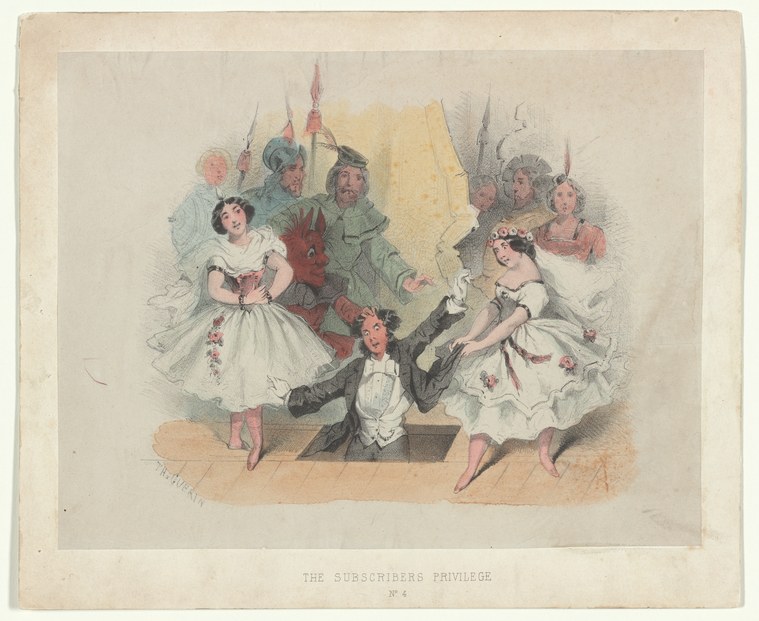
This print provides visual evidence of how Romantic-era ballet and opera were staged, costumed, and promoted to audiences—and how theatrical dance was circulated and remembered through print culture. It shows the female ballet body as central visual spectacle within a complex theatrical apparatus of machinery, supernatural effects, and supporting performers. For theatre historians, it documents the specific production practices and aesthetic values of Italian opera in this period.
What you are looking at
A theatrical scene shows six figures arranged in a dynamic composition suggesting performance and spectacle. At center stage stands a young woman in a white ballet dress with a floral garland in her hair, arms crossed in a modest pose. To her left, a boy in dark formal dress leans forward with an animated gesture. Behind and around them stand four demonic or fantastical creatures wearing horned headdresses and green costumes, their poses theatrical and exaggerated. The figures occupy a shallow stage space rendered in warm ochre and pale tones; the background is diffuse and atmospheric. The entire composition is framed within a rounded rectangular border, and the title "THE SUBSCRIBERS PRIVILEGE / No 4" appears below in printed text. The style is hand-colored engraving or lithograph, suggesting this is a theatrical print from a series.
The dancing
The central female figure stands in a balletic first position with weight evenly distributed, arms held at chest height in a formal, restrained manner typical of early 19th-century dance etiquette. The boy beside her leans forward with extended arms in a gestural pose suggesting drama or comic action. The four surrounding figures adopt exaggerated, non-naturalistic postures—arched backs, twisted frames, extended limbs—that emphasize their role as fantastical or supernatural creatures rather than human dancers. The composition mixes formal balletic presentation with theatrical burlesque or pantomime.
The dance depicted
This appears to be a scene from a theatrical pantomime or operatic performance, likely from the Italian opera tradition referenced in the catalogue title. The central figure's white dress, floral crown, and formal stance suggest a prima ballerina or female lead in a romantic ballet scene, possibly from a Romantic-era theatrical work. The demonic creatures and elaborate staging indicate this is a scene with theatrical machinery and supernatural elements—common in early 19th-century opera and ballet spectacle (such as infernal scenes in Romantic operas). The "subscribers privilege" notation suggests this print was issued as part of a subscription series documenting a specific production or company's repertoire.
How it was made
This is a hand-colored engraving or lithograph, as evidenced by the fine line work, the selective application of watercolor or gouache in flesh tones and costumes, and the printed title below. The technique allowed for mass reproduction and distribution to theatre subscribers and the public—these were commercial theatrical souvenir prints. The warm ochre wash and delicate hand-coloring give it the character of early 19th-century theatrical ephemera. The soft, diffuse background and atmospheric treatment are consistent with lithographic techniques that allowed broader tonal washes.
About this work
This is a theatrical print documenting a scene from an Italian opera or ballet production, likely from the 1830s-1850s, when such "subscribers privilege" prints were sold to patrons of major opera houses. It captures a moment of Romantic ballet aesthetic—a graceful, formally poised female dancer amid fantastical theatrical machinery and supernatural imagery. The print belongs to a category of theatrical documentation that was both artistic and commercial, distributed to theatre-goers and collectors as a memento of specific productions and star performers.
The work sits at the intersection of visual art and theatre history, capturing not a choreographed dance in motion but a staged moment frozen for circulation and collection. It reveals how dance was consumed and remembered in the pre-photographic era: through hand-colored prints that emphasized costume, theatrical design, and the spectacle of performance rather than the dynamism of actual movement.
How to look at it
Observe how the artist has positioned the female dancer in formal, balletic poise—she is not captured mid-leap or in dynamic motion, but rather in a posed, presentational stance that emphasizes her elegant silhouette and formal training. Notice the contrast between her restraint and the exaggerated, almost grotesque postures of the surrounding figures—the theatrical hierarchy is visual and spatial. The warm ochre wash and hand-coloring emphasize the theatrical lighting and spectacle rather than anatomical precision. The rounded frame and the printed caption below situate this as a commercial theatrical souvenir, part of a numbered series meant for collection and display.
The period
This print dates to the era of Romantic ballet and grand opera (approximately 1830s-1860s), when theatrical spectacle, elaborate machinery, and supernatural storylines were paramount. The Royal Italian Opera was a prestigious institution, and subscription prints were a major form of artistic patronage and theatrical publicity. Such prints served both as souvenirs for theatre subscribers and as promotional images circulated to wider audiences. The aesthetic favors the decorative, the theatrical, and the supernatural—consistent with Romantic-era values in dance and opera.
This was the height of the prima ballerina system, where individual female dancers (often in romantic or supernatural roles) were the central draw for audiences. The male figure and demonic creatures are supporting elements; the spotlight remains on the graceful, formally composed female dancer. This reflects the gendered division of theatrical labor and attention in Romantic ballet, where women embodied beauty, delicacy, and otherworldliness.
Where it lives
This print is held in the New York Public Library's collection of dance-related prints. It is numbered "No 4," indicating it is part of a series documenting scenes from productions at the Royal Italian Opera, likely issued as subscription series prints for theatre patrons. Such prints were standard theatrical merchandise in the 19th century.
Dance in this work
Questions about this work
What is the Royal Italian Opera, and when did it operate?
The Royal Italian Opera (Her Majesty's Theatre, later known as the Royal Opera House) was London's premier opera house in the 19th century. This series likely documents productions from the 1830s-1860s, when Italian opera was at peak popularity in London. Subscription prints like this were sold to patrons as souvenirs of celebrated performances and star dancers.
What does 'The Subscribers Privilege' mean?
This phrase indicates the print was issued as part of a subscription series—patrons who subscribed to the opera house or to a print subscription service received numbered prints documenting scenes from current or celebrated productions. It was both a privilege of subscription and a form of theatrical marketing.
Is this actually showing dance, or is it theatrical spectacle?
It shows both. The central female figure is posed in a formal balletic manner consistent with early Romantic ballet training and aesthetic. However, the scene is staged spectacle—a moment from a theatrical production meant to be visually striking and supernatural rather than to document actual choreography in motion. The print captures theatrical ballet as pageantry.
Why are the other figures so grotesque?
The demonic or fantastical creatures represent supernatural elements common in Romantic-era opera and ballet—infernal scenes, sprites, or otherworldly characters that provided theatrical contrast and spectacle. Their exaggerated postures and horned headdresses emphasize their non-human, theatrical nature, positioning them as supporting elements to the graceful central ballerina.
More dance artwork





