49 works in this view — arrow keys or swipe to move between them.
Dance in Art
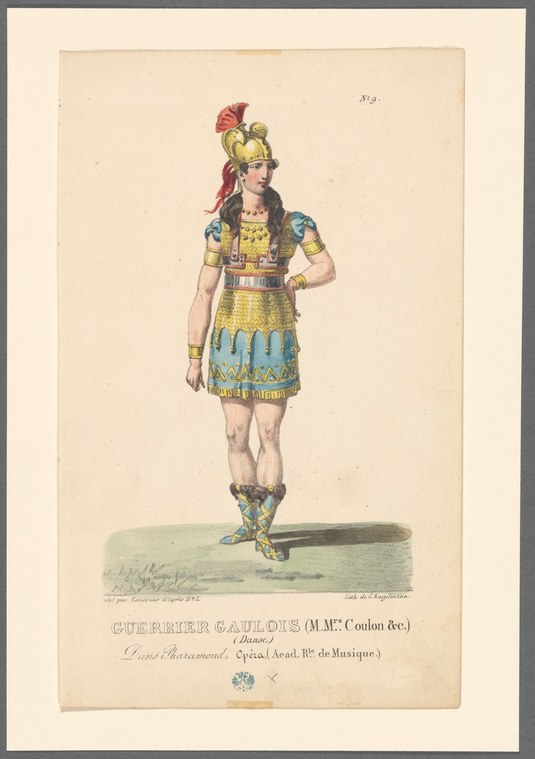
Guerrier gaulois (M.Mrs. Coulon &c.) (Danse) : Dans Pharamond, Opéra (Acad[émie] R[oya]le de Musique)
Unknown artist
- Collection:
- Prints depicting dance
- Source:
- New York Public Library
- Rights:
- Public domain — free to use, share and adapt.
- Recorded as:
- Public Domain
This print documents a moment when opera and dance were inseparable forms, and when the appearance of an opera performer—the costume, the stance, the character—was as much a subject of artistic representation as the performance itself. For historians of dance, it shows how movement was imagined to serve character and spectacle in the most prestigious theatrical contexts of the era, and it provides evidence that even martial or military roles in opera were danced, not simply spoken or walked through.
What you are looking at
A single figure in classical military dress stands alone against a neutral ground, posed in a moment of theatrical stillness. The warrior wears a gold-patterned short tunic with blue trim and matching blue sleeves, a wide decorative belt, and coordinating leg wrappings or greaves in blue and gold. A plumed helmet crowns the figure, with red feathers rising dramatically above curled blonde hair. The pose is commanding: weight settled on one leg, the other bent slightly, one hand resting on the hip in a position of authority. The figure gazes off to the side with a formal, almost statuesque composure. The handcoloring shows careful attention to the patterned textile details, with the gold geometric ornament of the tunic rendered in fine parallel lines. This is a costume study rather than a narrative scene—a single performer in character, presented for documentation or display.
The dancing
The dancer—or the performer in dance costume—stands in a relaxed contrapposto, supporting weight on the back leg while the front leg is freed slightly forward. The arms are held at the sides with one hand placed assertively on the hip, a gesture of confidence and authority common to military or heroic roles. The frame is upright and formal, without the fluidity or extension typically associated with ballet vocabulary. The isolated stance suggests this is a costume portrait or character study meant to showcase the theatrical dress rather than capture movement in progress.
The dance depicted
This is a figure from the opera *Pharamond* (music by Rebel and Francœur, first performed at the Académie Royale de Musique in 1733), identified as 'Guerrier gaulois'—a Gallic warrior. The work belongs to the tradition of costume studies for tragédie en musique, the French operatic form that combined sung drama with elaborate danced scenes and spectacle. The figure's classical military dress—part historical fantasy, part contemporary Baroque theatrical convention—would have appeared in the divertissement or ballet interludes that punctuated these operas. The static, presentational pose is typical of how performers in such theatrical prints were represented: the body shown clearly for the viewer to read the costume and character, rather than frozen mid-movement.
How it was made
This is a hand-colored engraving, a print technique suited to mass production and distribution. The base image is engraved in fine lines, with watercolor applied afterward to render the costume's gold patterns and blue trim with visual precision. Such prints served as accessible documentation of operatic costume and character for a literate audience who might not attend performances; they circulated among collectors and theater enthusiasts as records of Parisian operatic fashion. The technique allowed for multiple impressions to be colored individually or in the workshop, reaching a wider audience than a unique painting. The signature or attribution marks visible at the lower edge suggest this was part of a published series documenting the opera or its cast.
About this work
This is a costume study for a character in the French opera *Pharamond*, depicting a Gallic warrior in military dress designed for the stage. It belongs to a body of theatrical imagery produced in the early 18th century to document the spectacle and dress of tragédie en musique, an operatic genre that combined text, music, and dance. The hand-colored engraving is both an artwork and a historical artifact: evidence of how operatic performers looked, what audiences expected to see, and how theatrical fashion circulated beyond the theater itself.
The work sits at the intersection of opera history and dance history because tragic operas in this period depended crucially on embedded divertissements—moments when the sung drama gave way to pure spectacle, including danced interludes that showcased the virtuosity of performers and the wealth of the academy. A warrior figure such as this would have appeared in such passages, moving through steps designed to display both the costume and the disciplined body beneath it.
How to look at it
Attend to the precision of the costume details, which is the print's primary purpose. The geometric gold patterning on the tunic is rendered with care, and the coordination of colors across the tunic, sleeves, belt, and leg-coverings shows the designer's sophisticated sense of harmony. Notice the formality of the pose—there is no suggestion of mid-step or dynamic motion. The figure is presented for inspection, as if a costume on a stand. The decision to show the figure in a near-frontal stance, with the head turned slightly away, is a convention of costume portraiture meant to display both the front of the outfit and hint at profile and depth.
The artist
The engraver is not recorded in the catalogue. The work bears signatures or attributions at the foot that may identify the artist or the workshop responsible for the print, but these are not legible in the current record. Hand-colored theatrical engravings of this type were often produced by specialized print shops working with composers' or theaters' archives; attribution commonly went to the engraver or publisher rather than to the colorist.
The period
This print dates to the era of French tragédie en musique, the dominant operatic form at the Académie Royale de Musique from the 1670s into the 18th century. *Pharamond*, first performed in 1733, came late in the tradition's history—by mid-century, Italian opera and other forms had begun to displace it. Yet it remained an institutional symbol of French grandeur and royal patronage. The opera combined sung recitatives and airs with instrumental music and extensive dance sequences; these were performed by members of the Académie de Danse or guest virtuosi. The costume, blending historical fantasy with contemporary Baroque aesthetics, reflects the period's taste for exotic or antique subjects rendered in up-to-date finery. Such prints were part of a growing market for theatrical imagery that allowed those outside the court or theater to participate in knowledge of prestigious performances.
Where it lives
The work is held in the New York Public Library's collection of prints depicting dance. It is one of numerous theatrical prints preserved from the 18th century, likely part of a larger series documenting the opera *Pharamond* or the Académie Royale's productions of that period.
Dance in this work
Questions about this work
Was this an actual costume worn on stage?
Almost certainly. The print is a record of a costume designed for a specific role in *Pharamond*. Whether this exact garment survives is unknown, but the print's detail and precision suggest it was made from performance documentation, possibly a sketch or description provided by the theater or a costume workshop.
Who was the dancer?
The catalogue record identifies the character ('Guerrier gaulois') but not the performer. Casts for operas at the Académie were recorded in librettos and sometimes in other documents, but they are not indicated in this print's title or visible inscription.
Why is the figure posed so formally and alone?
This is a costume study or character portrait, not a narrative scene. The isolated figure against a plain ground allowed viewers to study the design and color of the outfit without distraction. Such prints were made to circulate the prestige of the opera and its spectacle to a broader public than could attend performances.
What was a 'divertissement' in French opera?
A scene of song, dance, and spectacle inserted into the narrative of a tragédie en musique, often without advancing the plot. These scenes showcased virtuoso dancers, elaborate scenery, and costumes, and were a major attraction for audiences. A warrior character like this would likely appear in such a scene.
More dance artwork





