49 works in this view — arrow keys or swipe to move between them.
Dance in Art
The Royal Italian Opera before & behind the curtain. Selections
Unknown artist
- Collection:
- Prints depicting dance
- Source:
- New York Public Library
- Rights:
- Public domain — free to use, share and adapt.
- Recorded as:
- Public Domain
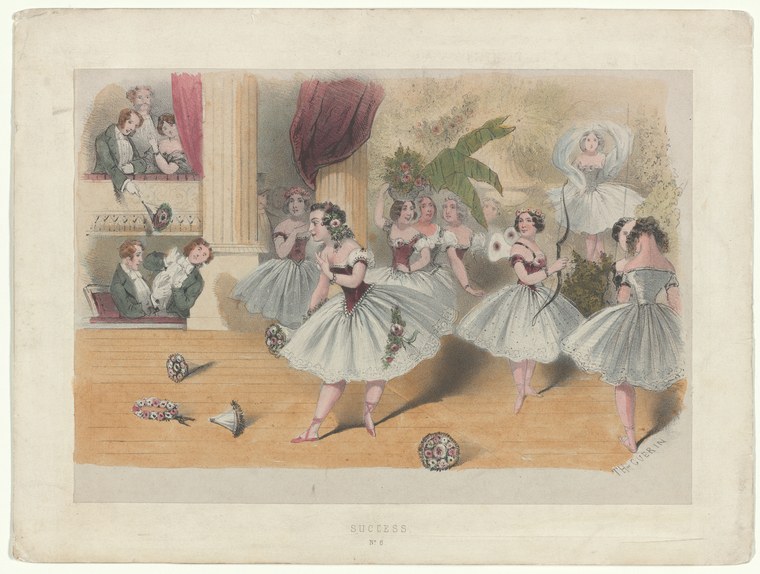
This print is valuable evidence of how romantic ballet was rehearsed and taught in mid-19th-century London, and of the specific theatrical conventions of the Royal Italian Opera. The scattered, conversational arrangement of dancers—rather than a formal line or symmetrical composition—gives us visual insight into what a working rehearsal actually looked like, beyond the polished performances audiences saw. The emphasis on observation and instruction, rather than performance, also reveals that theatre labour itself was a subject of cultural interest and visual representation.
What you are looking at
This is a theatrical print depicting a rehearsal or performance scene at the Royal Italian Opera, divided into two distinct spatial zones. On the left, framed by a proscenium arch, two figures—likely a conductor or choreographer and a musician—observe from an elevated box. The main stage floor fills the composition with seven female dancers in full romantic-era tutus of pale silk or tulle, their skirts held out in the bell-shape characteristic of 1840s–1850s ballet. The dancers are arranged in a loose spatial composition rather than a formal corps line: some gesture expressively with arms raised or extended, others appear mid-turn with skirts caught in motion, and their body positions suggest a rehearsal moment rather than synchronized performance. Scattered on the floor are decorative props—jeweled ornaments, mirrors, and what appear to be costume pieces—suggesting the practical disorder of a working theatre space. The setting includes classical architectural elements: tall columns, draped curtains in deep red, and warm golden lighting that throws soft shadows across the wooden stage floor. A young woman's face appears in a circular vignette at upper right, possibly indicating a featured dancer or ballerina.
The dancing
All seven dancers are female, dressed identically in the full-skirted tutus of classical ballet, with fitted bodices and pale pointe-length skirts. Their arm positions are expressive and varied rather than codified—some have arms raised in port de bras, others extended horizontally or gesturing downward. The poses suggest a mix of positions: one dancer appears to be en relevé or rising on pointe in the center; others lean or turn with weight shifted. Their heads are turned toward one another or angled in engagement with movement. The scattered arrangement and different body angles suggest they are not executing a unified step-pattern but rather participating in a group rehearsal or demonstration, with each figure inhabiting a different moment of a phrase.
The dance depicted
This appears to depict French or Italian romantic ballet of the 1840s–1850s, the period when the Royal Italian Opera was active in London and when such theatrical rehearsal scenes were popular subjects for prints. The tutus, arm carriage, and pointe-work positioning are consistent with the romantic ballet aesthetic of that era—the ethereal, expressive style associated with dancers like Maria Taglioni. The print's title foregrounds the "behind the curtain" aspect, suggesting interest in the labour and rehearsal process rather than finished performance. The presence of a conductor or rehearsal director observing from above confirms this is a working rehearsal, not a stage performance for an audience.
How it was made
This is a hand-coloured engraving or lithograph of the mid-19th century, evident from the fine linear work defining the figures and the subtle hand-colouring of the tutus in pale greens and pinks, the architectural elements in ochre and grey, and the warm floor tones. The technique allowed for broad circulation as a print commodity—such theatrical rehearsal scenes were popular parlour prints and souvenirs for opera-goers. The hand-colouring suggests this was a luxury or higher-quality issue, as plain prints were less expensive. The soft tonal work, particularly in the shadows and drapery, indicates a skilled printmaker working with both engraved line and possibly aquatint or wash-tinted methods.
About this work
This mid-19th-century print captures a rehearsal scene at a London opera house, showing seven romantic-era ballet dancers in characteristic full tutus during a working session observed by a conductor or choreographer. The "behind the curtain" conceit—pairing the rehearsal scene with the observer's elevated vantage—was a popular print genre of the 1840s–1850s, reflecting public fascination with theatrical labour and the glamour of opera. The work documents both the aesthetic of romantic ballet (the ethereal skirts, the expressive arm work, the pointe-work positioning) and the material reality of theatre—scattered props, the wooden stage floor, the presence of a rehearsal director. As both a dance document and a theatre print, it sits at the intersection of visual culture and performance history.
How to look at it
Notice the contrast between the observer's elevated, controlling position (the conductor in the box) and the dancers' scattered, exploratory arrangement below—this spatial hierarchy reflects the rehearsal power dynamic. Look closely at the arm positions and body angles: each dancer is caught in a different gesture or turn, suggesting the artist's understanding of how bodies move through space rather than holding a single pose. The scattered props on the floor ground the scene in theatrical reality, distinguishing it from an idealized stage performance. The soft golden light and the emphasis on the dancers' faces and upper bodies reveal romantic-era ballet's focus on expression and grace rather than spectacle or virtuosity.
The artist
The artist is not recorded. The print's style and subject suggest a London printmaker or theatre artist of the 1840s–1850s, working in the popular market for hand-coloured theatrical prints. Such prints were often created by anonymous or semi-professional artists working for theatrical publishers and print sellers, and were aimed at opera patrons who wanted souvenirs of the productions and dancers they had seen.
The period
The romantic ballet era (c. 1830–1860) saw an explosion of interest in theatrical imagery and "behind the scenes" subject matter. The 1840s and 1850s were the height of the London ballet craze, with the Royal Italian Opera a major venue. Contemporary prints depicting dancers, rehearsals, and theatre life were mass-produced as parlour prints and theatrical souvenirs. This was also the era of Taglioni's dominance and the cult of the ballerina; images of dancers—both in performance and in the intimacy of rehearsal—were highly marketable. The print's interest in showing labour and instruction reflects a broader 19th-century cultural shift toward documenting work and the "real" behind theatrical spectacle.
Where it lives
The work is held in the New York Public Library's Prints collection, catalogued under dance imagery. It is a single-sheet theatrical print, a common commodity in mid-19th-century London, and would have been sold as a hand-coloured souvenir or parlour print.
Dance in this work
Questions about this work
Who were the dancers in this scene?
The catalogue does not identify the individual dancers or the specific production depicted. The circular vignette at upper right may indicate a featured ballerina of the company, but without inscription or artist attribution, we cannot name her. The work is valuable more as a document of rehearsal practice and theatrical labour than as a record of specific performers.
What is the Royal Italian Opera and when was it active?
The Royal Italian Opera was the main venue for operatic and ballet performance in mid-19th-century London. It operated from the 1840s onwards and hosted major European dancers and singers. London audiences of this era were passionate about ballet, and the theatre was a centre of romantic ballet in Britain.
Why is this a rehearsal scene and not a performance?
The title explicitly states "before & behind the curtain," and the visual evidence supports this: the scattered props and mirrors on the floor, the informal spatial arrangement of the dancers, and the presence of a conductor or choreographer observing from an elevated box all indicate a working session rather than a finished stage performance for an audience.
What dance style is being shown here?
This is romantic ballet of the 1840s–1850s, identifiable by the full, bell-shaped tutus, the pointe-work positioning, the expressive arm carriage, and the ethereal aesthetic. The dancers are not in rigid geometric formations but in expressive, varied poses—characteristic of the romantic era's emphasis on emotion and grace over technical display.
More dance artwork





