49 works in this view — arrow keys or swipe to move between them.
Dance in Art
The Royal Italian Opera before & behind the curtain. Selections
Unknown artist
- Collection:
- Prints depicting dance
- Source:
- New York Public Library
- Rights:
- Public domain — free to use, share and adapt.
- Recorded as:
- Public Domain
The work documents Romantic ballet rehearsal and costuming practice in detail, offering evidence of how dancers trained, how musicians accompanied them, and how the theatrical workplace functioned beyond the footlights. For historians of dance technique and social history, it reveals the collaborative, informal dimension of nineteenth-century ballet that formal performance reviews and choreographic notation cannot capture.
What you are looking at
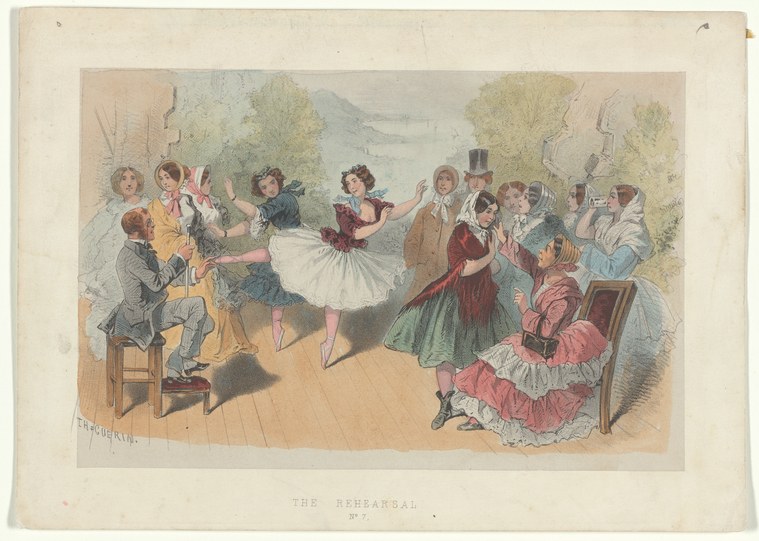
A theatrical or operatic rehearsal or social entertainment is underway in a sunlit interior or garden setting, with figures arranged in loose clusters. In the center, a woman in a white tutu-like skirt dances while others watch or wait their turn; the stage space appears to be an open floor or platform. To the left, a seated man in brown plays a stringed instrument (possibly a guitar or mandolin). Around the scene, figures in mid-nineteenth-century dress—women in colored skirts with white petticoats, men in coats and top hats—cluster at the margins, some standing, some seated on chairs, all engaged in the spectacle. The composition suggests backstage informality despite the formal dress: the title references both "before & behind the curtain," implying a contrast between public performance and private rehearsal or vice versa. Soft greenery (trees or painted foliage) frames the upper edges, and the light is warm and diffuse, giving the scene an intimate, domestic quality despite its theatrical framing.
The dancing
The central dancer stands in a lifted, vertical posture typical of early nineteenth-century ballet technique, with her arms held in rounded positions. Her white skirt is caught mid-motion, suggesting a turn or traveling step. The musicians and spectators adopt the relaxed poses of rehearsal or informal viewing: seated figures lean slightly forward with interest, and standing onlookers cluster informally rather than in a formal audience line. No couples are in closed ballroom hold; instead, the scene emphasizes solo performance and group attention rather than partner dancing or formations.
The dance depicted
The figure of the central dancer in white tutu, lifted posture, and the theatrical framing strongly suggest Romantic-era ballet, likely from the 1840s–1850s repertoire. The presence of musicians and the casual, behind-the-scenes atmosphere hints at a rehearsal for an operatic or ballet performance—consistent with the title's reference to the Royal Italian Opera and the contrast of preparation versus presentation. The scene documents not a finished performance but the working moment, the instruction or tryout that preceded stage presentation, making it a valuable record of mid-nineteenth-century ballet practice and costuming.
How it was made
The work is a hand-colored engraving or lithograph, evident from the fine line work, the careful tonal gradations achieved through parallel hatching in the background, and the selective application of watercolor or gouache tint to the figures. The technique allowed for broad circulation and reproduction—multiple impressions could be pulled from the plate—making this a commercial print for the mass market rather than a unique artwork. The hand-coloring distinguishes deluxe or specially commissioned copies from the basic printed edition, suggesting an intended audience of educated collectors and theater enthusiasts.
About this work
This is a mid-nineteenth-century theatrical print documenting the rehearsal or informal performance of ballet in an opera-house or private setting. The title indicates it shows the Royal Italian Opera "before & behind the curtain," capturing both the formal presentation and the casual labor of theater-making. The figure of the young dancer in white, the Romantic-era costumes, and the intimate, work-in-progress atmosphere place it squarely in the 1840s–1850s, when ballet was becoming a central attraction of opera performance and when Romantic ballet—with its emphasis on ethereal, elevated technique and white tutus—had established the aesthetic still recognizable in the image. The print preserves a fleeting moment of rehearsal culture, showing not the finished spectacle but the social and technical infrastructure that made it possible.
How to look at it
Notice the contrast between the central dancer's lifted, energetic posture and the settled, observational poses of the audience members: the artist chose to freeze a moment of active performance rather than a static display. Observe the detail of the woman's white tutu and the musicians' instruments—these are not generic but specific to the opera-ballet rehearsal setting. The composition's loose, informal arrangement (rather than a formal stage proscenium or line) reinforces the title's promise of backstage access: you are invited to see the work before it is polished into its final, public form.
The artist
The artist is not recorded in the catalogue. The signature or initials visible on the plate (if present) have not been transcribed. The work is consistent in style and subject with mid-nineteenth-century theatrical prints produced in London or Paris, where scenes of opera and ballet were popular subjects for commercial engravers and lithographers catering to theater audiences.
The period
The 1840s and 1850s saw Romantic ballet at its height: works by Taglioni, Cerito, Grahn, and Carlotta Grisi were celebrated across Europe, and ballet had become integral to operatic entertainment. The aesthetic of the ethereal, weightless female dancer—achieved through pointe work and the white tutu—was fully established. Simultaneously, operatic performance was moving from court settings to public commercial theaters, and theatrical prints documenting rehearsal and social aspects of performance became popular commodities. The title's reference to the Royal Italian Opera positions this in the context of London's opera culture, particularly the displacement and reconstruction of Italian opera performance during the period.
Where it lives
The work is held in the New York Public Library's collection of prints depicting dance. It is a commercial theatrical print, likely issued in multiple copies, and represents the type of popular entertainment documentation produced for sale to opera-goers and theater enthusiasts in the mid-nineteenth century.
Dance in this work
Questions about this work
Is this a real rehearsal or an imagined scene?
The specificity of the costume details, the instruments, and the title's reference to the Royal Italian Opera suggest it depicts a real or at least closely observed rehearsal setting. However, theatrical prints often idealized and dramatized backstage scenes for commercial appeal. The work is best understood as a plausible and carefully observed theatrical document, whether or not it depicts a specific historical event.
What is the woman in white dancing?
The image does not identify a specific ballet or choreography. Her posture, lifted carriage, and white tutu are consistent with the Romantic ballet style of the era—works by composers such as Adolphe Adam or Cesare Pugni for dancers like Taglioni or Cerito. The rehearsal setting suggests she may be learning or refining a role, but without additional documentation, the specific work cannot be determined.
Why does the title mention 'before & behind the curtain'?
The title signals that the print offers a dual perspective: it shows both the theatrical performance and the backstage or rehearsal reality—the 'before' the public sees the finished product. This was a popular conceit in nineteenth-century theatrical prints, which often marketed themselves as offering insider access to the world of opera and ballet.
More dance artwork





