49 works in this view — arrow keys or swipe to move between them.
Dance in Art
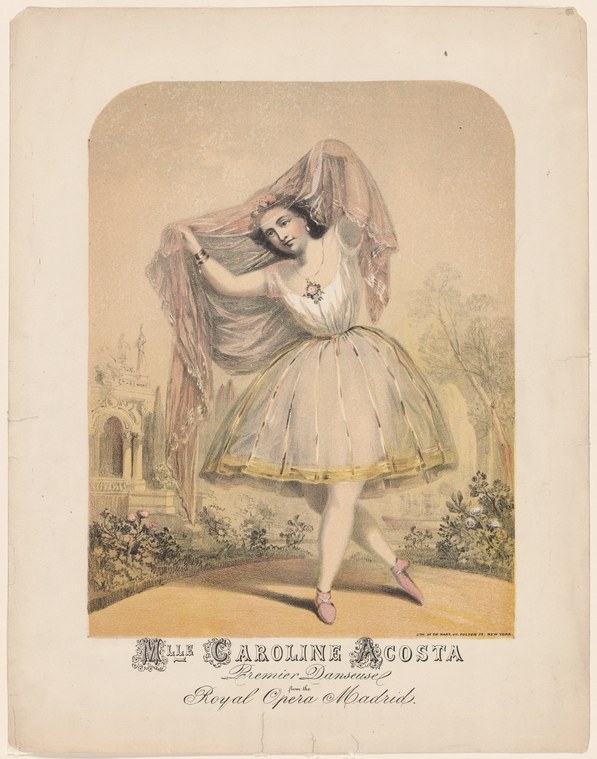
Mlle Caroline Acosta, premier [sic] danseuse from the Royal Opera, Madrid
Unknown artist
- Collection:
- Prints depicting dance
- Source:
- New York Public Library
- Rights:
- Public domain — free to use, share and adapt.
- Recorded as:
- Public Domain
This is evidence of the international circulation of Romantic ballet and the celebrity culture that surrounded it in the nineteenth century. The fact that a dancer from Madrid's Royal Opera was commemorated in a professional print suggests that ballet, though originating in Paris and London, had created a pan-European audience and distribution network by mid-century. For historians of dance, theatrical practice, and nineteenth-century visual culture, such prints are primary documents of how movement was imagined, marketed, and remembered before film.
What you are looking at
A young woman in mid-nineteenth-century theatrical dress stands alone in an architectural garden setting, caught mid-movement in what appears to be a moment of lyrical reverie. She wears a pale tulle skirt with a golden hem, a fitted bodice with a star brooch at the throat, and her dark hair is crowned with an elaborate veil or headdress that floats dramatically around her shoulders. Her left arm is raised gracefully to adjust or steady this headpiece, while her right arm drapes across her body. She stands on the balls of her feet in a pose of delicate balance and elongation. Behind her, classical ruins—a tower and masonry—frame the composition, while naturalistic foliage in soft greens and browns grounds the scene. The hand-coloured print has a warm, creamy tonality characteristic of the 1840s-1850s, with subtle shading that models the figure and suggests soft stage lighting.
The dancing
The dancer is a solitary figure, her weight transferred onto the balls of her feet in a position suggesting elevation or pointe work, though the representation is not anatomically precise in the manner of later ballet documentation. Her raised left arm reaches upward with the elbow bent, fingers extended, while her right arm curves inward across her waist—a pose that combines graceful elongation with an intimate, almost introspective quality. The pose suggests neither the rigid formality of classical ballet nor the geometric clarity of Romantic technique, but rather a theatrical attitude of absorption and ethereal lightness.
The dance depicted
This is almost certainly a portrait of a Romantic-era ballerina, likely performing in a work typical of the 1840s-1850s repertory. The theatrical dress—the gauze veil, the fitted bodice, the tulle skirt—and the pointe work indicate classical ballet of the Romantic period, when dancers performed sylphs, spirits, and ethereal maidens. The pose, while not an identifiable specific movement, captures the aesthetic of Romantic ballet: weightlessness, introspection, and a quality of otherworldliness. The setting among ruins reinforces this, suggesting a scene from a narrative ballet rather than a pure classical variation. Without additional documentation, the specific role cannot be determined, but the image is consistent with the repertory and aesthetic of mid-nineteenth-century European ballet.
How it was made
This is a hand-coloured lithograph or engraving, a medium of mass circulation that made theatrical celebrity portable and shareable in the era before photography. The technique allowed for subtle modulation of tone and delicate colour work, visible in the pale pink and golden hues of the dress, the warm cream background, and the careful rendering of the veil's transparency. Such prints were widely sold as theatrical souvenirs and mementos of celebrated dancers, circulating in parlours and collections across Europe. The quality of execution and the presence of the dancer's name suggest this was a professional commission, likely produced in Paris or London.
About this work
This hand-coloured print commemorates Mlle Caroline Acosta, identified as a premier danseuse of the Royal Opera in Madrid, in what appears to be a Romantic-era ballet role. The image captures the aesthetic of mid-nineteenth-century theatrical ballet: a solitary female figure in an attitude of ethereal grace, positioned among architectural ruins that situate her in a realm between the real and the fantastic. The work belongs to a vast and important category of nineteenth-century dance ephemera—the theatrical portrait print—which functioned as both advertisement and memento, celebrating individual dancers and disseminating images of the era's most celebrated performances.
How to look at it
Observe the dancer's weight and balance: she is poised on the balls of her feet, a position that was iconic to Romantic ballet but difficult to render convincingly in two dimensions. Notice how the artist has used the veil and the raised arm to suggest upward motion and an otherworldly lightness, even in a static pose. The architectural setting—the tower in shadow, the naturalistic foliage—frames her as a supernatural being in a human landscape, which was the defining visual conceit of Romantic ballet. The colour work, particularly the warm cream and pale gold, creates an atmosphere of stage lighting and theatrical illusion rather than daylight realism.
The period
The 1840s-1850s were the height of the Romantic ballet era, when works like *La Sylphide* (1832) and *Giselle* (1841) had established a new vocabulary of ethereal, pointe-work-dependent movement and a aesthetic privileging weightlessness and supernatural femininity. The ballerina had become the central figure of ballet, and stars like Marie Taglioni achieved international celebrity. Theatres across Europe—including Madrid's Royal Opera—maintained ballet companies and engaged with this repertory. Lithography and hand-coloured printing had become the dominant medium for theatrical portraiture and souvenir prints, creating a mass market for images of dancers. Such prints were as much a part of theatrical experience as the performances themselves.
Where it lives
The print is held in the New York Public Library's collection of dance-related prints. Such theatrical portrait prints were produced in large editions for commercial sale and distribution to theatre patrons, making them relatively common in public collections but collectively valuable as a record of nineteenth-century dance practice and celebrity.
Dance in this work
Questions about this work
Was Caroline Acosta a well-known dancer?
The title identifies her as a premier danseuse of Madrid's Royal Opera, which indicates significant status within that house. The production of a professional commemorative print suggests she was celebrated enough to warrant circulation as a souvenir. However, her international fame appears to have been regional rather than pan-European; she is not widely documented in general histories of Romantic ballet, which tend to focus on Paris and London stars.
What is she wearing on her head?
The elaborate fabric arrangement appears to be a theatrical veil or headdress, possibly indicating a supernatural or exotic character role. In Romantic-era ballet, such attributes were used to signal otherworldly status—sylphs, spirits, and odalisques all wore distinctive headpieces. The exact costume would have been specific to the role, but the veil's prominence suggests it was central to the character's visual identity.
Is she performing on pointe?
The rendering suggests she is on the balls of her feet, which is consistent with pointe work, though the artist has not rendered the feet with anatomical precision. By the 1840s-1850s, pointe work was becoming standard for female ballet dancers in the Romantic repertory, so the pose is likely intentional. However, early pointe work was less developed than later nineteenth-century technique, and many movements were performed in a softer, less extreme position than modern ballet.
Why are there ruins in the background?
The architectural fragments situate the dancer in a theatrical narrative space—a world of fantasy, antiquity, and supernature. This was a common setting convention in Romantic ballet, where human characters encountered supernatural beings in liminal spaces: forests, graveyards, moonlit gardens. The ruins suggest both melancholy and timelessness, themes central to Romantic aesthetics.
More dance artwork





