49 works in this view — arrow keys or swipe to move between them.
Dance in Art
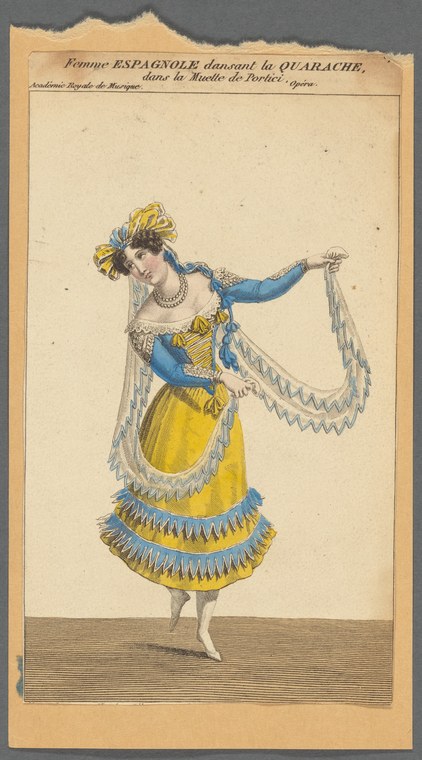
[618.] Femme espagnole dansant la quarache [also called the guaracha], dans La muette de Portici, [ballet du premier acte], Académie Royale de Musique, opéra
Unknown artist
- Collection:
- Prints depicting dance
- Source:
- New York Public Library
- Rights:
- Public domain — free to use, share and adapt.
- Recorded as:
- Public Domain
The guaracha is a Spanish and Spanish-American social dance that has been largely overshadowed by flamenco in modern accounts, yet it was a major attraction in European theaters. This print is one of the few surviving visual records of how the guaracha was performed in a professional setting during the Romantic era, before it vanished from European stages. For scholars of Spanish dance history, 19th-century ballet, and the circulation of colonial imagery in European culture, this image is direct evidence.
What you are looking at
A woman in elaborate Spanish costume performs a solo dance against a neutral background. She wears a yellow skirt with deep blue and gold scalloped trim at the hem and a matching blue bolero or jacket, her shoulders bare. Her blonde hair is dressed high with gold ornaments. She holds draped white fabric—possibly a shawl or veil—in her raised right hand and extends it across her body in a graceful arc. Her left arm curves downward. Her weight appears to be on one leg, the other slightly lifted, suggesting a moment of traveling motion or turning. The pose is frontal and theatrical, with the dancer gazing toward the viewer or slightly away. The whole figure is drawn with careful attention to the richness of her dress and the elegance of her carriage.
The dancing
A single female dancer occupies the entire composition. She stands in a three-quarter stance with her weight shifted, one leg supporting while the other appears to be moving or about to move. Her right arm is raised high and extended, holding drapery that creates a sweeping line across the upper body. Her left arm drops gracefully. Her upper body is relatively vertical and upright, her head held with dignity. The pose suggests momentum—either mid-turn, mid-travel across the stage, or caught in the opening or closing moments of a phrase. There is no closed hold or partnership; this is solo, presentational movement.
The dance depicted
This is a theatrical representation of the guaracha (also spelled huarache), a Spanish or Spanish-American dance that appears in the ballet *La muette de Portici* (The Dumb Girl of Portici), a famous five-act grand opera-ballet first performed at the Académie Royale de Musique in Paris in 1828. The guaracha was a popular social dance in Spain and the Spanish colonies, characterized by rhythmic hip movement, rapid footwork, and a flirtatious or playful character. The image captures a stage performance rather than social dance, and the costuming and presentation align with the Romantic-era convention of displaying *Spanish character dances* within operatic spectacle. The absence of visible male dancers and the emphasis on the woman's dress and bearing suggest a featured solo moment within a larger ensemble scene.
How it was made
This is a hand-colored engraving or etching, as evidenced by the fine linear work defining the figure, the parallel hatching used to establish form and shadow (visible in the background and drapery), and the careful articulation of the costume's decorative details. The coloring—bright yellows, deep blues, and flesh tones—was applied by hand after printing, a common practice for theatrical prints of the 1820s–1840s. This technique allowed for wide circulation of images documenting famous stage performances and was affordable enough for popular audiences, dancers, and theater professionals to own. The print format indicates this was a souvenir or teaching document, intended to preserve and disseminate the spectacle of the Paris opera to a broad public.
About this work
This is a documentary theatrical print: a record of a specific performer (unnamed in the surviving record) dancing a Spanish character dance in a famous grand opera-ballet at the apex of the Romantic period. The guaracha was one of many national or exotic dances incorporated into European theatrical spectacle during the early 19th century, when opera houses staged increasingly elaborate ballets featuring dancers in historical and foreign costumes. The image is valuable not for technical virtuosity on the page but as a witness to what a professional guaracha looked like in the Parisian theater around 1828–1835: costume, carriage, and a moment of motion frozen for study. It belongs in a dance history collection because it documents the choreographic vocabulary of Romantic ballet and the cultural appetite for Spanish material in Paris.
How to look at it
Notice the drapery: the white fabric held aloft in her right hand is the focus of the composition and suggests the kind of flowing, elegant arm work that would have been a signature of the guaracha and other Spanish dances of the period. The scalloped trim of her skirt, rendered in careful detail, is not merely decorative but signals the theatrical investment in authenticity (or the appearance of it). Observe the height of her hair ornaments and the exposure of her shoulders and upper body—this was a bold choice for a professional female dancer of the 1830s and marks the performance as Spanish and therefore slightly exotic or licentious by Parisian standards. The artist has frozen her in a moment that is both static enough to render clearly and dynamic enough to suggest the speed and playfulness of the dance.
The period
The print dates to the era of Romantic ballet (roughly 1830–1850), when European ballet companies turned away from the abstract geometry and mythological subjects of the Baroque and classical periods toward narratives of medieval romance, exoticism, and national character. *La muette de Portici*, a ballet based on the 1828 opera by Daniel Auber, was a flagship work of this tendency: it combined a melodramatic plot (a Neapolitan peasant girl in a volcanic eruption) with elaborate scene spectacle and *character dances*—stylized versions of folk or national dances inserted into the dramatic action. The guaracha, presented as a Spanish dance, fit perfectly into this appetite for cultural tourism and picturesque spectacle. Theatrical prints like this one were mass-produced and collected much as playbills or celebrity photographs are today, making them a major source for understanding how 19th-century dancers moved and dressed.
Where it lives
The print is held in the New York Public Library's collection of prints depicting dance, a specialized archive built to document theatrical performance and dance history through visual sources. Such collections preserve prints that were once common and affordable but have become historically precious as records of ephemeral performance.
Dance in this work
Questions about this work
What is the guaracha, and is it the same as flamenco?
No. The guaracha is a Spanish and Caribbean social dance, popular in the 18th and 19th centuries, characterized by rhythmic hip movement, rapid footwork, and a playful or flirtatious character. Flamenco, by contrast, is a distinct Andalusian form with its own techniques, music (cante jondo), and history. In the 19th-century European theater, both were sometimes conflated as *Spanish dance*, but they are separate traditions. The guaracha has largely disappeared from popular knowledge, making historical images like this one rare and valuable.
What is *La muette de Portici*, and why would it include a Spanish dance?
*La muette de Portici* is a grand opera-ballet first performed in Paris in 1828, based on a real uprising in 17th-century Naples. The plot gave choreographers an opportunity to incorporate character dances—stylized versions of folk dances from various regions—as entertainment and local color. A guaracha, labeled as Spanish, fit the appetite for spectacle and the assumption (common at the time) that any Mediterranean or colonial setting could be embellished with dances from nearby or conquered lands. This kind of theatrical borrowing tells us more about what Paris wanted to see than about actual Spanish dance.
How do we know this is from the Académie Royale de Musique's production?
The text at the top of the print reads: *Femme Espagnole dansant la Quarache, dans La muette de Portici [ballet du premier acte], Académie Royale de Musique, opéra.* This inscription documents the specific theater, the ballet, and the act. The Académie Royale (now the Palais Garnier) was Paris's principal opera house, and this print was almost certainly made as a souvenir for people who had seen the performance or wanted to own a record of it.
Is the dancer identifiable?
Not from the print itself. The text does not name her, and the image alone cannot identify a specific performer. Many dancers performed the guaracha in European productions during the 1830s and later. Future research in theater archives or periodicals might reveal which dancer this was, but for now, she remains anonymous—a common fate for female performers of the era.
More dance artwork





