49 works in this view — arrow keys or swipe to move between them.
Dance in Art
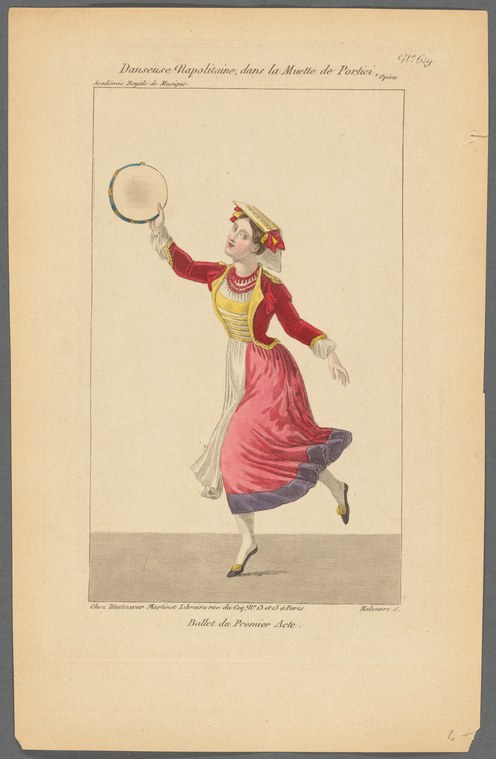
619. Danseuse napolitaine, dans La muette de Portici, ballet du premier acte, Académie Royale de Musique, opéra
Unknown artist
- Collection:
- Prints depicting dance
- Source:
- New York Public Library
- Rights:
- Public domain — free to use, share and adapt.
- Recorded as:
- Public Domain
This print is direct evidence of how *La muette de Portici*—one of the most influential operas of the 19th century—was actually danced and costumed on stage, capturing the athletic and exuberant style of character dance in the Romantic period. It documents the training, costume, and theatrical moment of a professional dancer at the height of the Opéra's prestige, preserved in a format designed to circulate her image to a broad public.
What you are looking at
A solo female dancer is captured mid-leap against a neutral background, her body suspended in an exuberant jump. She wears the costume of a Neapolitan woman: a fitted red velvet jacket with yellow or gold brocade trim across the bodice, a full pink skirt that billows and swings with the force of her movement, dark stockings, and yellow shoes. A red cap or bonnet sits on her head. She holds one arm extended upward, hand open, holding or reaching toward a circular object—likely a tambourine or frame drum. Her other arm hangs more naturally. The composition isolates the figure against pale cream paper with a thin frame line, a stage-like presentation typical of theatrical prints. The moment captures the peak of her jump, with both feet clearly off the ground, the fabric of her skirt caught in dynamic folds that show the violence of her motion.
The dancing
The dancer's body is extended in a vertical line upward, with considerable height to the jump—both feet are cleanly elevated and the torso is stretched. The raised arm reaches fully overhead, hand open and relaxed, while the lower arm and hand are less defined. The legs, though difficult to trace exactly beneath the full skirt, appear to be in some position of elevation or extension. The overall frame is that of a solo performer, not partnered, with all the focus on her vertical lift and the play of light across her costume.
The dance depicted
This image documents a moment from *La muette de Portici* (The Mute of Portici), a famous opéra comique (or historical opera-ballet) performed at the Académie Royale de Musique (Opéra) in Paris. The inscription identifies this as a Neapolitan dancer in the first act ballet. The leap, the isolated stage space, and the theatrical costume indicate a professional theatrical dancer, likely performing one of the character or national dances (national dances were stock elements of opera-ballet). The Neapolitan costume and the tambourine place this in the tradition of 'ethnic' or character dances common to 19th-century European theatre, though the energy and verticality of the jump suggest virtuoso training. This is theatrical-ballet in the academic sense of the period—a trained dancer in a formal theatre, though likely performing a character role rather than classical ballet proper.
How it was made
This is a hand-colored engraving or etching, as evidenced by the clean linear definition, the pale toning of the background, and the precise contours of the figure. The colored areas—red jacket, pink skirt, yellow trim—are applied by hand or in a limited color palette after printing, a common practice for popular theatrical prints of the early 19th century. The technique allowed for rapid, economical reproduction of theatrical images for sale to audiences and collectors. The thin frame line and the title inscription below indicate this was part of a numbered series documenting performances at the Opéra, likely sold as individual prints or in portfolios.
About this work
This is a theatrical print documenting a specific moment in a famous early 19th-century French opera-ballet. *La muette de Portici* was one of the most celebrated stage works of its era, and this image captures a Neapolitan character dance from the first act—a solo female dancer in national dress, performing with the virtuosity expected of a trained opera-house dancer. The print preserves not only the appearance of the costume and the theatre but the particular athleticism and exuberance valued in such dances: this is not a gentle folk gesture but a trained leap, witnessed and authorized by the Opéra.
The work sits at the intersection of theatrical history, dance history, and material culture. It is evidence of how 19th-century European theatres documented, advertised, and sold their own spectacles, and how those spectacles mixed classical ballet training with the aestheticized exoticism of 'national' character dances. For dance historians, it is a crucial record of stage technique and costume from a moment when ballet was beginning to establish itself as a dominant European theatrical form.
How to look at it
Note the moment the artist chose: not the takeoff or landing, but the apex of the jump, where the dancer is fully aloft and the skirt swirls around her. This creates a sense of weightlessness and daring. Observe how the costume is rendered—the bright colors, the bulk of the skirt, the fitted red jacket—all convey the visual impact the dancer would have had on stage under theatrical light. The raised arm and open hand suggest not a gesture of the classical vocabulary but something more naturalistic or character-based, a Neapolitan flourish. The isolation of the figure against the empty stage emphasizes her as the sole focus of attention.
The period
*La muette de Portici* (1828) was a landmark work that helped establish the opéra comique as a major form and influenced the development of Romantic ballet by demonstrating the public appetite for exotic, historical, and emotional spectacle. The 1830s and 1840s saw European opera-ballets incorporating character dances from across the Mediterranean and beyond—Spanish, Italian, Hungarian, and Oriental dances became standard features of the genre. The Académie Royale de Musique in Paris was the most prestigious opera house in Europe, and prints documenting its dancers and performances were widely collected and traded, serving both as mementos of witnessed spectacles and as advertisements for future performances. The engraved print was the standard medium for such circulation before photography.
Where it lives
This print is held by the New York Public Library in their collection of prints depicting dance. It is part of a series documenting performances at the Académie Royale de Musique, a standard theatrical print archive of the early 19th century. Such prints were produced and sold in Paris as individual sheets or collected in portfolios.
Dance in this work
Questions about this work
What is *La muette de Portici*?
*La muette de Portici* is a famous opéra comique first performed in 1828, based on a historical uprising in 17th-century Naples. It was one of the most celebrated stage works of the 19th century and sparked political controversy on its 1830 Brussels premiere. The work is known for its spectacular staging, including elaborate character and national dances in the operatic tradition.
What kind of dancer performed this role?
This was a character dance role at the Opéra, performed by a trained theatrical dancer. Character dances in 19th-century French opera required both classical ballet training and the ability to perform stylized versions of folk or national dances. The athleticism visible in this jump—the height, the control—shows that these dancers were highly skilled professionals, not folk performers.
Why was this print made and sold?
Theatrical prints documenting specific dancers and moments from celebrated operas were popular souvenirs and advertisements in the 19th century. They allowed people who had seen the performance to remember it, and encouraged others to attend. The prints were part of a broader culture of theatrical celebrity and the documentation of stage spectacle.
How do we know this is from the first act?
The inscription at the bottom of the print reads: 'Danseuse napolitaine, dans La muette de Portici, ballet du premier acte, Académie Royale de Musique, opéra.' It explicitly identifies the work, the act, and the theatre.
More dance artwork





