49 works in this view — arrow keys or swipe to move between them.
Dance in Art
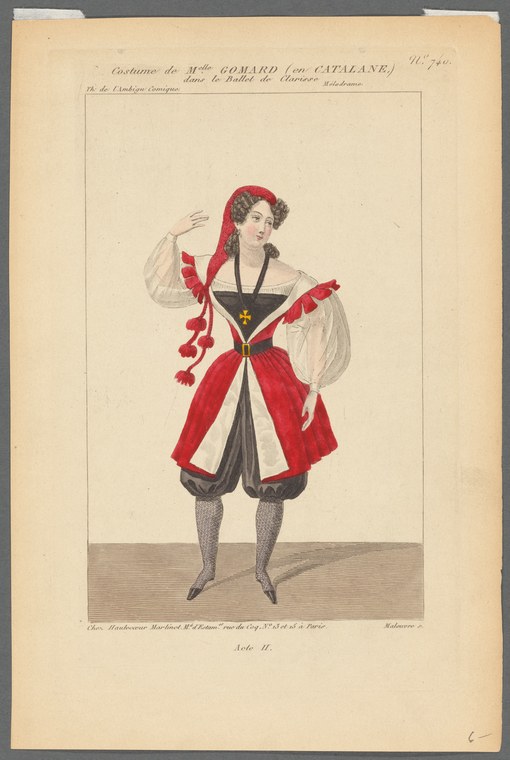
740. Costume de Melle. Gomard (en catalane) dans le ballet de Clarisse, Acte II, Th[éâtre] de l'Ambigu Comique, mélodrame
Unknown artist
- Collection:
- Prints depicting dance
- Source:
- New York Public Library
- Rights:
- Public domain — free to use, share and adapt.
- Recorded as:
- Public Domain
For dance historians, this print documents the conventions of character dance and national type in early 19th-century French theater, a context in which national dances were performed by French dancers in costume rather than being danced by performers of the actual national origin. It shows the importance of costume in communicating character and nationality in an era before realism became the dominant theatrical mode, and it offers a named performer (Gomard) and specific production context that can be researched in theater archives.
What you are looking at
A single female dancer stands at center in a three-quarter view, facing left with her body angled toward the viewer. She wears a striking costume in red and white: a red jacket or bodice with a white chemise visible beneath, red breeches, and a dramatic red headdress—a coif or bonnet tied with long red ribbons that fall down her back and sides. Her legs are clad in dark stockings and dark heeled shoes. In her right hand (raised at shoulder height) she holds the ribbons of her headdress, bunched in loose coils. Her left arm extends outward and downward, palm open, in a gesture of address or expression. Her posture is upright and composed, her weight settled on both feet, suggesting a moment of stillness or introduction rather than active movement. The background is a plain wash of paper tone, and a light source from above-left casts a subtle shadow beneath her feet. The entire composition is rendered in hand-colored engraving or etching, with delicate line work defining the figure and wash and watercolor defining the costume's vivid reds.
The dancing
The dancer is posed in a state of display rather than dynamic motion. Her arms are arranged for visual presentation: the right hand manipulates the decorative ribbons of her headdress in a theatrical flourish, while the left arm gestures outward in a pose of expression or invitation. Her torso is erect and composed, with no visible lean or shift of weight that would suggest traveling movement or turning. She stands in an approximately closed or neutral stance, her center of gravity centered. The overall impression is of an actress-dancer in a moment of characterful stillness—the pause before motion or at a significant narrative moment.
The dance depicted
This is a costume plate for a named performer, Mlle. Gomard, in the role of a Catalan character (noted 'en catalane') from Act II of the ballet *Clarisse* at the Théâtre de l'Ambigu Comique. The inscription identifies it as a theatrical document, likely from the late 18th or early 19th century based on costume style and printing technique. The work shows a dancer in stage character rather than executing a specific dance technique; the red and white palette, regional costume detail (the distinctive headdress), and the theatrical setting indicate this is a representation of national or ethnic character dance as performed in French melodrama and ballet d'action. The pose—formal, frontal, with attention to costume rather than footwork—is typical of costume documentation for the theater rather than technical dance instruction.
How it was made
This is a hand-colored engraving or etching, recognizable from the fine parallel line work defining form and the areas of tint applied by hand in watercolor or gouache, most notably the vivid reds of the jacket and headdress. The technique allowed for wide circulation of theatrical documentation to audiences and to dancers who might aspire to perform the role; the format is small enough to be bound into volumes or kept as a reference. The hand coloring indicates this is a relatively expensive production, suggesting it was issued for a educated or theatrical audience with disposable income, rather than as a cheap broadside.
About this work
This is a costume plate documenting the stage dress of a character dancer named Gomard performing a Catalan-themed role in the melodrama-ballet *Clarisse* at the Ambigu Comique theater in Paris (the Théâtre de l'Ambigu Comique was a significant house for melodrama and mixed spectacle). The work belongs to the tradition of theatrical prints that documented performers and roles for audiences, aspiring dancers, and costume makers. It offers a precise visual record of how national or regional character was conveyed through costume and presentation on the early 19th-century Paris stage.
The image is valuable as evidence of how 'national character' dance—here, a Catalan role—was conceived and performed in French theatrical contexts. The formal, presentational pose and attention to decorative dress rather than technical movement suggests that character dance of this period was as much about costume and theatrical identity as about footwork or choreographic virtuosity. The red and white palette, distinctive headdress with ribbons, and breeches identify the Catalan character type visually; a contemporary audience would have recognized the costume instantly.
How to look at it
Attend to the posture and gesture: the dancer is not shown in active movement but in a posed presentation. Her right hand bunching the ribbons and her left arm extended outward are deliberate theatrical gestures, not steps or turns—they are designed to display the costume and convey character. The headdress dominates visually and is clearly the chief marker of national type. Note also her facial expression (calm, direct) and her eye contact with the viewer, which suggests she is being presented to an audience as a role or character type rather than shown as a virtuoso performer mid-movement.
The period
This work dates to the height of French melodrama and the early phase of Romantic ballet, when the Théâtre de l'Ambigu Comique was a major venue for mixed spectacle blending drama, song, and dance. The costume style and printing technique suggest a date in the 1810s–1830s. During this period, character dance and 'national' types were performed regularly in Paris theaters, particularly in the boulevard theaters like the Ambigu. Dancers often performed multiple national characters (Spanish, Italian, Turkish, Chinese) in a single evening, using costume and gesture to signal regional identity. The development of lithography was displacing engraving for theatrical prints by the 1820s, so this hand-colored engraving may represent an earlier mode of theatrical documentation.
Where it lives
This print is held in the New York Public Library's Prints collection, catalogued as part of a series of dance and theatrical costume documentation. It belongs to a class of theatrical ephemera produced for circulation among theater professionals, dancers, and educated audiences in Paris.
Dance in this work
Questions about this work
What is a Catalan character dance?
In early 19th-century French theater, 'national character' roles and dances were performed by French dancers in stereotypical regional costumes. Catalan dances were associated with a Spanish/Mediterranean character type, often perceived as fiery or passionate. These were theatrical conventions rather than accurate representations of actual Catalan dance; the dancer Gomard would have learned the steps and gestures from French choreography rather than studying Catalan traditions.
What was the Théâtre de l'Ambigu Comique?
The Ambigu Comique (later Théâtre de l'Ambigu) was a boulevard theater in Paris, established in the late 18th century. It specialized in melodrama, vaudeville, and mixed spectacle combining dialogue, song, and dance. It was a major venue for working dancers and choreographers and was known for its technical spectacle and varied programming.
How do we know this is Mlle. Gomard?
The inscription at the top of the print identifies the costume and performer: 'Costume de Mlle. Gomard (en catalane) dans le ballet de Clarisse, Acte II.' This kind of attribution was standard on theatrical costume plates. Whether Gomard was a principal dancer or a secondary performer in this production is not clear from the print alone, but the costume documentation suggests she was a named performer with a recognizable role.
What can we learn about early 19th-century dance from this image?
This print shows that theatrical dance in this era was often as much about character, costume, and gesture as about technical footwork. The formal presentation pose and the visual dominance of the headdress and colored dress indicate that audiences were meant to read the character and nationality of the role through costume rather than through intricate choreography. It also shows the integration of dance into mixed theatrical productions rather than the dominance of ballet as an independent art form.
More dance artwork





